Service-Oriented Architecture (SOA) is an architectural method for organizing and building software systems. The core principle is to decompose a system’s functionality into a collection of distinct, independent business services that communicate over a network.
Instead of a single monolithic application, capabilities like ‘Process Payment’ or ‘Check Inventory’ are encapsulated as discrete units. This approach imposes order on complex enterprise systems, establishing a foundation for reusable functionality and streamlined integration between disparate applications.
The Enduring Relevance of Service-Oriented Architecture
In an industry focused on microservices, the continued relevance of SOA might seem counterintuitive. However, SOA addresses a persistent and fundamental challenge: managing the operational chaos of disconnected, tightly-coupled systems.
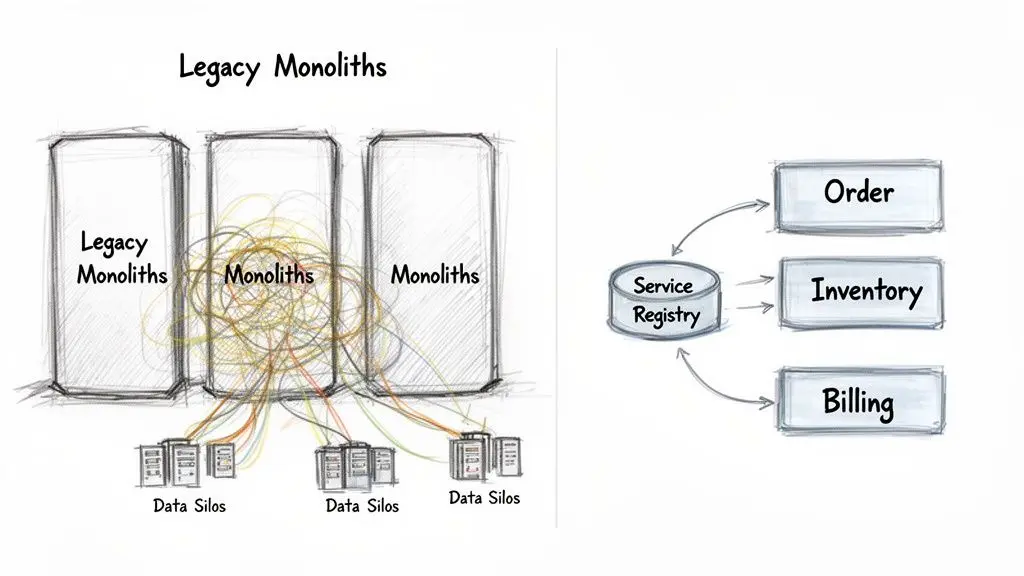
Consider a typical scaling e-commerce business. Initially, its customer management, inventory, and billing systems likely operate as separate applications. As the business grows, developers implement direct, point-to-point integrations. A new customer signup triggers a custom-built hook to the billing system. An order placement fires another brittle connection to the inventory application. This ad-hoc approach inevitably creates an unmanageable and fragile web of dependencies.
The Problem: Architectural Brittleness and Operational Drag
This tight coupling introduces significant operational friction and risk. A minor change to the billing system’s API could break the customer management integration, necessitating a coordinated, high-risk deployment to resolve. Introducing a new mobile application requires building another set of point-to-point connections, duplicating business logic, and increasing the maintenance burden.
This architectural fragility manifests as critical business constraints:
- Reduced Agility: Deploying new features or updating existing ones becomes slow and costly, as any change can have unpredictable cascading effects across the system.
- Data Silos: Information becomes trapped within individual applications, making it difficult to achieve a unified view of business operations for analytics or compliance reporting.
- High Maintenance Costs: Engineering resources are consumed by patching fragile integrations and navigating a complex dependency map, diverting focus from delivering new business value.
SOA as a Strategic Solution
A service-oriented architecture is the strategic framework designed to resolve this complexity. It is not about a specific technology but a fundamental shift in design philosophy. The objective is to transition from a tangled mess of integrations to an organized ecosystem of well-defined, reusable business services.
By defining clear boundaries and standardised contracts, SOA imposes discipline on system design. It forces architects to think about business capabilities first, creating a foundation for scalable, maintainable, and resilient digital products.
Instead of building a direct link from a CRM to a billing system, an organization implementing SOA would expose a CreateCustomer service. This service encapsulates all the logic for that specific business function. Any authorized application—the CRM, a new mobile app, or a future partner portal—can then consume this service. This paradigm transforms IT assets from isolated monoliths into a portfolio of reusable business capabilities, a foundational principle for any durable, long-term technology strategy.
The Foundational Principles of a Robust SOA
Transitioning from a collection of APIs to a genuine service-oriented architecture requires discipline. The choice of technology is secondary to the strict application of core architectural principles. These principles are what distinguish a well-organized, adaptable ecosystem from a distributed monolith.
The initial investment in defining clear boundaries and contracts is significant, but it yields substantial long-term returns in maintainability, scalability, and genuine business agility.
Loose Coupling
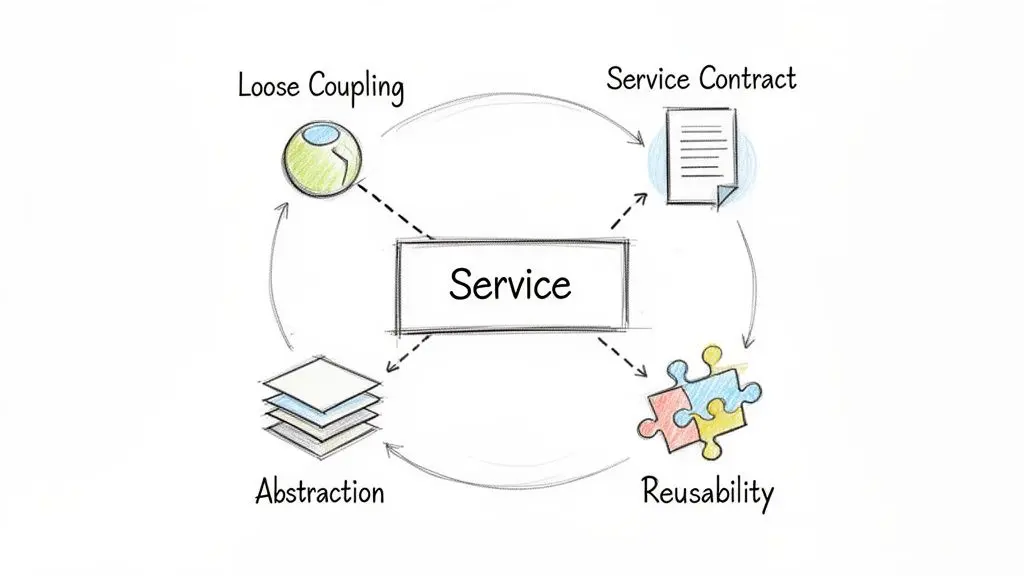
Loose coupling is the most critical principle. It dictates that services should have minimal knowledge of or dependency on each other. A change within one service—such as a database migration or a logic refactor—should not necessitate changes in the services that consume it. This independence is essential for building resilient, maintainable systems.
Consider an e-commerce platform with an Order Processing service and an Inventory service:
- Tightly Coupled: The
Order Processingservice connects directly to theInventoryservice’s database. If the inventory team migrates from SQL Server to a NoSQL database, the order service breaks and requires a substantial rewrite of its data access logic. - Loosely Coupled: The
Order Processingservice interacts with theInventoryservice only through a stable API contract, sending aCheckStockLevelrequest. The inventory team can re-architect its entire backend. As long as the API contract is honored, theOrder Processingservice remains unaffected and unaware of the change.
This separation of concerns allows teams to develop and deploy in parallel, reducing dependencies and accelerating innovation cycles.
Service Contracts
The service contract is the formal mechanism that enables loose coupling. It is a formal agreement between a service provider and its consumers, explicitly defining the terms of interaction. The contract exposes the public “what” of the service while encapsulating the implementation details—the “how”—as a private concern.
A robust service contract specifies:
- The operations the service provides (e.g.,
CreateUser,GetOrderStatus). - The precise structure and data types of the messages exchanged.
- The communication protocols to be used (e.g., SOAP, REST).
A service contract is the bedrock of trust and predictability in a distributed system. By enforcing a clear, published agreement, it ensures that all interacting components speak the same language, preventing misunderstandings and integration failures.
Without formal contracts, developers are forced to make assumptions, leading to brittle integrations that fail when underlying implementations change.
Abstraction
Abstraction is the principle of hiding implementation complexity. Consumers of a ProcessPayment service should not know whether it is backed by Stripe, Adyen, or a proprietary banking gateway. These are implementation details.
The complex logic—payment processing, fraud detection, transaction logging—is concealed behind the service boundary. The consumer interacts with a simple interface: provide payment details and receive a success or failure response. This grants the service owner the freedom to switch payment providers, optimize internal workflows, or enhance security layers without disrupting dependent applications, mitigating vendor lock-in and enabling technological evolution.
Reusability
The confluence of these principles yields the primary strategic benefit of SOA: reusability. A service should represent a core business capability, not a one-off function for a single project. A well-designed AuthenticateUser service should be consumable by a web application, a mobile app, an internal administrative tool, and future partner integrations.
Achieving reusability requires an enterprise-level perspective to identify common business functions and design services that are generic enough for multiple contexts. While designing a reusable service demands more upfront architectural effort than a project-specific solution, the long-term return on investment is significant. Each reuse of a service eliminates the cost of building, testing, and maintaining that capability from scratch, accelerating the delivery of new products and enforcing consistency across the digital landscape. This is how code becomes a strategic business asset.
SOA Principles and Their Business Impact
These architectural principles translate directly into measurable business outcomes. The technical discipline required by SOA drives tangible value for both leadership and engineering teams.
| Principle | Technical Implication | Business Outcome |
|---|---|---|
| Standardised Contracts | Services communicate via a well-defined, published interface (e.g., WSDL, OpenAPI). | Predictability & Lower Integration Cost. New systems can connect reliably without reverse-engineering, reducing project timelines. |
| Loose Coupling | A change in one service’s implementation doesn’t force a change in its consumers. | Increased Agility. Teams can update and deploy services independently, accelerating time-to-market for new features. |
| Abstraction | Consumers are shielded from the underlying technical complexity of a service. | Future-Proofing & Flexibility. The business can swap technologies or vendors (e.g., payment gateways) without a major system overhaul. |
| Reusability | Services are designed as enterprise assets, representing core business functions. | Reduced Development Cost & Faster Delivery. New applications are assembled from existing, proven components, not built from scratch. |
| Autonomy | Teams have control over the design, implementation, and deployment of their services. | Team Empowerment & Parallel Development. Small, focused teams can innovate faster without being blocked by other departments. |
| Statelessness | Services don’t retain client-specific state between requests, improving scalability. | Higher Scalability & Reliability. The system can handle more users and is more resilient to server failures. |
| Discoverability | Services can be found and understood via a central registry or metadata. | Improved Visibility & Governance. Architects have a clear view of enterprise capabilities, preventing redundant work and enforcing standards. |
Enforcing these principles allows an organization to move faster, reduce redundant effort, and build a technology platform that can adapt as the business evolves.
Diving into Common SOA Architectural Patterns
Once the core principles of a service-oriented architecture are understood, the next step is examining its practical implementation. SOA is realized through architectural patterns that govern inter-service communication and business process flows. For technical leaders, the selection of these patterns is a critical decision that directly impacts system scalability, maintainability, and resilience.
These patterns exist to solve the primary challenge of distributed systems: managing communication chaos. Without a deliberate strategy, an SOA implementation can devolve into the same point-to-point complexity it was meant to replace.
The Enterprise Service Bus: The Central Hub
Historically, the dominant pattern for managing SOA communication was the Enterprise Service Bus (ESB). An ESB functions as a central messaging backbone for the enterprise, acting as a universal translator and traffic controller for all service interactions. Instead of communicating directly, services connect to the ESB, which handles the mechanics of message delivery.
An ESB typically performs several critical functions:
- Message Routing: It intelligently directs messages from a source to one or more destinations based on predefined rules. For instance, a new
OrderPlacedmessage might be routed to both theInventoryandShippingservices. - Protocol Transformation: It can mediate between different communication protocols. A legacy service using SOAP can communicate seamlessly with a modern RESTful JSON API because the ESB handles the translation.
- Message Enhancement: It can enrich a message with additional data before forwarding it. An incoming order message might be augmented with customer details from a CRM before it reaches the billing service.
While the centralized control and visibility of an ESB are compelling, this pattern introduces a significant trade-off. The ESB can become a single point of failure and a major development bottleneck. Concentrating all integration logic in one component can overwhelm the team responsible for it, slowing down the entire organization.
Modern Alternatives and Integration Patterns
Due to the risks associated with a monolithic ESB, many modern architectures favor more lightweight and decentralized patterns. These approaches align with the SOA philosophy but distribute integration “smarts” to the endpoints, avoiding a central bottleneck.
An API Gateway is a common modern alternative. It provides a single entry point for external clients but typically limits its role to concerns like security enforcement, rate limiting, and request routing. Complex business logic and orchestration are delegated to the services themselves. This avoids the “smart pipes, dumb endpoints” anti-pattern of the classic ESB. For a deeper look at connecting different systems, you can learn more about our approach to IT system integration.
Regardless of whether an ESB or a decentralized model is used, two fundamental communication patterns are nearly always present.
The Request-Response Pattern
This is the simplest communication pattern. It is a synchronous, blocking interaction where a client sends a request to a service and waits for an immediate response. It is analogous to a phone call: you ask a question and wait on the line for the answer before proceeding.
Scenario: A user on an e-commerce site clicks “View Order History.” The web application sends a
GetOrdersrequest to theOrderServiceand blocks. TheOrderServicequeries its database, assembles the order list, and returns it. Only upon receiving the response can the web page render the information.
This pattern is well-suited for user-facing interactions where an immediate answer is expected. However, its synchronous nature is a liability. If the target service is slow or unavailable, the client application is left waiting, which can lead to a poor user experience and potential cascading failures.
The Publish-Subscribe Pattern
In contrast, the Publish-Subscribe (Pub/Sub) pattern is asynchronous and non-blocking. Instead of one service calling another directly, a “publisher” emits an event to a message broker without any knowledge of its consumers. Other services, the “subscribers,” can register their interest in specific event types and react accordingly.
Scenario: When a new customer signs up, a
CustomerServicepublishes aCustomerCreatedevent. TheBillingService,MarketingAutomationService, andDataAnalyticsServicehave all subscribed to this event type. Each receives a copy of the message and can execute its independent process—create a billing profile, add the user to a welcome email campaign, and update a metrics dashboard—all without theCustomerServicebeing aware of their existence.
This asynchronous model promotes extreme loose coupling. The publisher is completely decoupled from the subscribers, allowing new listeners to be added or removed without modifying the original service. This results in a highly scalable and resilient architecture, ideal for background processing and broadcasting system-wide state changes.
SOA vs. Microservices: A Strategic Comparison
The debate between a service-oriented architecture (SOA) and a microservices architecture is a common fixture in system design discussions. However, positioning them as direct competitors is a misunderstanding of their relationship. They are evolutionary relatives, both designed to dismantle monolithic applications but differing in philosophy, scope, and optimal use cases.
For a CTO or IT leader, the choice is not about adopting the “newer” trend. It is a strategic decision based on organizational scale, team structure, and the specific business problem being addressed. A pragmatic decision requires a clear understanding of their fundamental differences.
Key Differences Between SOA and Microservices
This table highlights the critical distinctions between the two architectural styles.
| Dimension | SOA (Service-Oriented Architecture) | Microservices |
|---|---|---|
| Service Granularity | Coarse-grained. Services represent broad business capabilities (e.g., “ManageCustomer”). | Fine-grained. Services focus on a single, specific function (e.g., “AddressValidation”). |
| Scope | Enterprise-wide. Designed for reuse across multiple applications and business units. | Application-specific. Scoped to the needs of a single product or bounded context. |
| Communication | ”Smart pipes.” Often relies on a central Enterprise Service Bus (ESB) for routing and orchestration. | ”Dumb pipes.” Uses lightweight protocols like REST APIs for direct, point-to-point communication. |
| Data Governance | Shared data. Services often access a common, shared database, leading to potential coupling. | Encapsulated data. Each service owns its own data store (“database-per-service”). |
| Coupling | Loosely coupled at the service level, but can be tightly coupled to the central ESB and shared databases. | Highly decoupled. Services are independent units that can be developed, deployed, and scaled on their own. |
| Deployment | Typically deployed as part of a larger, coordinated release cycle. Monolithic deployment of multiple services. | Deployed independently. Teams can release their services on their own schedule without impacting others. |
This comparison clarifies that the decision is less about technology and more about operational philosophy: are you optimizing for enterprise-wide standardization or for product-level agility?
Scope and Granularity
The most significant difference lies in the size and purpose of each service. It is the distinction between a multi-tool and a scalpel.
SOA services are coarse-grained, designed to represent broad, enterprise-level business functions. A single ManageCustomer service in an SOA might handle creating customer records, updating addresses, and retrieving purchase histories. They are built for reuse across the entire organization.
Microservices are fine-grained. Each service is built to perform one function exceptionally well. In place of a single ManageCustomer service, a microservices architecture would have separate services for CustomerRegistration, AddressValidation, and OrderHistoryLookup, each scoped to the specific needs of one application. This granularity profoundly impacts development and deployment. SOA services, as shared assets, often require more cross-team coordination, whereas microservices grant teams high autonomy to build and deploy independently.
Communication and Data Governance
The methods of inter-service communication and data management reveal a core philosophical divergence.
A traditional service-oriented architecture often employs a “smart pipe” approach, typically an Enterprise Service Bus (ESB). This central component orchestrates message routing, protocol transformation, and complex business processes, allowing the service endpoints to remain relatively simple.
Microservices advocate for a “dumb pipes, smart endpoints” model. Communication occurs over simple protocols like REST, and each microservice contains the business logic necessary for its function. The absence of a central orchestrator pushes responsibility to the individual services, fostering true decentralization.
Data governance follows a similar pattern:
- SOA often permits data sharing. It is common for multiple services to access a shared enterprise database. While this may simplify data consistency initially, it creates tight coupling that becomes a liability over time.
- Microservices mandate data encapsulation. The “database-per-service” pattern is a core tenet. Each microservice owns its data and exposes it only through a well-defined API, which is the key to achieving true service independence.
This diagram illustrates how classic SOA patterns are often managed through a central component like an ESB.
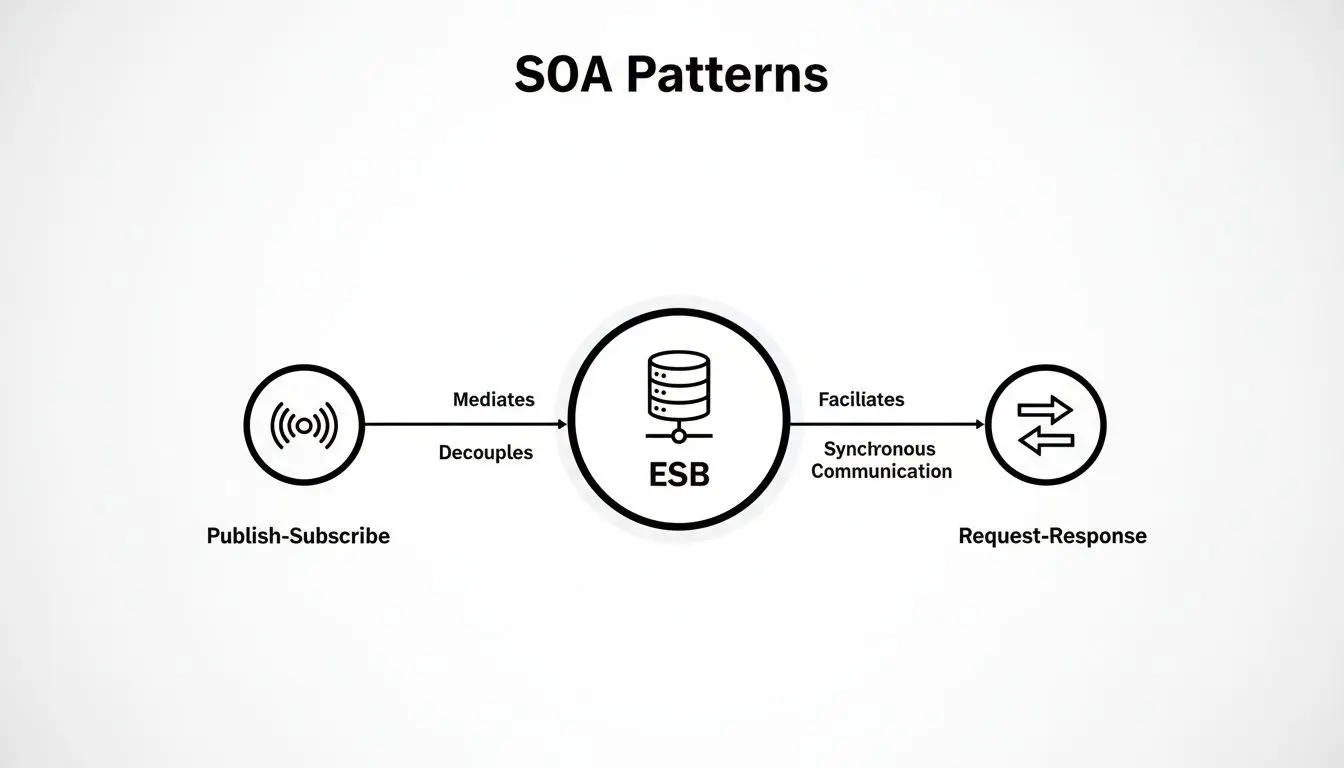
The ESB’s role as a central mediator contrasts sharply with the direct, peer-to-peer communication typical in a microservices environment.
Making the Right Strategic Choice
Ultimately, the choice of architecture requires weighing these trade-offs against your organization’s strategic objectives. Neither is a silver bullet.
The decision between SOA and microservices really boils down to one question: Are you optimising for enterprise-wide integration and reuse, or for team agility and speed of delivery within a single product? SOA is built for the first; microservices for the second.
For large organizations seeking to integrate a heterogeneous landscape of legacy systems, SOA provides a structured, governable framework. It excels at creating a standardized set of business services that can bring order to IT complexity. In these scenarios, the infrastructure model is critical; understanding the trade-offs between on-premises vs. cloud solutions is crucial for a successful SOA implementation.
However, for a company building a single, complex product that must evolve rapidly, a microservices architecture is often a better fit. It empowers small, autonomous teams to develop, deploy, and scale their components independently, which translates to faster innovation cycles. While operational complexity is higher, the development velocity it unlocks can be a significant competitive advantage. Many organizations now adopt a hybrid approach, using SOA principles for enterprise integration while leveraging microservices for customer-facing applications.
Implementing Governance and Security in SOA
A service-oriented architecture without strong governance is not an architecture; it is a fast track to organized chaos. While SOA principles promise reusability and agility, realizing these benefits depends entirely on enforcing non-functional requirements.
Governance and security are not afterthoughts. They are the foundational scaffolding that prevents an SOA from becoming a sprawling, unmanageable liability. Without this structure, services proliferate without standards, contracts become inconsistent, and security vulnerabilities emerge. The initial vision of a clean architecture degrades into a distributed monolith—as brittle and difficult to manage as the system it was intended to replace.
Establishing Architectural Governance
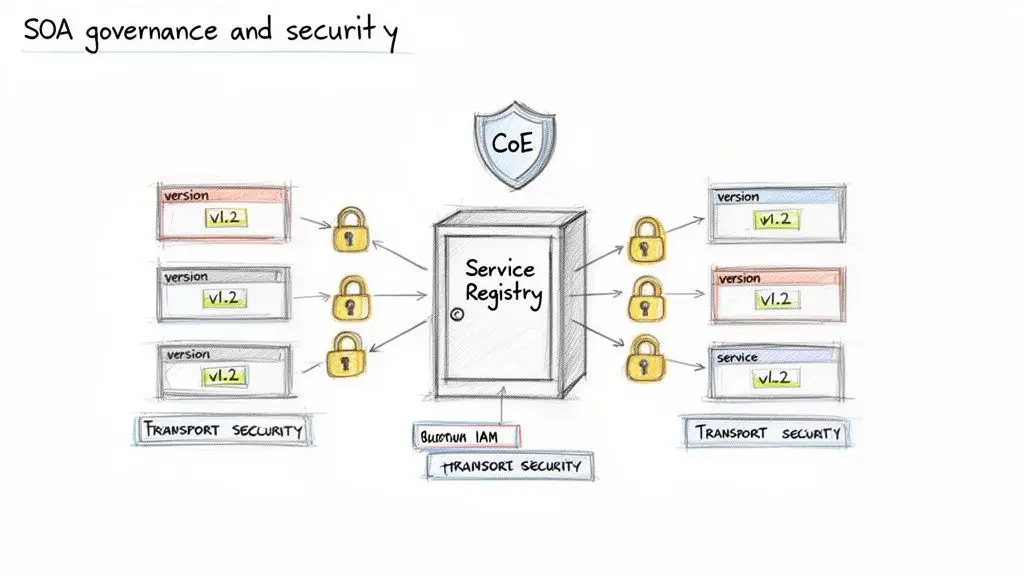
Governance provides the “rules of the road” for your SOA, ensuring consistency, preventing architectural drift, and standardizing development practices. This is the human and process layer that enables the technical architecture to function correctly. A Center of Excellence (CoE), a cross-functional team responsible for defining best practices and protecting the architecture’s integrity, is often established to oversee these standards.
Key components of effective governance include:
- Service Registry: A central, searchable catalog of all services in the ecosystem. It is essential for discoverability. Without a registry, teams will inevitably rebuild services that already exist simply because they were unaware of them.
- Versioning Strategy: A clear, predictable policy for how services evolve. Using semantic versioning (e.g., v1.0.1) allows consumers to understand the impact of an update—whether it is a non-breaking bug fix or a major change—preventing cascading failures.
- Service Lifecycle Management: A defined process for a service from conception to retirement. A formal lifecycle—covering proposal, design, deployment, and decommissioning—ensures a consistent standard of quality.
A well-governed SOA essentially documents itself. By forcing services to be registered with clear contracts, you organically build an enterprise-wide catalogue of business capabilities. This makes planning future projects faster and simpler.
Securing a Distributed Architecture
Transitioning to a distributed architecture like SOA significantly expands the attack surface. Security must be an integral part of the design from the outset, not an addition. The objective is to build a layered defense that protects data both in transit and at rest.
A centralized Identity and Access Management (IAM) system should be the single source of truth for authentication and authorization. When a user or service makes a request, the IAM system verifies its identity and confirms its permissions. This approach avoids scattering security logic across dozens of individual services, which is a nightmare to maintain and audit. For any organization handling sensitive data, embedding these controls is fundamental and aligns directly with the principles of privacy by design.
Practical Security Patterns
To secure the architecture effectively, several patterns are essential:
- Transport-Level Security: Securing the communication channel, typically with TLS encryption for all data in transit. This is the first line of defense against eavesdropping and man-in-the-middle attacks.
- Message-Level Security: Encrypting the message payload itself. Even if the transport layer is compromised, the data remains unreadable. This is critical for end-to-end security, especially in workflows where messages pass through multiple intermediaries.
- Endpoint Security: Hardening every service endpoint. API gateways are often used to enforce policies such as rate limiting and threat detection, ensuring only legitimate, authorized traffic reaches the service.
A well-governed and secure SOA is a significant asset for regulatory compliance. When dealing with regulations like GDPR, NIS2, or DORA, having clearly defined service boundaries with controlled access points simplifies auditing. It provides a transparent, provable record of how data is accessed and processed, making it far easier to demonstrate compliance.
The Strategic Business Value of Modern SOA
Architectural choices are only meaningful if they deliver tangible business outcomes. Service-oriented architecture is often mischaracterized as a legacy concept. It is more accurately viewed as a strategic investment in organizational agility. A modern SOA provides a stable, scalable foundation that enables a business to adopt new technologies without requiring a complete system overhaul.
This is a practical reality for companies now integrating AI. To incorporate a new AI-powered recommendation engine or a machine learning model for fraud detection, an organization with a mature SOA does not need to build brittle, one-off connections. The new AI system is exposed as another well-defined service within the ecosystem, available for consumption by any authorized application. This approach is more robust and sustainable.
Future-Proofing Through Architectural Discipline
A well-structured SOA directly impacts the bottom line by reducing long-term maintenance costs and accelerating time-to-market. By enforcing a design paradigm based on reusable business capabilities, it eliminates redundant development effort and promotes enterprise-wide consistency.
The market reflects this enduring value. The global Service-Oriented Architecture (SOA) market, valued at US$28.1 billion, is projected to reach US$68.7 billion by 2030, growing at a CAGR of 16.1%. This growth signals SOA’s critical role in building scalable IT infrastructure. You can dig deeper into this market trend on MarketResearch.com.
Modern SOA for Real Organisational Agility
Cloud-native technologies and Integration Platform as a Service (iPaaS) solutions have made SOA accessible beyond large enterprises. What once required a complex, resource-intensive implementation is now achievable for small and midsize businesses without the prohibitive upfront investment of the past.
SOA creates a composable enterprise. It allows a business to assemble and reassemble its digital capabilities quickly, responding to market changes not with costly monolithic rewrites, but with surgical adjustments to its service portfolio.
This approach transforms IT from a cost center into a strategic enabler. By focusing on a library of stable, reusable services, a modern SOA ensures a business can confidently adopt new tools, streamline complex processes, and build a digital foundation designed for longevity.
Common Questions (and Straight Answers) About SOA
To conclude, let’s address some of the practical, real-world questions that technical leaders face when considering a Service-Oriented Architecture.
Is SOA Obsolete Now That We Have Microservices?
No. While microservices offer superior agility for specific applications, SOA remains the dominant paradigm for large-scale, enterprise-wide integration. Many core microservices principles, such as service contracts and loose coupling, are direct descendants of SOA. A hybrid approach is often optimal: use SOA to govern stable, enterprise-level services (e.g., OrderFulfillment, CustomerProfile) while using microservices for fast-evolving application features. This provides both stability and speed where they are most needed.
What’s the Biggest Hurdle in an SOA Rollout?
The primary challenge is organizational, not technological. A successful SOA implementation requires a fundamental shift in governance, cross-team collaboration, and long-term architectural planning. Without a robust governance framework established from the outset, the result will be an unmanageable tangle of services, not a clean architecture.
This framework must include:
- Clear Service Ownership: Who is responsible for a service throughout its lifecycle?
- Strict Versioning Policies: How are breaking changes managed to prevent downstream failures?
- A Shared Service Registry: How do developers discover and reuse existing services?
How Can We Try SOA Without a Massive Upfront Investment?
Start with a pragmatic, iterative approach. Identify a single critical business process that is currently managed by brittle, ad-hoc integrations and focus on solving that specific problem first. Instead of a monolithic ESB, consider modern, lightweight tools like a cloud-based integration platform (iPaaS) or a simple API Gateway. Focus on establishing correct contracts for a small number of core services. This allows you to demonstrate value quickly and build momentum for a broader initiative.
At Devisia, we architect and build robust, maintainable systems that deliver measurable business value. Whether you’re modernising a legacy platform or integrating AI, we provide a clear path to meaningful, scalable software. Learn how we can help you turn your vision into a reliable digital product at https://www.devisia.pro.