A Data Processing Agreement (DPA) is a legally binding contract that specifies the rules, responsibilities, and technical measures for handling personal data. For technical leaders responsible for software systems, a DPA is the operational blueprint governing how third-party vendors—from cloud providers to SaaS tools—process user data on your behalf. It contractually obligates them to act only on your instructions and adhere to specified security and compliance standards.
The Problem: Unmanaged Third-Party Data Risk
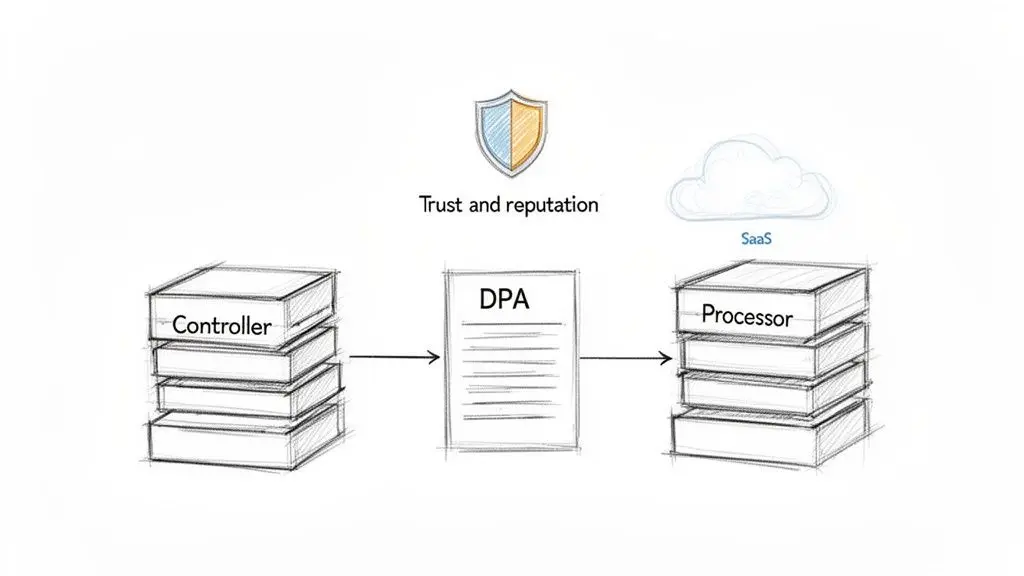
In a modern software architecture, your product’s integrity is directly tied to the third-party services it integrates. Cloud infrastructure, analytics tools, and CRM platforms are extensions of your system. The moment these vendors handle personal data on your company’s behalf, the relationship dynamics change. You become the data controller, responsible for deciding the “why” and “how” of data processing. Your vendor becomes the data processor, obligated to execute only on your documented instructions.
A DPA is the critical instrument that formalizes this relationship. Without one, the risk is unmanaged and ambiguous. The problem isn’t just a lack of paperwork; it’s a lack of control and a direct threat to your system’s security and compliance posture.
Risks of a Missing or Superficial DPA
A weak or absent DPA creates significant operational and reputational vulnerabilities. It leaves you with no contractual recourse if a vendor:
- Uses customer data for unauthorized secondary purposes, such as training their own AI models.
- Fails to implement adequate security controls, directly contributing to a data breach for which you are ultimately accountable.
- Onboards new sub-processors without your knowledge or consent, creating a shadow data supply chain.
- Refuses to delete data upon contract termination, violating fundamental data protection principles.
The Financial and Regulatory Stakes
Regulations like the GDPR mandate DPAs for all controller-processor relationships. Non-compliance carries severe financial penalties. Breaches of GDPR can lead to fines of up to €20 million or 4% of global annual revenue. Processor-specific violations, such as operating without a compliant DPA, can attract fines of up to €10 million or 2%.
These are not theoretical risks. Regulatory authorities consistently penalize organizations of all sizes, reinforcing that a robust, binding DPA is a mandatory component of the technical and legal architecture. It translates abstract privacy principles into concrete engineering and operational requirements, ensuring your partners uphold the same standards you promise your customers. As your organization scales, mastering these agreements is a core competency, sometimes requiring specialized expertise like that of a Data Protection Officer in our comprehensive guide.
The Solution: A Technical Breakdown of DPA Components
A DPA is not merely a legal document for compliance teams; it is a technical specification for data handling. For a CTO or engineering lead, its clauses map directly to system architecture, data flows, and security protocols. A superficial review is a direct path to compliance gaps and operational risk.
Let’s dissect the core components of a DPA from an engineering perspective to understand their real-world implementation impact.
Scope, Purpose, and Duration
This section defines the operational boundaries of the agreement. It details the types of data (e.g., user email, IP address), the categories of data subjects (e.g., customers, employees), and the nature of the processing (e.g., storage, analysis, transmission).
- Implementation Constraint: Your system architecture must enforce these limits. If a DPA specifies data is processed only for analytics, your application logic must prevent that same data from being fed into a separate marketing automation system.
- Trade-off: Vague scope definitions (e.g., “for service improvement”) grant vendors excessive latitude. Precise definitions provide clarity but may require amendments if your use case evolves.
The duration clause dictates data retention, tying directly to data lifecycle management. Your systems must include automated routines for data deletion or anonymization that trigger upon contract termination or the end of the specified processing period.
A DPA is a precise set of instructions, not a license for a vendor to use data as they see fit. Ambiguity in the scope creates technical and compliance debt that can lead to unauthorized data use.
Security and Confidentiality Obligations
This section translates legal requirements, like Article 32 of GDPR, into concrete security controls. These are not suggestions but contractual commitments. A robust DPA will mandate specific technical and organizational measures:
- Encryption: Specifies requirements for data encryption at rest (in databases, object storage) and in transit (over networks using protocols like TLS 1.2+). Verification requires checking the vendor’s actual implementation, not just taking their word for it.
- Access Controls: Requires the vendor to implement and demonstrate effective role-based access control (RBAC) systems and provide audit logs to ensure only authorized personnel can access data.
- Resilience and Disaster Recovery: Outlines requirements for system backups, failover capabilities, and business continuity plans to ensure data integrity and availability.
- Regular Testing: Mandates periodic security assessments, such as penetration tests or vulnerability scans, to validate the effectiveness of their security posture.
The confidentiality clause contractually binds the processor’s employees to secrecy, reinforcing the technical controls.
Controller and Processor Responsibilities
A primary function of any data processing agreement is to delineate responsibilities, removing ambiguity during critical events like a security incident or a data subject request. As the controller, your organization retains ultimate accountability, but the processor has specific, mandated duties.
This table maps the distinct obligations defined in a typical DPA, providing a clear reference for technical teams.
Controller vs. Processor Responsibilities in a DPA
| Responsibility Area | Data Controller (Your Company) | Data Processor (Your Vendor/Partner) |
|---|---|---|
| Instructions | Provide clear, lawful, and documented instructions for all data processing activities. | Process personal data only on the controller’s documented instructions. |
| Security Measures | Define the required level of security appropriate to the risks involved. | Implement and maintain the contractually agreed-upon technical and organizational security measures. |
| Data Subject Rights | Directly manage and fulfill requests from users (e.g., access, deletion, correction). | Provide necessary assistance (technical and organizational) to help the controller respond to requests. |
| Breach Notification | Notify the relevant supervisory authority and affected data subjects of a breach, where required. | Notify the controller of any data breach without undue delay after becoming aware of it. |
| Record Keeping | Maintain records of processing activities under its responsibility (as per GDPR Art. 30). | Maintain its own records of processing activities carried out on behalf of the controller. |
| Sub-processors | Provide general or specific authorization for the engagement of any sub-processors. | Engage sub-processors only with the controller’s prior consent and impose the same contractual obligations. |
Understanding these roles is fundamental. It ensures that when a user requests data deletion, your internal process correctly triggers a corresponding, contractually obligated action from your vendor. Without this clarity, critical compliance tasks are easily missed.
Managing Sub-processors and Global Data Flows
An organization’s data security is only as strong as its weakest link. In modern software, that weak link is often a sub-processor—a third party engaged by your vendor to deliver part of their service. This creates a data supply chain. A well-constructed DPA is the primary tool for managing this chain.
For example, when a CRM provider uses a cloud platform like AWS for hosting, AWS becomes a sub-processor for your data. Without contractual controls, you have no visibility or say over who handles your information, where it is stored, or what security standards are applied.
The DPA as a Control Mechanism
A robust DPA functions as a gatekeeper. It contractually requires your primary vendor (the processor) to disclose all sub-processors and, critically, to obtain your consent before engaging new ones. This grants you the right to object if a proposed vendor fails to meet your security or compliance requirements.
The DPA cascades your data protection requirements down the supply chain, ensuring every entity that processes your data is bound by the same core security, confidentiality, and breach notification rules.
This diagram illustrates how core DPA components interrelate, highlighting the critical role of sub-processor management.
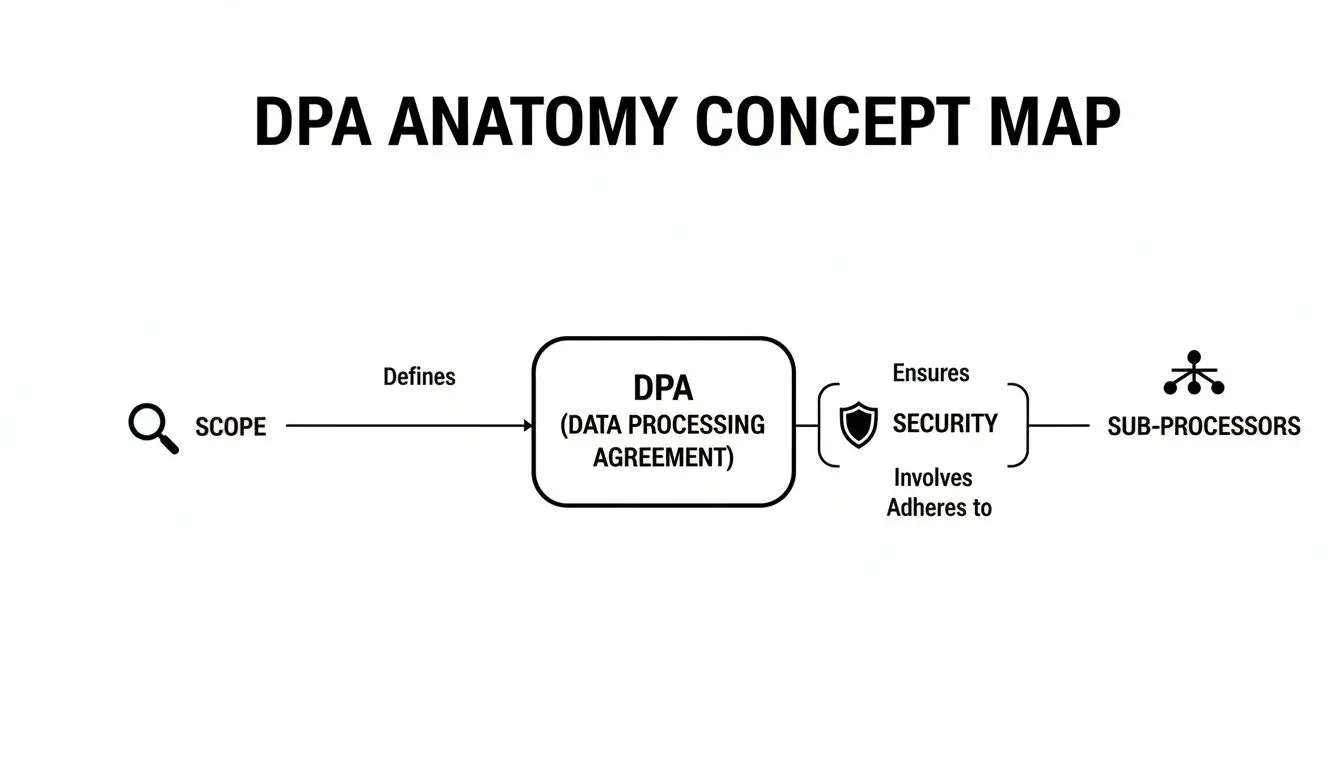
As the visual shows, managing sub-processors is not an afterthought but a fundamental pillar of a DPA, directly linked to its scope and security mandates.
Navigating International Data Transfers
Complexity increases when data crosses borders, particularly from the European Union to countries like the United States. GDPR imposes strict conditions on such transfers to ensure data receives a level of protection equivalent to that within the EU. The Schrems II ruling by the Court of Justice of the European Union invalidated the former EU-US Privacy Shield framework, increasing the compliance burden.
The most common solution today is the use of Standard Contractual Clauses (SCCs).
Standard Contractual Clauses (SCCs) are pre-approved legal terms issued by the European Commission. Integrating them into a DPA creates a binding contract that legally compels a data importer (e.g., a U.S. vendor) to adhere to EU-level data protection standards.
The updated SCCs, released in 2021, have become the de facto standard for international data transfers. Regulatory audits on post-Schrems II compliance are common, requiring companies to provide evidence of appropriate safeguards. Today, over 80% of EU tech contracts involving international data flows rely on SCCs. You can learn more about how these clauses strengthen data protection on GDPR.eu.
The Obligation of a Transfer Impact Assessment (TIA)
Signing SCCs alone is insufficient. The Schrems II ruling also obligates data exporters to conduct a Transfer Impact Assessment (TIA) for each international transfer. A TIA is a risk assessment of the destination country’s legal framework to determine if it could undermine the protections guaranteed by the SCCs.
For example, a TIA for a transfer to a U.S.-based SaaS provider must assess the risk of U.S. government agencies accessing EU user data under surveillance laws in a manner that would be unlawful in the EU.
If a TIA identifies significant risks, the data exporter must implement “supplementary measures” to mitigate them. These can include:
- Technical Measures: Strong end-to-end encryption where the decryption keys are held exclusively by the EU-based data exporter.
- Organizational Measures: Policies and procedures for challenging government access requests and notifying the data controller.
- Contractual Measures: Additional clauses in the DPA that reinforce these obligations.
Failure to conduct and document a TIA is a significant compliance failure that can result in fines and suspension of data flows.
How the EU Data Act Reshapes Cloud DPAs
For years, DPAs were primarily concerned with privacy and security under GDPR. The EU Data Act introduces a new paradigm, transforming DPAs from pure compliance documents into strategic commercial contracts, particularly for SaaS, PaaS, and IaaS solutions.
This regulation targets vendor lock-in by embedding principles of fair competition and data mobility into cloud contracts. The focus expands from just protecting data to ensuring it remains portable and accessible. This has direct architectural and contractual implications.
Architecting for Data Portability
Switching cloud providers has historically been technically and financially prohibitive. The Data Act establishes data portability as an enforceable right, compelling processors to design services that facilitate customer exits without imposing unreasonable barriers.
This means your vendor’s DPA must now explicitly detail:
- Data Export Procedures: The methods for exporting all customer data in a structured, commonly used, and machine-readable format.
- Transition Assistance: The obligation for the processor to provide reasonable assistance during migration to a new provider, such as technical support or API access.
- Elimination of Switching Charges: The Act mandates a phase-out of switching charges, preventing vendors from using exit fees as a retention tool.
The EU Data Act effectively makes “data liberation” a contractual right. The DPA must now govern not only what a vendor does with data during the contract term but also what they must help you do with it upon termination.
Extraterritorial Reach and Contractual Fairness
The Data Act’s influence is global. It has an extraterritorial reach, forcing non-EEA providers to update data processing agreements for any services offered to EU customers. The effective date for these changes is September 12, 2025.
Given that U.S. firms hold over 70% of the European cloud market share, this regulation is a direct challenge to vendor lock-in. DPAs must now include clauses that support cost-free switching by September 2026 and facilitate data exports in open formats. You can discover more insights about the EU Data Act’s global impact on fenwick.com. This levels the playing field, making data portability and fair terms a standard regardless of vendor location. For a deeper analysis of infrastructure choices, see our comparison of cloud computing vs on-premise solutions.
Furthermore, the Act introduces an “unfairness test” to protect small and medium-sized businesses (SMEs) from one-sided contracts. A DPA clause can be deemed non-binding if it grossly deviates from good commercial practice, providing smaller companies with leverage against terms that unfairly limit liability or grant a provider overly broad data usage rights.
This requires CTOs and product leaders to build systems architected for data mobility and to negotiate DPAs that reflect these new commercial and legal realities.
Special DPA Considerations for AI Systems
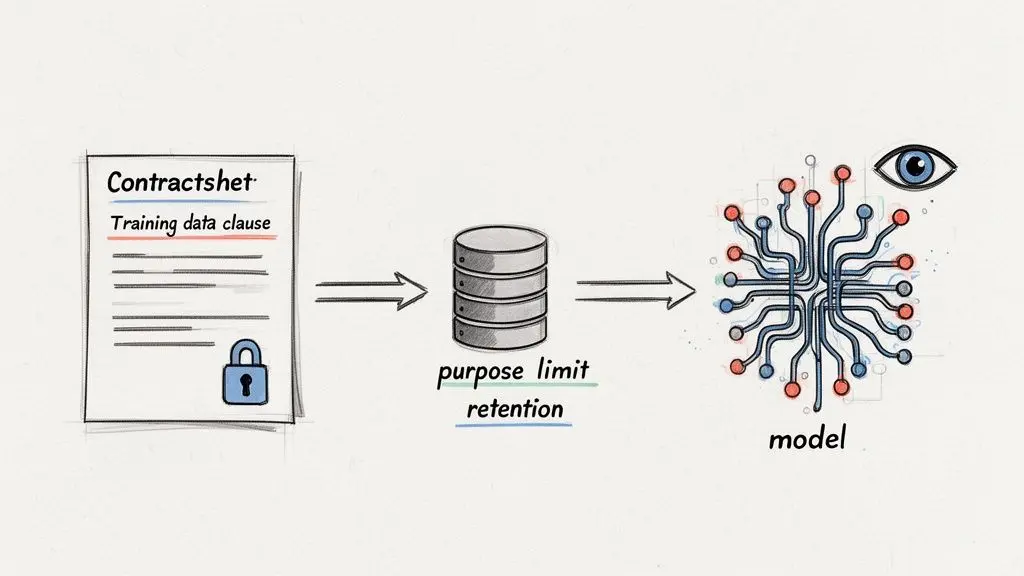
When processing data for AI model training and deployment, the risks and requirements change significantly. A generic data processing agreement designed for simple data storage is inadequate. AI processing introduces unique challenges related to purpose limitation, data retention, and accountability.
A standard DPA might permit data processing for “service delivery,” but it’s often dangerously ambiguous whether this includes using customer data to train a new AI feature. This ambiguity creates legal and reputational risk.
Data Usage for Model Training
The most critical DPA modification for AI systems is an explicit clause governing the use of data for model training. Assuming you have the right to use customer data to improve your product is a common and costly mistake.
Your DPA must state, without ambiguity, whether customer data will be used for training.
- Opt-In Consent: If training on customer data, explicit, affirmative consent is required. Vague language like “improving our services” is insufficient.
- Purpose Specification: The DPA must define the specific training purpose. “Improving our product” is too broad. “Training a sentiment analysis model to enhance customer support ticket routing” is specific and defensible.
- Data Anonymization: The DPA should specify the technical measures, such as anonymization or pseudonymization, that will be applied before data is used in a training pipeline.
An AI-focused DPA acts as a precise instruction manual. It must eliminate all ambiguity about how data moves from a customer environment into a training set and a production model.
Defining Roles and Responsibilities in AI Chains
Integrating third-party AI APIs (e.g., from OpenAI, Anthropic, Google) further complicates the controller-processor relationship. The DPA must clarify these roles to prevent accountability gaps. Is the API provider a processor executing your instructions, or a separate controller with its own rights to the data?
The DPA must also address ownership and usage rights for model inputs (prompts) and outputs (generations). Clarify whether the API provider can use this data to train their foundational models. If so, this must be reflected in your DPA and communicated transparently to your customers. Our guide on a code of conduct for engineering and AI teams provides a practical framework for establishing these guardrails.
Addressing Model-Specific Risks
Finally, a data processing agreement for an AI system must address risks inherent to the models themselves:
- Data Retention for Training Sets: Define a specific, justifiable retention period for training data that is separate from standard production data policies.
- Liability for Bias and Inaccuracy: Clarify liability for damages caused by biased, inaccurate, or harmful model outputs.
- Data Leakage Mitigation: Include clauses requiring the processor to implement safeguards preventing the model from inadvertently disclosing personal data from its training set during inference.
By addressing these AI-specific issues in your DPA, you build a contractual framework that supports responsible and trustworthy AI development.
A Practical Checklist for Reviewing DPAs
Reviewing a vendor’s DPA requires a technical and operational lens, not just a legal one. The objective is to ensure the contract aligns with your system architecture, risk tolerance, and compliance obligations. A superficial review is a common mistake that creates latent risk.
This checklist provides a pragmatic guide for CTOs and product leaders to evaluate a new DPA, identify red flags, and negotiate terms that protect your organization and its customers.
Foundational Due Diligence
Before analyzing the legal text, validate the vendor’s security claims with external evidence.
- Verify Security Certifications: Request current certificates for standards like ISO 27001 or SOC 2 Type II. Do not accept a logo on a marketing page; review the actual report to confirm its scope and validity. These audits provide independent verification of security controls.
- Review Sub-Processor Lists: Obtain a complete and current list of all sub-processors that will process your data. Investigate any unrecognized entities and ensure the DPA contractually obligates the vendor to notify you—and obtain consent—before adding new ones.
Key Clauses for Scrutiny
Focus on the contractual clauses with the greatest operational impact. Ambiguity in these areas often indicates an attempt by the vendor to shift risk onto your organization.
A vendor’s standard DPA is written to protect them, not you. It is the starting point for negotiation, not a non-negotiable document.
The following clauses demand detailed attention:
- Data Breach Notification Timelines: A clause stating notification “without undue delay” is standard GDPR text but operationally insufficient. Negotiate a concrete timeframe, such as “within 24 or 48 hours” of discovery. This provides your incident response team with the necessary window to act effectively.
- Audit Rights: The agreement must grant you the right to audit the processor’s compliance. This can include reviewing security reports and certifications or, for critical processors, conducting on-site inspections. A vendor resistant to reasonable audit rights may have deficiencies in their security posture.
- Data Deletion and Return Protocols: The DPA must be explicit about data handling upon contract termination. It should specify that all data will be securely deleted or returned and require the processor to certify this deletion in writing. Scrutinize for loopholes that permit them to retain copies for undefined “analytical purposes.”
By systematically applying this checklist, you can transform the DPA from a passive legal formality into an active instrument for managing third-party risk.
Frequently Asked Questions About DPAs
For technical leaders, the legal intricacies of data processing agreements can seem peripheral, but their proper implementation is fundamental to system integrity. Here are concise answers to common questions.
Is a DPA Required for Every Vendor?
Yes, if that vendor processes any personal data on your behalf. This clearly applies to major providers like AWS or Azure and SaaS platforms like Salesforce. It also extends to less obvious services, such as analytics tools or embedded support widgets.
The determining factor is whether the vendor processes personal data for which you are the controller. If they do, a DPA is a legal requirement under regulations like GDPR. If a vendor provides a service entirely isolated from personal data (e.g., office furniture supply), a DPA is not necessary.
What Is the Difference Between a DPA and a Privacy Policy?
These two documents serve distinct functions and are directed at different audiences.
- A Privacy Policy is a public-facing document directed at your users (the data subjects). It explains how your organization collects, uses, shares, and protects their personal data, fulfilling transparency obligations.
- A Data Processing Agreement (DPA) is a private, legally binding contract between two businesses: the data controller (your company) and a data processor (your vendor). It dictates the terms under which the vendor may process data on your behalf.
In short, your Privacy Policy is the promise you make to your users; the DPA is a contractual tool to ensure your vendors help you uphold that promise.
Can I Just Sign the Vendor’s Standard DPA?
While using a vendor’s template is a common starting point, signing it without a thorough technical and legal review is a significant risk. Vendor-supplied DPAs are drafted to minimize their liability, not yours.
A vendor’s DPA should be treated as the opening of a negotiation, not the final word. Its terms must be reconciled with your own compliance obligations and risk posture.
Analyze clauses on liability caps, data breach notification timelines, audit rights, and sub-processor approval. For any vendor handling critical or sensitive data, it is essential to negotiate terms to ensure the data processing agreement adequately protects your organization.
At Devisia, we believe that privacy and compliance are architectural choices, not afterthoughts. We build reliable, maintainable software and AI systems with these principles at their core, ensuring your digital products are secure and trustworthy from the ground up. Learn more at https://www.devisia.pro.