In an environment of complex data pipelines and continuous delivery, a Data Protection Officer (DPO) is not a bureaucratic hurdle but a strategic architect for trust and resilience. This role is essential for navigating regulations like GDPR and embedding privacy deep into a product’s architecture from its inception.
Why a Data Protection Officer is a Technical Necessity
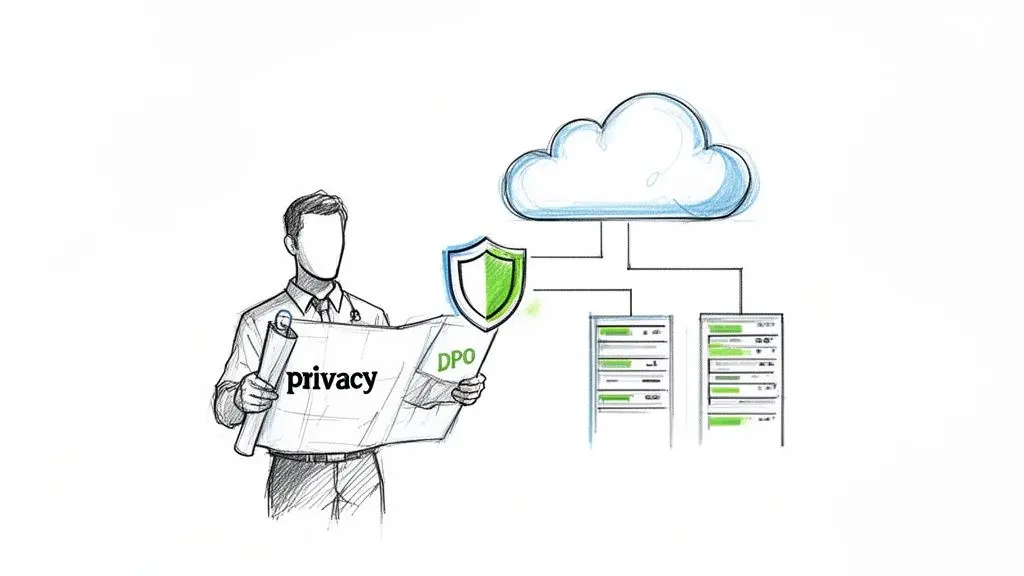
For any modern tech company, treating data protection as a last-minute compliance check is a recipe for architectural debt and regulatory failure. Reactive compliance—bolting on privacy controls after a feature is built—is slow, expensive, and fails to address systemic risks.
This approach is particularly dangerous as data regulations intensify globally. Non-compliance with laws like GDPR can result in fines of up to 4% of global annual turnover, a figure that poses a significant threat to both startups and established enterprises.
The Problem: Compliance as an Afterthought
In software development, particularly within agile and CI/CD frameworks, velocity is paramount. When privacy is not a primary design constraint, engineers often build systems that are inherently difficult to secure or audit.
This leads to recurring architectural anti-patterns:
- Entangled Data Models: Personal data becomes intertwined with operational data, making it nearly impossible to honor a user’s “right to be forgotten” without compromising core system integrity.
- Unmonitored AI Systems: Models are trained on user data without robust consent mechanisms or impact assessments, creating significant legal and ethical liabilities.
- Over-Privileged Access: Broad permissions are granted for operational convenience, exposing sensitive information to unnecessary internal and external threat vectors.
Addressing these issues post-launch requires costly refactoring, slows down future development velocity, and erodes user trust. What should have been a manageable design choice becomes a significant technical liability.
A Data Protection Officer’s primary function is to shift the paradigm from reactive fixes to proactive architectural design, ensuring privacy is a core principle, not a belated feature.
The Solution: From Liability to Competitive Advantage
Integrating a DPO early in the product lifecycle transforms compliance from a burden into a strategic asset. By advising on Privacy by Design, a DPO helps engineering teams build systems that are compliant, secure, and trustworthy by default.
This proactive stance delivers concrete business benefits. It provides demonstrable due diligence to enterprise customers and investors, who now scrutinize data handling practices more rigorously. Furthermore, a strong privacy posture can be a powerful market differentiator, building a foundation of user trust that is difficult for competitors to replicate.
For founders and CTOs, the DPO is a critical partner in building resilient, defensible, and ultimately more valuable digital products.
Understanding the DPO Role in a Software Environment
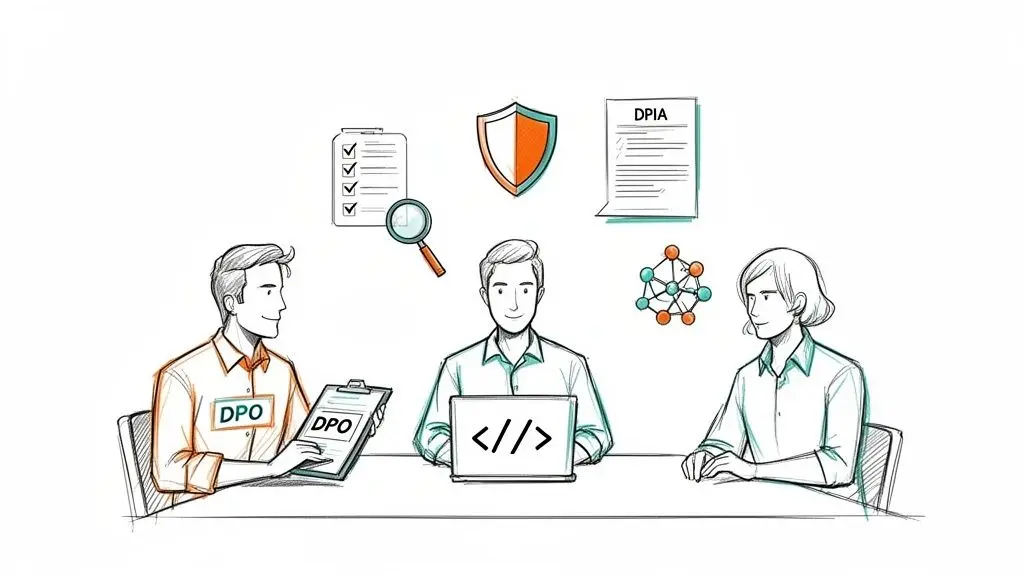
In a technology company, a Data Protection Officer is far more than a legal advisor. They are a strategic partner who translates complex regulatory requirements into actionable technical controls and architectural patterns.
Their objective is not to impede innovation but to enable it by ensuring new products and AI features are built on a compliant and trustworthy foundation. An effective DPO collaborates directly with engineering, product, and AI teams, embedding practical guidance within development cycles to help teams build more resilient systems without sacrificing momentum.
Core Responsibilities in Practice
A DPO’s duties extend beyond interpreting legal texts. In a software context, their work is deeply integrated into the product lifecycle. They function as a facilitator, auditor, and advisor, ensuring privacy is a consideration from the first sprint planning session to final deployment.
This hands-on approach is more critical than ever. In Europe, GDPR fines recently surpassed €2 billion, a 38% increase in a single year, highlighting the material risk for any company processing EU citizen data. A recent survey also revealed that 71% of organizations consider cross-border data transfers their primary compliance challenge—a direct concern for companies building global software and AI systems.
A DPO’s value is not measured by the number of policies they write but by their ability to prevent architectural flaws that render a system unauditable or inherently non-compliant.
Translating Law into Code
A competent DPO in a technical setting bridges the gap between legal obligations and software architecture. This involves specific activities that directly influence how products are designed, built, and maintained. The following table outlines a DPO’s key functions and their practical application within a typical software or AI development pipeline.
Core DPO Responsibilities in a Tech Environment
| Responsibility Area | Practical Application in Software/AI Development | Key Stakeholders |
|---|---|---|
| Risk Assessment & Mitigation | Conducting Data Protection Impact Assessments (DPIAs) before developing a new feature or training an AI model to identify and fix risks like data leakage or algorithmic bias. | Product Managers, Engineering Leads, AI/ML Engineers |
| Privacy by Design & Default | Advising on architecture to implement privacy principles, such as recommending pseudonymisation for analytics or ensuring data deletion requests can be efficiently handled. | Software Architects, UX/UI Designers, Front-end & Back-end Developers |
| Compliance Monitoring | Regularly reviewing data maps, processing activities, and third-party vendor integrations to maintain a clear picture of data flows and spot compliance gaps early. | DevOps, Security Team, Legal Department |
| Incident & Authority Liaison | Acting as the primary contact for supervisory authorities or during a data breach, ensuring communication is accurate, timely, and transparent to minimise penalties. | Executive Leadership (CEO/CTO), Legal Counsel, Communications Team |
These responsibilities ensure that compliance is not an afterthought but a core component of the development process itself.
Key DPO Activities
- Conducting Data Protection Impact Assessments (DPIAs): Before a new AI model is trained or a feature processing personal data is built, the DPO assesses potential risks. This is a technical risk assessment designed to identify issues like potential data leakage, algorithmic bias, or inadequate consent mechanisms before they are codified.
- Advising on Privacy by Design: The DPO collaborates with product managers and engineers during the design phase to embed privacy-enhancing principles. To learn more about integrating these principles, see our guide on Privacy by Design. This may involve recommending pseudonymisation for analytics data or architecting a system to support data deletion requests without requiring extensive rework.
- Monitoring Compliance Across Platforms: The DPO regularly reviews data maps, processing activities, and third-party vendor integrations to maintain an accurate understanding of data flows and identify compliance gaps before they escalate.
- Acting as a Liaison with Authorities: In the event of a data breach or an inquiry from a supervisory authority, the DPO serves as the primary point of contact. Their detailed knowledge of the company’s data practices ensures communications are accurate and transparent, which can significantly reduce regulatory penalties and reputational damage.
Deciding When to Appoint a Data Protection Officer
Knowing when to appoint a Data Protection Officer is more than a legal formality. While regulations like GDPR specify clear triggers, the strategic imperative for a tech company often arises much earlier. Delaying the appointment until legally mandated means you are already accumulating technical and compliance debt.
A more effective approach is to view the decision through a risk-based lens, tying it to your company’s growth, data architecture, and product roadmap. Proactive appointment builds a scalable foundation for compliance and trust, preventing reactive scrambles following an audit or data breach.
Technical and Business Indicators
Certain operational realities should signal the need for a DPO, even if you do not yet meet strict legal thresholds. These indicators point to a level of complexity that cannot be managed effectively as a collateral duty by legal or engineering teams.
Key triggers include:
- Processing Sensitive Data at Scale: The collection of health information, biometric data, or other special categories of personal data increases your risk profile significantly.
- Developing AI Systems on Personal Data: If your roadmap includes training machine learning models or using LLMs with user information, the need for expert oversight is immediate to establish necessary guardrails.
- Expanding into New Jurisdictions: Entering new markets, particularly the EU, requires navigating a complex web of data protection laws. A DPO provides the specialized knowledge needed for safe expansion.
- Handling Large Volumes of User Data: Even if the data is not classified as “sensitive,” processing personal information for a large number of individuals increases your obligations and potential liabilities.
A DPO is not just a compliance officer; they are a risk mitigator for your architecture. They facilitate informed decisions before you build systems that are difficult or impossible to make compliant later.
A Proactive Approach to Risk Management
Appointing a DPO early is an investment in your product’s long-term viability and your company’s reputation. The financial and operational risks of inadequate data governance are substantial.
GDPR fines have now exceeded €4 billion in total, with authorities increasingly scrutinizing proof of principles like data minimization. Consequently, 82% of companies are planning new investments in compliance technology to improve risk visibility. While only 32% of US firms currently have DPOs, EU adoption is much higher as audits target 40% of enterprises, making the role essential for demonstrating due diligence. You can find more details in this data protection trends report.
A proactive appointment also streamlines engagements with enterprise clients, who conduct rigorous due diligence on their vendors’ data protection practices. Demonstrating mature governance can become a significant competitive advantage.
For organizations building AI, this proactive mindset is even more critical. To ensure responsible AI development, it is helpful to use a structured framework. Our free AI Risk & Privacy Checklist allows you to assess your projects without uploading any sensitive data, helping to identify potential risks early so you can build privacy considerations directly into your development lifecycle, guided by your DPO.
Choosing Your DPO Model: Internal Hire vs. Outsourced Service
Once you have decided to appoint a Data Protection Officer, the next architectural question is whether to hire a full-time internal DPO or engage an external ‘DPO-as-a-Service’ (DPOaaS). This is a strategic choice that will influence how privacy is integrated into your engineering culture and product roadmap.
Each model presents distinct trade-offs. The optimal choice depends on your company’s stage, system complexity, and the specific expertise your product vision requires. An internal hire offers deep, embedded knowledge, while an outsourced service provides a flexible bench of specialized skills.
The Case for an Internal DPO
An internal DPO becomes an integrated team member, absorbing your company culture, learning the intricacies of your architecture, and understanding your long-term objectives. This model is particularly effective for companies with complex, proprietary systems or those whose core business involves processing highly sensitive data.
The primary advantage is contextual depth. An internal DPO can participate in daily stand-ups, sprint planning sessions, and architectural reviews. Over time, they build an institutional memory of your data flows, legacy systems, and risk appetite that is difficult for an external party to replicate. This deep integration ensures their advice is pragmatic and tailored to your engineering reality.
However, this model has challenges:
- High Cost: A seasoned, full-time DPO represents a significant investment in salary, benefits, and ongoing training.
- Narrow Expertise: It is difficult for a single individual to master all relevant domains. A DPO may be an expert in GDPR but have limited experience with AI ethics or emerging cybersecurity regulations like NIS2.
- Recruitment Difficulty: Finding a candidate with proficiency in both law and software architecture is challenging. The talent pool for technically adept DPOs remains limited.
The Flexibility of an Outsourced DPO
The DPO-as-a-Service (DPOaaS) model provides access to a team of experts on a fractional or on-demand basis. For startups, SMBs, or companies with variable compliance needs, this is often the most practical solution, offering immediate expertise without the overhead of a full-time hire.
The key benefits are breadth of expertise and flexibility. A DPOaaS provider can deploy specialists across various domains—from AI governance and cybersecurity law to specific industry regulations. This allows you to access the right expertise at the right time, such as when launching a new AI feature or entering a new market.
For many organizations, the DPOaaS model offers a practical way to access high-calibre data protection guidance that would otherwise be out of reach. It provides the independent oversight regulators expect while adapting to the dynamic needs of a growing tech business.
This decision tree can help visualize the choice.
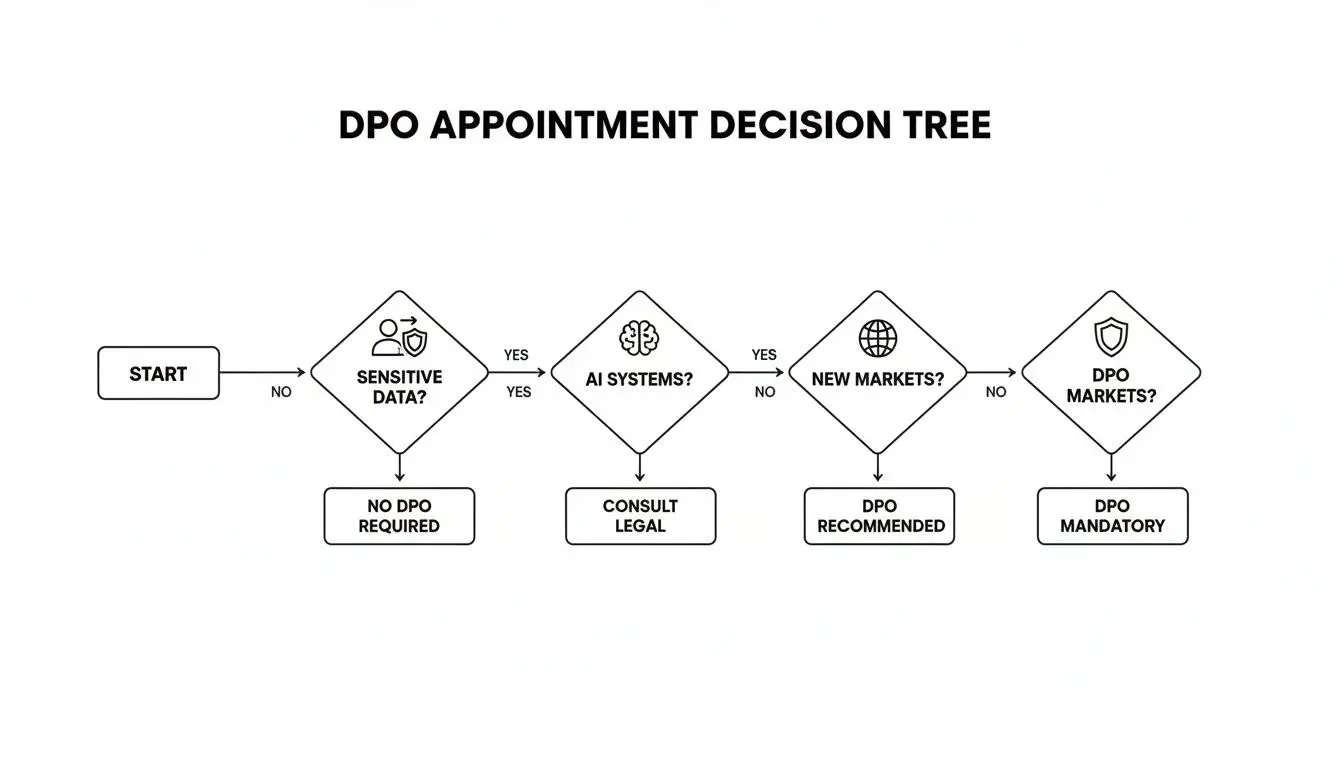
As the flowchart indicates, factors such as handling sensitive data at scale, developing AI systems, or entering new markets are key signals that should guide your decision toward the model that best fits your risk profile.
Making the Right Architectural Choice
Choosing between an in-house and outsourced DPO is a foundational decision with no single correct answer. The optimal choice is contingent on your specific circumstances. This comparison clarifies the trade-offs.
Comparing Internal DPO vs Outsourced DPO-as-a-Service
| Factor | Internal DPO | Outsourced DPO (DPOaaS) |
|---|---|---|
| Integration | Deeply embedded in culture and daily workflows. | External advisor, integrated via defined processes. |
| Cost Structure | High fixed cost (salary, benefits, training). | Flexible, often lower variable cost (retainer, project-based). |
| Expertise | Deep knowledge of your systems; expertise limited to one person. | Broad access to a team of specialists (AI, GDPR, etc.). |
| Scalability | Scaling expertise requires a new hire. | Scales up or down with business needs. |
| Independence | Potential for internal conflicts of interest. | Guaranteed independence and objectivity. |
| Recruitment | Time-consuming and challenging to find the right fit. | Immediate access to vetted, experienced professionals. |
As your company matures, a hybrid model may become appropriate. Many businesses begin with a DPOaaS provider to establish a solid compliance framework, then hire an internal DPO for day-to-day management once they reach a certain scale, often retaining the external service for specialized advice on complex issues like AI impact assessments. This approach allows you to balance cost, expertise, and integration effectively.
Integrating Your DPO with Engineering and AI Teams
A Data Protection Officer operating in a silo is ineffective. Their value is realized only when they are deeply embedded within your development and governance workflows, acting as a collaborative partner rather than a remote auditor. This integration transforms the DPO from a compliance function into a strategic asset for building secure, trustworthy systems.
The alternative—a disconnected DPO—inevitably leads to friction and rework. When advice is delivered too late in the cycle, engineering teams are forced to refactor already-built features. This creates bottlenecks, positions the DPO as an obstacle, and fails to address privacy risks at their source: the architectural design phase.
Shifting Compliance Left in the Development Lifecycle
To maximize a DPO’s effectiveness, you must shift their involvement “left,” moving their engagement from the end of the development cycle to its beginning. This means making them a key stakeholder in product discovery, feature planning, and architectural reviews for any project involving personal data.
This requires a cultural shift where privacy is treated as a core non-functional requirement, equivalent to performance or security. The DPO’s role is to help define and verify these requirements, not to obstruct progress.
This proactive approach is also critical for addressing knowledge gaps within technical teams. PwC’s 2026 Global Digital Trust Insights survey identified a significant skills shortage, with 50% of organizations admitting their teams lack knowledge in emerging security technologies. Embedding a DPO injects specialized expertise directly where it is most needed. You can find more details in the insights from Kiteworks on 2026 data security predictions.
Practical Steps for Effective Integration
Integrating your DPO requires more than just calendar invites. It involves building clear processes and communication channels that make their input a natural part of the workflow.
-
Involve the DPO in Product Discovery: During the ideation phase for new features that process personal data, include the DPO. They can identify potential privacy pitfalls early, enabling the team to explore compliant-by-design alternatives before writing any code.
-
Mandate DPIAs for New AI Initiatives: Establish a Data Protection Impact Assessment (DPIA) as a standard requirement for any new AI model or data-intensive feature. This formalizes risk assessment and ensures the DPO evaluates potential issues like algorithmic bias or data leakage before development begins.
-
Integrate into Agile Ceremonies: Invite the DPO to relevant sprint planning meetings or backlog grooming sessions. This provides them with visibility into the roadmap and allows them to offer real-time guidance, preventing teams from pursuing a non-compliant implementation. For more on creating strong team alignment, see our guide on creating a code of conduct for engineering and AI teams.
Establishing Guardrails for AI and LLM Integration
The proliferation of AI, particularly Large Language Models (LLMs), introduces new and complex privacy challenges. An integrated DPO is essential for establishing the guardrails necessary for responsible innovation, helping engineering teams navigate this ambiguous territory.
The DPO’s role in AI governance is to translate legal uncertainty into technical reality. They help engineering teams implement controls that manage risk without stifling innovation, ensuring AI systems are both powerful and principled.
Key areas where a DPO provides critical guidance include:
- Data Minimization for Prompts: Advising on techniques to strip personally identifiable information (PII) from user inputs before they are sent to an LLM API.
- Evaluating Vendor Contracts: Scrutinizing the data processing agreements of third-party model providers to ensure they meet your compliance standards.
- Governance for Fine-Tuning: Establishing clear policies on the use of personal data for fine-tuning models, including obtaining proper consent and defining data retention rules.
By making the Data Protection Officer an active member of your technical teams, you build more resilient systems, mitigate risks early, and transform compliance from a burden into a core architectural strength.
Conclusion: Key Takeaways for Technical Leaders
The Data Protection Officer is not merely a legal function to satisfy regulators; it is a core component of building resilient, modern software. For founders, CTOs, and product leaders, viewing the DPO as a strategic partner is essential for building products that are defensible, market-ready, and trustworthy.
Privacy Is an Architectural Choice
The most critical takeaway is this: privacy is not a feature added later. It is a series of architectural decisions made from day one. Deferring compliance to the end of the development cycle is a recipe for technical debt, costly refactoring, and significant regulatory risk.
An effective Data Protection Officer helps you shift compliance left, embedding privacy principles directly into your sprints and system design. This prevents the construction of systems that are difficult to audit or secure later.
Key Actions for Leadership
To operationalize this, technical leaders should focus on a few practical priorities that empower the DPO to protect the company and strengthen the product.
-
Appoint Proactively: Do not wait for a regulatory mandate. Engage a DPO (internal or outsourced) as soon as your roadmap includes sensitive user data, AI model training, or expansion into new markets.
-
Integrate Deeply: A DPO isolated within a legal silo is ineffective. Embed them directly with your engineering and AI teams. They must be present during architectural reviews, product discovery, and sprint planning for any feature that processes user data.
-
Empower Independence: Your DPO must have a direct line to senior leadership—C-level or the board—and operate without conflicts of interest. This is a regulatory requirement and your best defense against systemic blind spots.
A well-integrated DPO transforms compliance from a burden into a competitive advantage. They become a strategic partner in building products that are not only innovative but fundamentally trustworthy.
Frequently Asked Questions About the DPO Role
Even with a clear strategy, practical questions often arise when appointing a Data Protection Officer. Here are common queries from founders and CTOs, with direct answers to inform your decision.
Does My Startup Really Need a DPO?
While GDPR specifies triggers for a mandatory DPO, the practical need often emerges much earlier for a tech startup. If your business model relies on user data—for a SaaS product, training AI models, or collecting behavioral analytics—viewing a DPO as a strategic investment rather than a legal obligation is prudent.
This proactive step signals due diligence to investors and enterprise customers, who increasingly scrutinize vendor data handling. More importantly, it helps you avoid expensive architectural rework and prepares your product to scale into regulated markets. It is less a burden and more a foundation for trust.
Can Our CTO Also Serve as the DPO?
This is a frequent question with a definitive answer: no. Doing so creates a fundamental conflict of interest. GDPR is explicit that the Data Protection Officer must operate independently, free from influence that could compromise their oversight.
A CTO’s primary responsibility is to direct data processing and system architecture to meet business objectives. A DPO’s role is to independently monitor and advise on the compliance of those same decisions.
Appointing the same person to both roles means they would be auditing their own work. Regulators view this as a serious failure of governance, and it can undermine your entire compliance framework. Separation of these duties is non-negotiable.
How Does a DPO’s Role Adapt to AI and LLMs?
With the adoption of AI and Large Language Models (LLMs), the DPO’s role becomes even more critical. Their focus must expand beyond traditional data protection to address the novel and complex risks associated with these technologies.
In an AI context, their key responsibilities evolve to include:
- Advising on Training Data: Guiding teams on the legal basis for using personal data to train models, ensuring principles of consent and data minimization are implemented.
- Conducting AI Impact Assessments: Leading DPIAs that specifically analyze AI-related risks such as algorithmic bias, data leakage through model outputs, and the challenges of “black box” systems.
- Establishing Governance Frameworks: Helping to create clear, enforceable policies for using third-party LLMs and developing models in-house, including data retention rules for prompts and outputs.
- Championing Privacy by Design in AI: Collaborating with engineers to build technical safeguards, such as prompt engineering to strip PII or designing systems that can effectively honor data subject rights in an AI context.
The DPO acts as an essential advisor, translating the legal ambiguities of AI into practical technical controls to ensure innovation does not outpace your ability to protect users and the business.
At Devisia, we believe that privacy is an architectural choice, not a feature. We help businesses build reliable, secure, and compliant digital products and AI-enabled systems with a long-term, pragmatic approach. Learn how we turn your business vision into maintainable software.