A data processing agreement (DPA) is not merely a legal document to be signed and filed. For technical and product leaders, it’s a critical architectural specification for any software system that processes personal data. It is a binding contract between a data controller (your organization) and a data processor (a vendor), defining precise responsibilities for protecting user data across your entire technology stack.
The DPA as an Architectural Specification
In modern digital architectures, data is rarely confined to a single system. A typical application relies on a distributed ecosystem of cloud services, SaaS platforms, and APIs for functions ranging from analytics and payments to AI-driven features. Each time user data is transmitted from your direct control to a third-party vendor’s system, you introduce a potential point of failure for security, compliance, and operational integrity. This distributed model creates significant risk if not managed with technical and legal rigor.
The core problem is this: without a formal DPA, you have no contractual control over how vendors handle that data. A verbal assurance or a standard clause in a Master Service Agreement is insufficient. A DPA addresses this gap by establishing a formal technical and legal framework that specifies exactly how personal data must be handled, secured, processed, and managed throughout its lifecycle.
For CTOs, architects, and product leaders, viewing the DPA through this lens is essential. It is not an administrative task to be delegated to legal counsel post-procurement; it is a foundational component of implementing privacy by design from the initial stages of system architecture.
The Problem: Naive Vendor Integration
Consider a common scenario: a B2B SaaS company integrates a third-party analytics service to analyze user behavior. The engineering team integrates the SDK, and user interaction data—which may include personal identifiers like email addresses, user IDs, or IP addresses—begins flowing to the vendor’s servers.
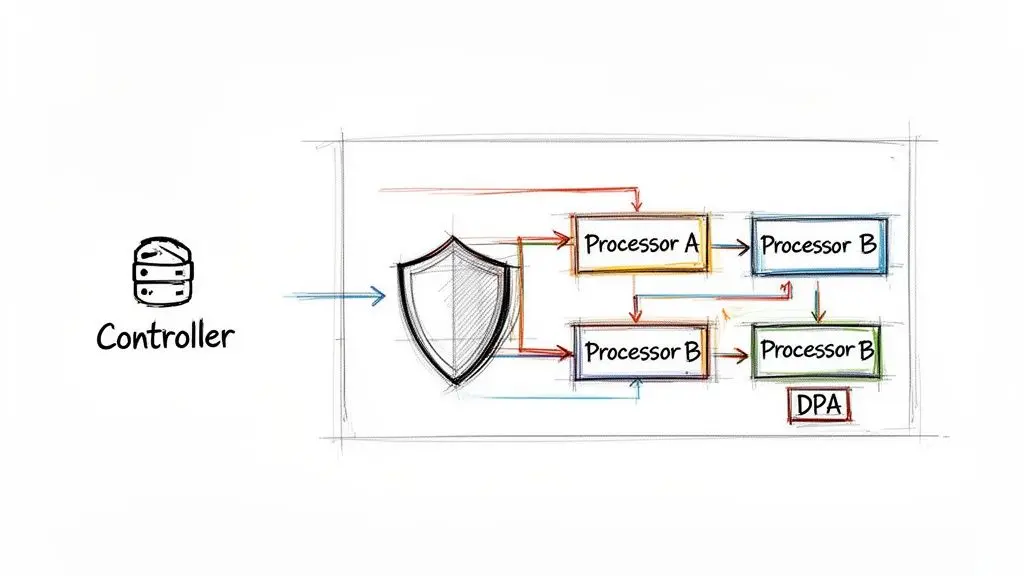
Without a robust DPA, the company is exposed to several material risks:
- Undefined Liability: If the analytics vendor suffers a data breach, who is responsible for notifying users and regulatory authorities? Who bears the financial and reputational costs? Ambiguity leads to legal disputes and loss of customer trust.
- Inadequate Security Posture: The vendor may not adhere to the same security standards for encryption, access control, or data retention as your organization, creating a weak link in your overall security architecture.
- Compliance Gaps: You have no contractual assurance that the vendor complies with regulations like GDPR or CCPA, exposing your entire organization to significant financial penalties.
The Solution: Establishing Control and Mitigating Risk
A well-structured DPA transforms this high-risk scenario into a managed, compliant, and auditable process. It functions as a set of enforceable instructions, compelling the vendor to operate within your data protection framework. The EU’s GDPR makes this non-negotiable. With potential fines of up to €20 million or 4% of annual global turnover, the financial incentives for compliance are substantial. Under GDPR Article 28(3), it is explicitly prohibited to use a third-party processor without a written DPA. You can explore further details on achieving data privacy compliance.
Ultimately, the DPA is the primary instrument for extending your privacy architecture beyond your organizational boundaries. It contractually obligates your vendors to function as compliant extensions of your data governance strategy, ensuring that privacy is maintained throughout the entire data lifecycle, regardless of where the data resides.
Anatomy of a Data Processing Agreement
A generic DPA template provides a starting point, but it is rarely sufficient for a complex software system. The value lies in translating abstract legal requirements into specific technical and operational controls. For engineering and product teams, engaging with the details of a DPA is not a legal formality but a critical exercise in setting clear technical boundaries for data handling to prevent compliance failures and security vulnerabilities.
This level of precision is increasingly critical. The data analytics market, which powers many of these systems, is projected to exceed $105 billion by 2027, illustrating how integral data processing has become to modern business. As organizations rely more on specialized vendors for everything from cloud infrastructure to AI APIs, the DPAs governing these relationships must be technically sound. You can find more on this trend and its effect on data agreements on morae.com.
Let’s dissect the essential clauses that directly impact your system’s architecture and operational procedures.
Roles and Responsibilities
Every DPA begins by defining the data controller and the data processor. This is not merely a legal distinction; it has profound technical implications.
- Data Controller: This is your organization. You determine the “why” and “how” of data processing. You own the relationship with the end-user (the data subject) and bear primary responsibility for data protection.
- Data Processor: This is your vendor—cloud provider, analytics tool, AI service. They process data only on your documented instructions. They are an extension of your infrastructure, not an independent entity.
This distinction establishes the foundation for all other clauses. It clarifies that the processor cannot legally use your customer data for their own purposes, such as training their public AI models, unless explicitly authorized by you.
The Scope of Processing
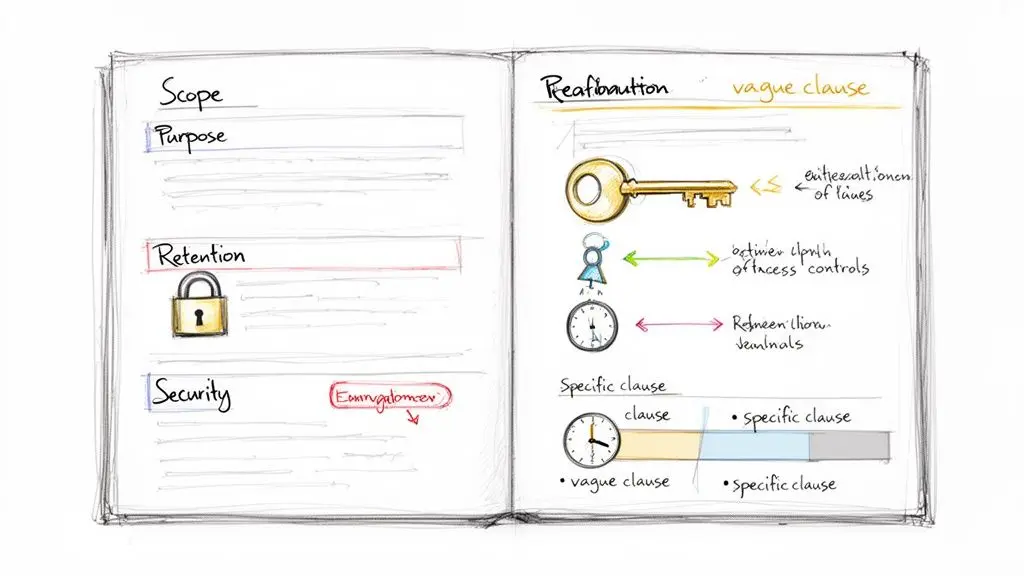
This clause translates legal intent into technical reality. Vague language is a significant source of risk, creating ambiguity that can lead to compliance violations. A well-written scope clause functions as a technical specification, precisely defining:
- Subject Matter: A clear description of the processing activity (e.g., “analysis of user behavior within the SaaS application”).
- Duration: The time period for the processing (e.g., “for the term of the Master Services Agreement”).
- Nature and Purpose: The specific actions to be performed (e.g., “to generate aggregated, anonymized usage reports for product improvement”).
- Types of Personal Data: An exhaustive list of the data categories involved (e.g., “user ID, IP address, session duration, features accessed”).
- Categories of Data Subjects: The groups of individuals whose data is being processed (e.g., “customers’ authorized users”).
Trade-off: A highly specific scope provides strong control but may require amendments if your use of the service evolves. A slightly broader scope offers more flexibility but increases risk. The key is to be precise without being unnecessarily restrictive.
Security Measures
A DPA must go beyond generic statements like “appropriate security.” It must translate this legal phrase into concrete, verifiable technical controls. This requires collaboration between legal and engineering teams.
A strong DPA will explicitly mandate specific security measures, such as:
- Encryption: Specifying standards for data at rest (e.g., AES-256) and in transit (e.g., TLS 1.2 or higher).
- Access Controls: Requiring role-based access control (RBAC) to ensure only authorized personnel can access personal data, coupled with multi-factor authentication.
- Data Deletion: Defining the exact process and timeline for secure data erasure upon contract termination or request.
- Personnel Security: Mandating confidentiality agreements and background checks for employees who access the data.
These are not just legal requirements; they are enforceable architectural constraints. By embedding these controls in your contracts, you build systems where privacy is an architectural choice, not a contractual afterthought.
Navigating Sub-Processors and International Data Transfers
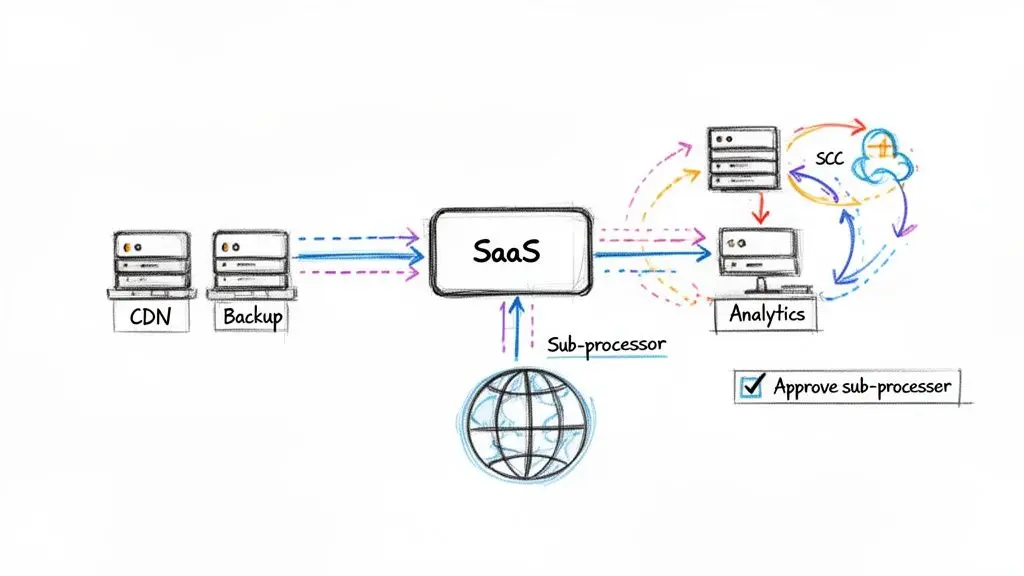
Modern software architectures are built on a supply chain of services. Your cloud provider, SaaS platform, and other vendors rarely operate in isolation; they rely on other services to deliver their product. These downstream vendors are known as sub-processors, and they create a complex chain of data custody.
Without explicit controls in your DPA, you lose visibility and control over where your users’ data is transferred and processed. This is a significant compliance and security risk.
The proliferation of outsourcing for everything from payroll to cloud hosting is a key driver for the importance of DPAs. Each link in this service chain must be contractually governed. You can get a deeper analysis of how outsourcing has shaped the need for DPAs on dataguard.com.
Managing the Sub-Processor Chain
A robust DPA does more than hold your direct vendor accountable; it contractually enforces your data protection standards down the entire supply chain. It is a naive assumption that your vendor’s DPA with its suppliers automatically protects you. Your DPA must include clauses that provide you with direct control over their sub-processor management.
Key contractual requirements include:
- Prior Written Authorization: The processor cannot engage a new sub-processor without your prior written consent. This provides you with veto power.
- Right to Object: For general authorizations, the processor must notify you of any planned changes to their sub-processor list, providing a reasonable period for you to object.
- Flow-Down Obligations: The DPA must mandate that the contract between your processor and their sub-processor contains data protection obligations that are at least as stringent as those in your agreement with the processor.
- Full Liability: Your primary processor must remain fully liable to you for any breach or failure caused by one of its sub-processors.
Implementation Note: A practical approach is to require the processor to maintain a public, up-to-date list of its sub-processors. The DPA can reference this list and specify a notification process for changes, such as an email alert followed by a 30-day period for objection.
Handling International Data Transfers
When the personal data of EU residents is transferred outside the European Economic Area (EEA), GDPR imposes strict requirements to ensure the data remains protected. Using a US-based cloud provider to process European customer data constitutes an international transfer.
Your DPA must specify the legal mechanism that legitimizes these transfers. For most organizations working with US vendors, the primary mechanism is Standard Contractual Clauses (SCCs).
Operationalizing SCCs and Supplementary Measures
SCCs are pre-approved legal contracts issued by the European Commission that establish data protection safeguards. However, following the Schrems II court ruling, simply signing SCCs is no longer sufficient. You are now required to conduct a Transfer Impact Assessment (TIA) to verify that the laws of the destination country do not undermine the protections afforded by the SCCs.
Where risks are identified, you must implement “supplementary measures.” These are technical, contractual, and organizational controls designed to protect data from foreign government surveillance and other risks.
Examples of effective supplementary measures include:
- End-to-End Encryption with Controller-Held Keys: Ensuring data is encrypted in transit and at rest, where only you (the controller) hold the decryption keys.
- Data Anonymization or Pseudonymization: Removing or obscuring personal identifiers before data is transferred.
- Contractual Transparency Obligations: Requiring the processor to notify you of any government data access requests and to legally challenge such requests where feasible.
Failure to properly address international transfers in your DPA is a direct violation of GDPR and can lead to severe penalties.
Verification and Enforcement: Audits, Breach Notifications, and Liability
A Data Processing Agreement is ineffective without mechanisms for verification and enforcement. Audit rights, breach notification requirements, and liability clauses provide the necessary teeth, transforming a list of promises into an accountable framework.
These clauses are not legal formalities; they are the operational tools for managing third-party risk.
Think of these provisions as the monitoring, alerting, and incident response systems for your data supply chain. They define how you verify compliance, the protocol for a security crisis, and the allocation of financial responsibility when a failure occurs.
The Right to Verify: Audit Clauses
A promise of “appropriate technical and organizational measures” is meaningless without verification. The audit clause provides the contractual right to inspect a processor’s practices and confirm they are compliant.
A well-negotiated audit clause typically provides two options:
- Review of Third-Party Certifications: The processor provides current audit reports, such as SOC 2 Type II or ISO 27001 certifications. This is an efficient method for obtaining independent validation.
- On-Site Inspections: This stronger right, typically reserved for high-risk data processing, allows you or a hired third party to conduct a direct inspection. It offers greater visibility but is more costly and operationally intensive.
The implementation trade-off involves balancing the need for assurance against the operational burden on the processor. A common approach is to rely on certifications for routine checks, with the right to an on-site audit reserved for cause (e.g., following a security incident).
The Clock is Ticking: Breach Notifications
In the event of a data breach, time is critical. GDPR mandates a 72-hour deadline for notifying authorities of a serious breach, starting from the moment of awareness. Meeting this deadline is entirely dependent on prompt notification from your processor.
A vague breach notification clause is a significant liability. Your DPA must require the processor to notify you of any personal data breach “without undue delay.” Best practice is to define this further, for example, “within 24 hours of discovery.” The clause must also specify the information to be provided, including:
- A description of the breach, including the types of data and approximate number of individuals and records affected.
- The likely consequences.
- The mitigation steps the processor has taken or plans to take.
Without these specifics, your incident response will be delayed, almost certainly causing you to miss regulatory deadlines. The DPA should also clarify responsibility for notifying affected individuals, a task often managed by a Data Protection Officer.
Allocating Risk: Liability and Indemnification
Liability and indemnity clauses address the financial consequences of a breach or regulatory fine. This is often one of the most heavily negotiated sections of a DPA.
An indemnity clause can require the processor to cover your costs—including fines, legal fees, and damages—arising from their failure to comply with the DPA. This provides a critical financial backstop, ensuring your organization is not held liable for a failure it did not cause.
An Actionable DPA Implementation Checklist
Implementing a Data Processing Agreement is an operational process, not a one-time legal event. Without a structured workflow, even a perfectly drafted DPA will fail to provide meaningful protection. A common pitfall is a disconnected process where legal negotiates the DPA in isolation from engineering, leading to a mismatch between contractual promises and technical reality.
The DPA must be integrated into your procurement, vendor management, and technical workflows.
Phase 1: Pre-Signature Due Diligence
Before negotiating a DPA, you must rigorously vet the potential processor to verify their security and privacy posture.
- Conduct a Security Assessment: Request and review third-party security certifications (SOC 2 Type II, ISO 27001). For high-risk vendors, use a detailed security questionnaire to assess their controls.
- Review Sub-Processor Lists: Scrutinize the complete list of sub-processors. Identify any vendors that do not meet your internal security standards or are located in high-risk jurisdictions.
- Evaluate Data Transfer Mechanisms: For international data transfers (e.g., EEA to the US), confirm a valid legal mechanism like Standard Contractual Clauses (SCCs) is in place and inquire about the supplementary measures they use.
Phase 2: DPA Negotiation and Customisation
Never accept a vendor’s standard DPA without a thorough review. Tailor key clauses to your specific risk profile and technical requirements.
A significant red flag is a processor’s unwillingness to negotiate their standard DPA. This often indicates a rigid, one-size-fits-all approach to security and compliance that is unlikely to meet your needs.
Key negotiation points:
- Breach Notification Timeline: Push for a specific timeline, such as “within 24 hours of discovery,” instead of the ambiguous “without undue delay.” This provides your incident response team with maximum time to act.
- Audit Rights: Secure the right to review audit reports annually. For critical vendors, negotiate the right to conduct your own audit following a major security incident.
- Data Deletion Guarantees: Specify a concrete timeframe for data deletion upon contract termination (e.g., “within 30 days”) and require written certification of secure erasure. A Privacy Impact Assessment can help identify risks that inform these negotiations.
Phase 3: Post-Signature Implementation and Monitoring
The signing of the DPA marks the beginning of the management lifecycle. You must have a system for managing these agreements and monitoring compliance.
This table outlines key responsibilities during DPA implementation.
DPA Implementation Checklist for Controllers and Processors
| Action Item | Controller’s Responsibility | Processor’s Responsibility |
|---|---|---|
| Define Processing Scope | Clearly document the subject matter, duration, nature, and purpose of processing. Specify the types of personal data and categories of data subjects. | Confirm understanding of the scope and agree not to process data for any other purpose without written instruction. |
| Implement Security Measures | Define required technical and organisational security measures (e.g., encryption, access controls) based on risk. | Implement and maintain the specified security measures. Provide documentation (e.g., certifications, audit reports) to demonstrate compliance. |
| Manage Sub-processors | Review and approve the processor’s list of sub-processors. Retain the right to object to new sub-processors. | Maintain an up-to-date list of all sub-processors. Obtain prior written authorisation from the controller before engaging any new sub-processor. |
| Handle Data Subject Rights | Establish a process to receive and respond to data subject requests (e.g., access, deletion). | Provide necessary assistance to the controller to help them respond to data subject requests in a timely manner. |
| Breach Notification | Define the breach notification timeline and required information. Prepare your internal incident response plan. | Notify the controller of a data breach without undue delay (as defined in the DPA) and provide all relevant details. |
| Audits and Inspections | Define audit rights, including frequency and scope. Schedule and conduct periodic reviews or request audit reports. | Make information available to the controller to demonstrate compliance and allow for and contribute to audits. |
| Data Deletion/Return | Specify the process and timeframe for data deletion or return upon contract termination. | Securely delete or return all personal data as instructed by the controller at the end of the contract and certify completion. |
Establish a Central DPA Repository: Maintain a single source of truth for all signed DPAs. This system should track key details for each vendor:
- Contract renewal dates.
- Permitted scope of processing.
- The approved sub-processor list.
- Contact information for their Data Protection Officer (DPO).
Automate Monitoring and Reviews: Set calendar reminders for key events like annual DPA reviews. Implement a process to regularly review vendors’ public sub-processor lists for changes. By integrating DPA management into your procurement workflow, you ensure no new vendor is onboarded without a fully executed and compliant agreement.
Key Takeaways for Technical and Product Leaders
A Data Processing Agreement should be treated as a critical component of your software architecture and risk management strategy. For leaders of technical and product teams, translating this legal framework into operational reality is essential for building robust, compliant systems.
Privacy is an architectural choice, not a feature to be added later. The DPA is the contractual instrument that extends this choice across your entire vendor ecosystem, ensuring data is protected throughout its lifecycle.
This is a continuous process, not a one-time task.
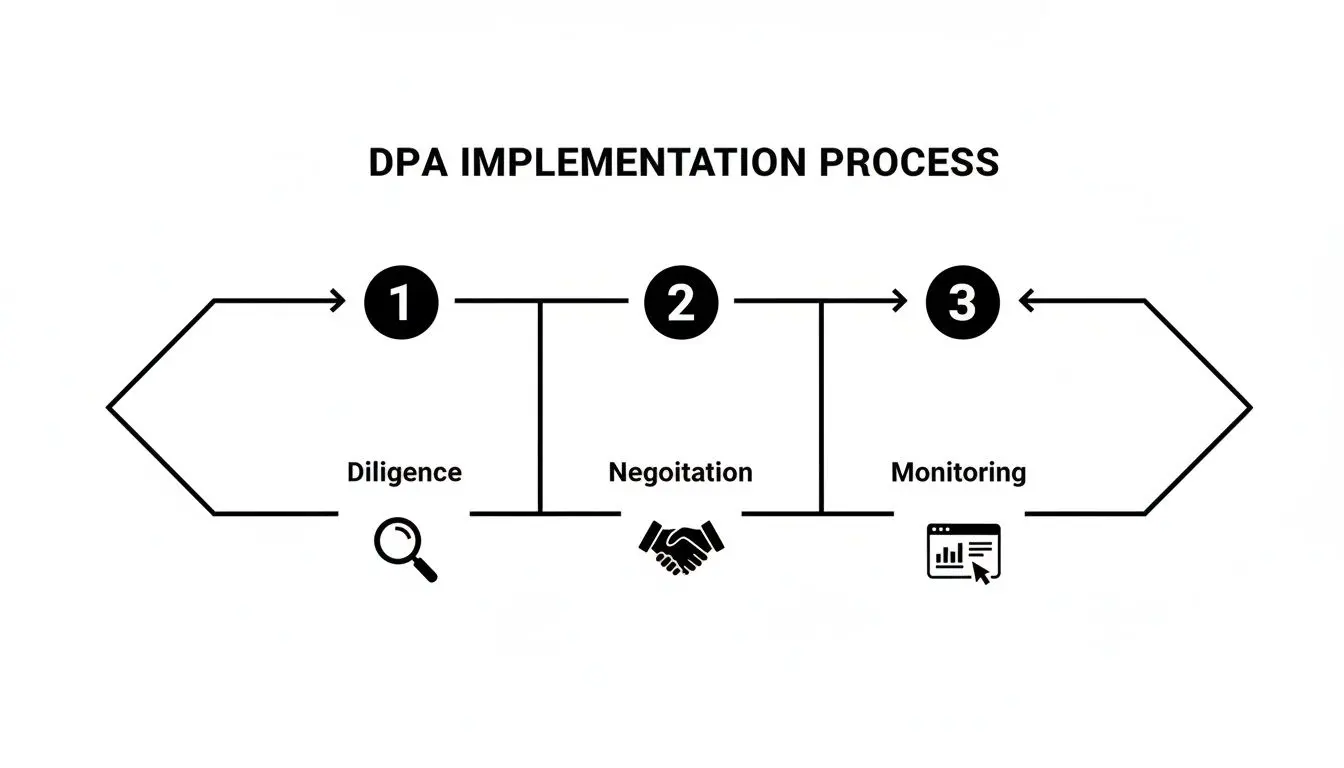
This cycle of due diligence, negotiation, and monitoring is fundamental to effective third-party risk management.
Core Principles for DPA Management
- Treat DPAs as Architectural Documents. Integrate DPA reviews into your technical due diligence and procurement processes. Ensure contractual commitments align with your system’s capabilities.
- Conduct Rigorous Due Diligence. Scrutinize every processor and sub-processor for their security posture, data transfer mechanisms, and compliance track record before signing an agreement.
- Demand Technical Specificity. Replace vague promises with clear, measurable requirements for encryption standards, data deletion timelines (e.g., within 30 days of termination), and breach notification protocols (e.g., within 24 hours of discovery).
- Implement a Lifecycle Management Process. Establish a central repository and a clear internal process for DPA reviews, approvals, and ongoing monitoring. This system must track vendor compliance and changes to their sub-processor ecosystem.
DPA Questions Answered
Here are concise answers to common questions from engineering and business leaders during vendor reviews and compliance audits.
Do We Need a DPA for Every Single Vendor?
If a vendor processes personal data on your behalf, a DPA is required. This applies not only to major cloud providers but also to analytics tools, email marketing platforms, CRMs, and customer support software.
The determining factor is whether the vendor acts as a data processor—handling personal data according to your instructions. If so, regulations like GDPR mandate a DPA. The compliance risk is independent of the vendor’s size.
What’s the Difference Between a DPA and a Master Service Agreement (MSA)?
The Master Service Agreement (MSA) governs the commercial relationship, defining terms like payment, service levels, and general obligations. The DPA is a legally required addendum focused exclusively on data protection.
While an MSA may contain a confidentiality clause, a DPA provides detailed, specific rules for handling personal data, including security measures, sub-processor management, and breach response protocols. The DPA supplements, but does not replace, the MSA.
How Often Should We Review Our DPAs?
DPAs are not static documents. Review them at least annually for all vendors. More frequent reviews are necessary when:
- A vendor updates their terms or changes their sub-processor list.
- Your use of the service changes, altering the scope of data processing.
- New data protection laws are enacted or major court rulings (like Schrems II) alter the regulatory landscape.
This is a matter of ensuring your agreements accurately reflect current operational and legal realities.
What Are the Biggest Red Flags in a Vendor’s DPA?
When reviewing a vendor’s standard DPA, be alert for clauses that shift undue risk onto your organization. Key red flags include:
- Vague Security Commitments: Language like “industry-standard security” without reference to specific, auditable controls.
- Unrestricted Sub-processor Engagement: Clauses allowing the vendor to add new sub-processors without notification or providing you a right to object.
- Ambiguous Breach Notifications: Use of phrases like “in a timely manner” instead of a concrete timeframe (e.g., within 48 hours).
- Broad Limitations of Liability: Clauses that excessively cap the processor’s financial liability in the event of a data breach caused by their negligence.
At Devisia, we believe robust agreements are the foundation of secure, compliant software. We build systems where privacy is an architectural choice, ensuring your digital products are reliable from the ground up. Learn how Devisia can help you build your next product with a product mindset.