A Warehouse Management System (WMS) is the core operational software for a modern logistics facility. It acts as the central nervous system, providing a real-time, granular view of all inventory and orchestrating every physical process—from goods-in and putaway to picking, packing, and shipping.
The Problem: Operational Chaos in Physical Inventory Management
Consider a large-scale data system operating without a database management system. Data integrity would be non-existent, retrieval would be inefficient and error-prone, and scalability would be impossible. A warehouse managed with spreadsheets or paper-based systems faces an analogous set of problems in the physical world. This approach creates a high-friction environment prone to costly failures, operational delays, and constraints on growth.
The core problem a WMS solves is imposing systemic order and verifiable accuracy on a complex physical environment.
Without a robust WMS, organisations inevitably encounter critical operational deficiencies that impact both financial performance and client satisfaction. These are not minor inconveniences but fundamental architectural flaws in the logistics process.
Key failure modes of manual warehouse management include:
- Inventory Discrepancy: A persistent mismatch between physical stock and recorded data leads to stockouts on high-velocity items and excess capital tied up in slow-moving goods.
- Inefficient Labour Allocation: Without systemic guidance, human operators spend a significant portion of their time on non-value-added activities like navigating aisles or searching for items, leading to low productivity.
- High Error Rates: Manual data entry and order picking are inherently susceptible to human error, resulting in incorrect shipments, costly reverse logistics, and erosion of customer trust.
- Suboptimal Space Utilisation: Lack of data on item velocity, dimensions, and handling requirements prevents efficient storage strategies. This leads to wasted cubic space and a disorganized, potentially unsafe, working environment.
The WMS as a Single Source of Truth
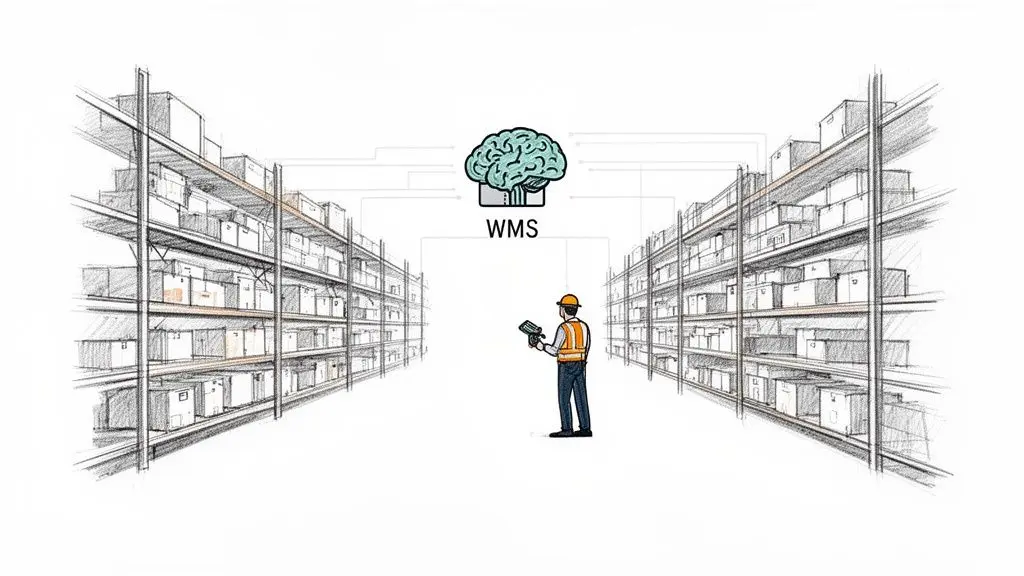
A WMS addresses these issues by establishing a single source of truth for all warehouse activities. It is not merely an inventory ledger; it is an operational control plane that orchestrates the flow of goods, equipment, and personnel. By digitising and centralising information, it coordinates every movement within the facility.
From the moment a shipment is received to the final outbound scan, the WMS directs the workflow, captures transactional data, and provides real-time feedback. This transforms the warehouse from a reactive cost center into a proactive, data-driven component of the supply chain.
Strategic Importance for the Business
Fundamentally, the purpose of a WMS is to manage complexity through systematisation. It provides the structured framework required to handle thousands of SKUs, complex order profiles, and fluctuating demand with high fidelity.
For any organization scaling its fulfilment operations, a WMS is a foundational requirement, not an optional upgrade. It provides the architectural backbone needed to increase throughput without sacrificing speed or accuracy. Implementing a WMS is a strategic decision to embed efficiency and intelligence directly into the logistics function, making it a critical investment for sustainable growth.
Understanding Core WMS Architecture and Modules
A WMS is not a monolithic application. It is a layered system architected for resilience, scalability, and granular operational control. Understanding its technical anatomy—a set of distinct, interacting layers—is key to appreciating its function. This architecture ensures a clean, auditable flow of data from an operator’s handheld device on the floor to a C-level dashboard.
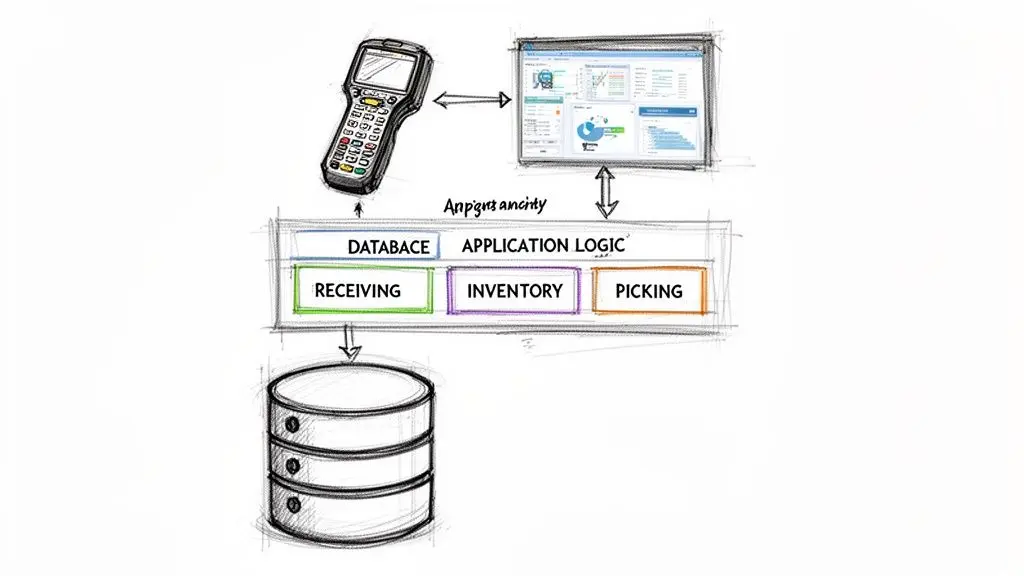
The foundation of any WMS warehouse management system is the data layer. This is typically a relational database (PostgreSQL or SQL Server) that serves as the transactional record for every inventory unit, location, order, and user action. Its primary responsibility is to enforce data integrity, as the correctness of all subsequent operations depends on it.
Above this sits the application or logic layer. This is the system’s engine, executing the core business rules, workflows, and algorithms. For example, when a new shipment arrives, this layer processes the incoming data, validates it against a purchase order, and executes a putaway algorithm to determine the optimal storage location.
Finally, the presentation layer is the interface through which users and other systems interact with the WMS. This includes the graphical UI for managers, the simplified mobile interface for floor staff, and the APIs that enable communication with ERPs or e-commerce platforms.
The Functional Building Blocks: Core WMS Modules
The application layer is composed of specialized modules, each designed to manage a discrete segment of the warehouse workflow. While feature sets vary, any enterprise-grade WMS is constructed around several core modules that provide essential operational control.
These modules are the functional heart of the system.
-
Receiving and Putaway: This module governs inbound logistics. It directs staff on where to place incoming goods based on configurable rules such as item velocity, dimensions, weight, or special handling requirements (e.g., cold chain). A naive implementation might use a simple “first available” logic; a sophisticated WMS optimizes this process to reduce future picking travel time.
-
Inventory Management: This is the system’s central ledger. It provides a real-time, high-fidelity view of every item, tracking not just quantity and location but also attributes like batch numbers, serial numbers, and expiration dates. This module also facilitates cycle counting, enabling continuous inventory verification and eliminating the need for disruptive, full-scale physical stocktakes.
-
Order Picking and Packing: Once an order is received, this module orchestrates the fulfilment process. It generates optimized pick lists and directs operators along the most efficient travel paths. It supports various picking methodologies, such as batch, zone, or wave picking, to maximize throughput and minimize order cycle time.
-
Shipping and Logistics: This module manages the final stages of dispatch. It handles the generation of shipping labels, validates packing accuracy, and integrates with a transportation management system (TMS) to coordinate carrier pickup and shipment tracking. It provides the final link in the outbound supply chain.
The table below maps these software modules to their direct business impact, translating technical functions into measurable operational improvements.
Core WMS Modules and Their Business Impact
| WMS Module | Primary Function | Key Business Impact |
|---|---|---|
| Receiving & Putaway | Manages inbound stock and directs its placement into optimal storage locations based on velocity, size, and other attributes. | Increases storage density by up to 20%, reduces time to make inventory available for sale, and minimises damage by ensuring proper handling. |
| Inventory Management | Provides real-time, accurate tracking of all stock levels, locations, and attributes (e.g., lot numbers, expiration dates). | Achieves 99%+ inventory accuracy, reducing stockouts and overstock situations, thereby improving cash flow and customer satisfaction. |
| Order Picking & Packing | Optimises the process of retrieving items from storage to fulfil customer orders and prepares them for shipment. | Boosts labour productivity by 25-40% through optimised pick paths and picking strategies, while reducing order errors significantly. |
| Shipping & Logistics | Coordinates the final packing, labelling, and dispatch of orders, often integrating with carrier and transportation systems. | Improves on-time shipping rates, reduces shipping costs through carrier selection, and provides end-to-end order traceability for customers. |
These modules are not standalone features; they are interconnected components that work in concert to impose logic and control on the inherently dynamic warehouse environment.
A WMS is fundamentally an orchestration engine. Its modules are not isolated features but interconnected components designed to impose logic, order, and efficiency on the inherently complex and chaotic environment of a warehouse. Without this structure, scaling operations becomes nearly impossible.
Architectural Decision: Custom vs. Off-The-Shelf WMS
A critical architectural decision for any CTO or Head of Operations is whether to license an off-the-shelf (OTS) WMS or invest in a custom-built solution. This is not merely a technical choice but a strategic one with long-term implications for operational agility, total cost of ownership (TCO), and competitive differentiation. A superficial analysis at this stage often leads to significant downstream costs and operational friction.
The correct path depends on business context, operational complexity, and long-term strategic goals.
The Case for an Off-The-Shelf WMS
For many organizations with standard warehousing requirements, an OTS solution represents the most pragmatic approach. These systems are productized solutions designed to address common industry workflows, offering a well-defined feature set and a faster path to implementation.
The primary advantages are:
- Rapid Deployment: An OTS WMS can often be implemented in months, not years, enabling a faster response to scaling needs.
- Lower Initial Capital Outlay: Licensing a pre-built product avoids the significant upfront investment required for a ground-up software development project.
- Predictable Functionality: The system’s capabilities are known and documented, reducing the risk of functional gaps for standard operations.
However, these benefits come with significant trade-offs. The primary risk is being forced to adapt business processes to the rigid workflows of the software. This can stifle process innovation and introduce operational inefficiencies. Vendor lock-in is another material risk; migrating away from a deeply integrated OTS system can be technically complex and costly.
When to Build a Custom WMS
A custom WMS is the logical choice when warehousing operations are a core source of competitive advantage, involve unique or complex processes, or require a high degree of flexibility. If your fulfilment process is your “secret sauce”—perhaps involving specialized kitting, value-added services, or unique regulatory constraints—an OTS system will likely act as a constraint on the business.
For businesses planning for scale, the choice of deployment model has major infrastructure implications. We explore this in our analysis of cloud computing vs on-premise architectures.
A custom WMS is an investment in your operational independence. It lets you build a system that is a perfect digital twin of your ideal workflow, not a clunky approximation dictated by a software vendor.
Building a proprietary solution offers distinct advantages:
- Process-Centric Design: The system is architected around your specific operational model, optimizing every workflow for maximum efficiency and eliminating the need for awkward workarounds.
- Sustainable Competitive Advantage: A bespoke WMS can enable unique service offerings that competitors using generic software cannot easily replicate, transforming the warehouse from a cost center to a strategic asset.
- Architectural Flexibility and Scalability: The system is designed from the outset to support your specific growth trajectory and can be adapted to future business pivots without being constrained by a third-party vendor’s product roadmap.
The custom path requires a greater commitment of resources. The upfront investment is substantial, and it necessitates a skilled engineering team, whether in-house or through a partner. The risks of budget overruns and timeline extensions are real but can be mitigated through disciplined, agile delivery methodologies. The decision ultimately hinges on whether the warehouse is a utility function or a strategic driver of business value.
WMS Integration Patterns and Data Architecture
A WMS delivers maximum value when it operates not as an informational silo, but as an integrated component of the broader enterprise technology stack. While a standalone wms warehouse management system can optimize internal warehouse processes, its strategic value is amplified when it shares data seamlessly with other core business systems. This integration transforms warehouse data into actionable business intelligence.
Without robust integration, you create data islands. A highly efficient warehouse is of limited value if its data is not available to finance, procurement, or customer service in a timely manner. The objective is to establish clean, reliable data pipelines that ensure all business functions are operating from a consistent and current dataset.
Critical Integration Points in the Tech Stack
To create a resilient and responsive supply chain, a WMS must establish well-defined communication channels with several key systems. Each integration serves a distinct business purpose, and a failure in any one of these pipelines can introduce significant operational friction.
The most critical integration partners for a WMS are:
- Enterprise Resource Planning (ERP): This is the primary integration. The ERP serves as the company’s financial system of record and requires real-time inventory valuation, goods receipt confirmations, and shipment data from the WMS to manage procurement, accounting, and overall financial reporting.
- Transportation Management System (TMS): After an order is picked and packed, the WMS passes the baton to the TMS. It transmits package weight, dimensions, and destination data, which the TMS uses to optimize carrier selection, generate shipping labels, and provide tracking information.
- Warehouse Control System (WCS): In automated facilities, the WCS acts as the real-time interface to material handling equipment like conveyors, sorters, and robotics. The WMS provides high-level directives (e.g., “move pallet X to location Y”), and the WCS translates these into low-level commands for the hardware.
The diagram below illustrates the trade-offs between building custom integrations versus configuring pre-built connectors in an OTS product.
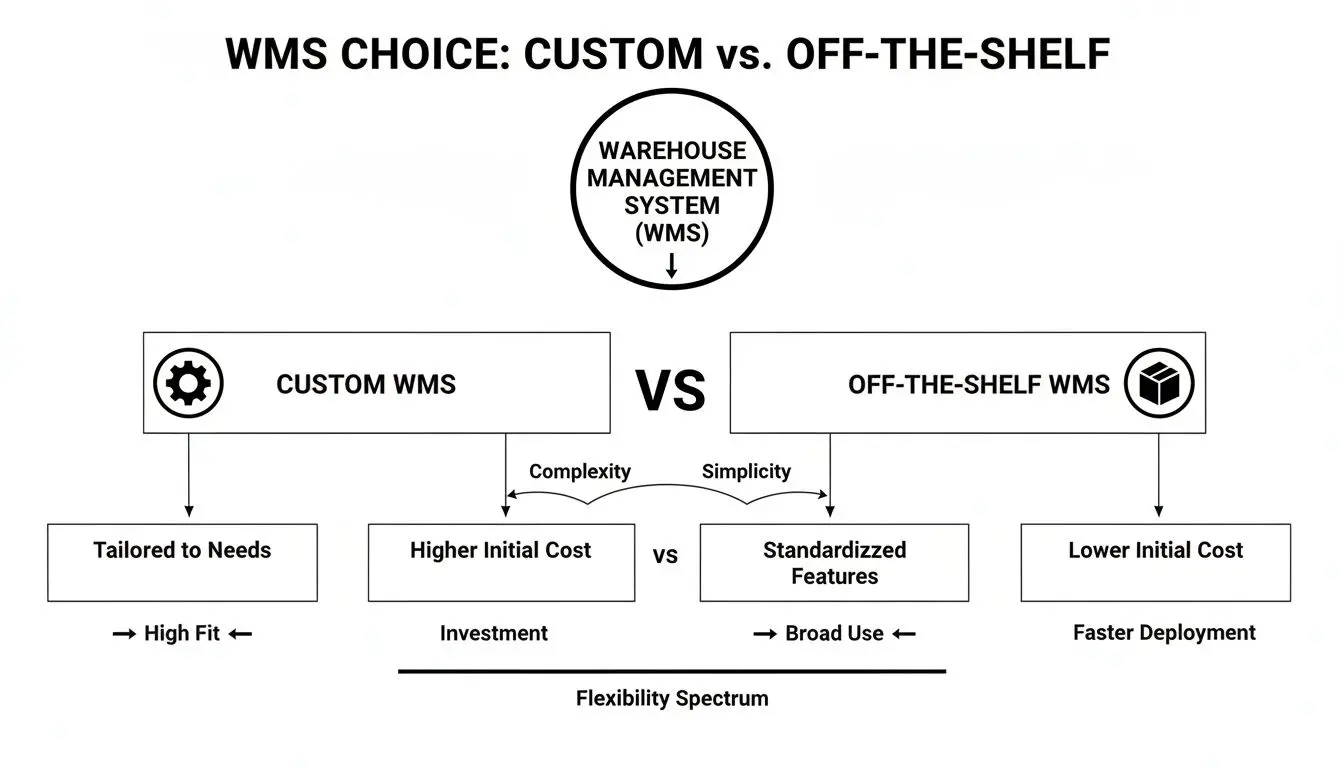
The choice reflects a classic build-vs-buy trade-off: custom development offers perfectly tailored integrations at a higher initial cost, while OTS connectors provide faster implementation but may lack the flexibility to support unique business processes.
Architectural Patterns for Data Synchronisation
Selecting the appropriate data exchange mechanism is a critical architectural decision that directly impacts system performance, data latency, and operational responsiveness. A naive approach, such as nightly batch file transfers, introduces data lags and integrity risks that are unacceptable in a modern fulfilment operation.
The most common architectural mistake in WMS integration is failing to match the synchronisation method to the operational need. Not every data flow requires millisecond-level updates; over-engineering for real-time everywhere adds unnecessary complexity and cost.
Two primary patterns dominate modern WMS integration:
- API-Led Integration (Synchronous/Real-Time): This is the prevailing standard for time-sensitive data exchange. Systems communicate directly via REST or GraphQL APIs. For example, when an item is picked, an API call can instantly decrement inventory levels in both the WMS and an e-commerce platform, preventing overselling. This pattern requires careful management of API rate limits, latency, and network reliability.
- Message Queues (Asynchronous): For processes that can tolerate minor delays, message-oriented middleware (e.g., RabbitMQ, AWS SQS) provides a more resilient and decoupled architecture. The WMS can publish a “shipment complete” message to a queue, which the TMS can consume when it is ready. This prevents a slowdown or failure in one system from directly impacting the other. For a deeper dive, read our guide on modern IT system integration.
The demand for this level of integrated, intelligent warehousing is growing rapidly. The North American WMS market is projected to reach USD 10.89 billion by 2031. This growth is primarily fueled by cloud-based systems that facilitate these complex integrations and provide a single source of truth, which can improve fulfilment accuracy by up to 30%. More trends can be found at Mordor Intelligence.
Ultimately, successful integration is not just a technical exercise. It is about architecting a digital nervous system that enables the entire organization to react faster, make more informed decisions, and deliver a superior customer experience.
Applying AI and Automation within the WMS
Beyond the marketing hype, AI and automation in a WMS context refer to practical, data-driven tools designed to solve specific operational challenges. These technologies are not about futuristic, fully autonomous warehouses but about augmenting human decision-making and optimizing complex logistical variables at a scale beyond human capability.

The adoption of intelligent warehousing is accelerating. In Europe, a hub for logistics innovation, the WMS market is projected to grow at a 21.9% CAGR, reaching USD 15.95 billion by 2033. This expansion is driven by cloud platforms that enable the integration of machine learning models, which have demonstrated the ability to increase order accuracy by 25-30%.
Furthermore, for organizations with robust AI governance, Europe’s stringent data privacy regulations like GDPR align well with human-in-the-loop control systems, potentially reducing operational risks by up to 40%. Additional data is available in the latest Grand View Research analysis.
Practical AI Use Cases with Clear ROI
Effective AI implementation focuses on augmenting human operators, not replacing them. Successful deployments target tasks where algorithms can process vast datasets far more efficiently than human analysis allows. These models integrate directly with the WMS warehouse management system to drive more intelligent, automated workflows.
Concrete examples include:
- Predictive Slotting: Machine learning models analyze historical sales data, seasonality, and order profiles to forecast SKU velocity. The WMS uses these predictions to dynamically re-slot inventory, moving high-demand items to the most accessible pick faces. This optimization directly reduces picker travel time and accelerates order fulfilment.
- Optimised Picking Paths: Pathfinding algorithms calculate the most efficient route for an operator to fulfil a batch of orders. This goes beyond simple A-to-B navigation, considering real-time constraints like aisle congestion, equipment availability, and item weight to minimize cycle time for each pick tour.
- Demand Forecasting: By analyzing historical trends and external factors, AI-powered models can predict future inventory requirements with greater accuracy than traditional methods. This allows for more precise procurement, reducing both the risk of stockouts and the capital cost of carrying excess inventory.
A core principle of successful implementation is maintaining a human-in-the-loop. AI is excellent at generating recommendations for slotting or purchasing, but the final strategic decision should reside with an experienced manager who understands the broader business context.
The Impact of Large Language Models (LLMs)
More recently, Large Language Models (LLMs) are enabling new interaction paradigms for WMS users. Instead of navigating complex dashboards or building custom reports, managers can use natural language to query the system’s data.
For example, a warehouse manager could ask:
“Identify the 10 slowest-moving SKUs in Zone C by inventory value for Q3, and compare this to their value in Q2.”
An LLM integrated with the WMS database can parse this query, retrieve the relevant data, and present a concise, synthesized answer. This significantly reduces the time between a business question and a data-driven insight, a key aspect of the ongoing digital retail transformation.
Of course, production deployment requires robust governance to manage costs, ensure data privacy, and validate the accuracy and determinism of the LLM’s responses.
WMS Implementation Roadmap and Pitfall Avoidance
Implementing a warehouse management system is not merely a software installation; it is a fundamental re-engineering of core business processes. A successful deployment depends on a disciplined, phased roadmap that anticipates and mitigates risks. An ad-hoc approach is a direct path to budget overruns, operational disruption, and a system that fails to deliver its intended value.
A structured, phased project plan provides clarity, accountability, and prevents scope creep. This framework is not about rigidity but about creating a predictable path to a successful outcome.
Phase 1: Discovery and Process Mapping
Before any discussion of vendors or technology, a thorough and honest assessment of the current state is required. This phase involves meticulously mapping every existing warehouse process, from receiving to shipping. The goal is to identify every manual touchpoint, workaround, and operational bottleneck.
This exercise produces a detailed blueprint of your as-is operations. It invariably uncovers latent inefficiencies and forms the non-negotiable foundation for your system requirements. Skipping this step is a classic error that leads to implementing a WMS that solves the wrong problems.
This phase must answer critical questions:
- Which manual processes have the highest error rates?
- Where are the most significant time sinks for operational staff?
- What critical operational data is currently unavailable or unreliable?
Phase 2: Requirements Gathering and Vendor Selection
With a clear process map, you can begin to define the functional and non-functional requirements for the future WMS. This involves translating operational pain points into specific system capabilities. Functional requirements define what the system must do (e.g., “support batch picking of up to 100 orders”). Non-functional requirements define how well it must perform (e.g., “maintain 99.9% uptime during operational hours”).
This detailed requirements document becomes the primary tool for evaluating vendors or scoping a custom build. It ensures you are conducting a like-for-like comparison based on your specific needs, not a vendor’s marketing materials.
Underestimating the change management component of a WMS implementation is the single biggest predictor of failure. The technology is only half the equation; preparing the organization and its people for new workflows is the other, more critical half.
Phase 3: Data Migration and System Configuration
This is the implementation phase and carries significant risk. Migrating data from legacy systems or unstructured spreadsheets into a normalized WMS database is a complex task. The cardinal rule is non-negotiable: cleanse all data prior to migration. Introducing inaccurate, incomplete, or duplicate data into a new system will cripple it from day one.
Concurrently, the WMS is configured to reflect the workflows defined in Phase 1. This involves setting up the warehouse layout, user roles, picking strategies, and integration endpoints. This stage requires close collaboration between the operational team and the technical implementers to ensure the digital model accurately reflects the physical reality of the warehouse floor.
Common pitfalls to avoid include:
- Insufficient Data Cleansing: Migrating “dirty” data contaminates the new system, erodes user trust, and causes a cascade of operational errors.
- Inadequate User Training: Training must be role-specific, hands-on, and focused on the “why” behind the new processes, not just the “how.” Without proper adoption, staff will revert to old, inefficient habits.
- Poor Stakeholder Communication: Maintain a regular cadence of communication with all stakeholders, from floor staff to the C-suite, regarding progress, challenges, and upcoming changes. Lack of transparency breeds resistance.
By following a structured roadmap and proactively addressing these common challenges, you can navigate the complexities of a WMS implementation and deliver a system that generates lasting operational value.
Common Questions About WMS Systems
When evaluating a WMS, several key questions consistently arise from business and technical leaders. Here are concise, pragmatic answers.
How Long Does a WMS Implementation Really Take?
There is no single answer, but a realistic timeframe can be established based on complexity. A standard, off-the-shelf cloud WMS for a single, small-to-medium-sized warehouse can typically be implemented in 3 to 6 months.
However, a custom-built system with deep integrations into an ERP, TMS, and potentially MHE/robotics across multiple facilities should be planned as a 12 to 18-month project, or longer.
The primary drivers of the timeline are often not technical but operational:
- Data Cleansing: Preparing clean, accurate, and complete product and inventory data for migration is frequently the most underestimated and time-consuming task.
- Process Definition: Gaining consensus and clearly documenting future-state workflows before configuration begins is critical to avoiding costly rework.
- Change Management: The human element—training users, driving adoption, and managing the transition—is a significant variable and cannot be rushed.
What Is the Typical ROI for a WMS?
Most organizations realize a return on their WMS investment within 18 to 24 months. The ROI is a composite of multiple measurable improvements. For instance, labor productivity often increases by 20-30% due to optimized travel paths and system-directed work.
Inventory accuracy improvements, often reaching 99%+, directly reduce the carrying costs of excess stock, the expense of emergency replenishments, and lost revenue from stockouts. Furthermore, improved order accuracy and faster fulfilment times enhance customer retention, a benefit that compounds over time.
A common mistake is to calculate ROI based solely on direct cost savings. Significant value also derives from indirect gains: improved customer satisfaction, reduced operational risk, and the ability to scale fulfilment volume without a linear increase in headcount.
Can a WMS Integrate With My Existing Systems?
Yes. Integration is a core, non-negotiable function of any modern WMS. The system is designed to act as the operational hub for the warehouse, connecting to other enterprise platforms via APIs and established data exchange protocols.
Standard integrations include connecting to an ERP for financial and master data, an e-commerce platform for order ingestion, and a Transportation Management System (TMS) for coordinating outbound logistics.
At Devisia, we architect and build robust, maintainable software systems that solve complex operational challenges. If your workflows are too unique for an off-the-shelf product, we can help you design and build a custom WMS architecture that becomes a genuine competitive advantage. Learn more at https://www.devisia.pro.