
Digital retail transformation is more than a new e-commerce site or a mobile app. It is the fundamental re-architecting of operations, technology, and data strategy to meet modern customer expectations. The core challenge is not a lack of digital channels, but the architectural debt of legacy systems.
For many retailers, point-of-sale (POS), order management (OMS), and customer relationship management (CRM) systems operate in isolated silos. These monolithic platforms are brittle, expensive to maintain, and cannot deliver the seamless, omnichannel experiences customers now demand. Attempts to add modern features, such as real-time inventory visibility or AI-powered recommendations, often result in complex, high-risk integration projects. This gap creates tangible friction—a product visible online is unavailable in-store, or a loyalty status from an app is not recognised at checkout. These disconnects erode trust and drive customers to competitors.
A superficial approach of bolting on new digital tools only adds complexity and cost without addressing the root problem: a fragmented and inflexible architecture.
Defining Digital Transformation Beyond the Buzzwords
The primary obstacle to meaningful transformation is architectural debt. Legacy systems operate as independent silos, making it impossible to create a unified view of the business or the customer. These monolithic platforms are rigid, expensive to maintain, and incapable of supporting the seamless omnichannel experiences that are now standard expectations. Any attempt to add a modern feature, like real-time inventory visibility or an AI-powered recommendation engine, becomes a high-risk integration project.
This architectural friction creates a clear experience gap. A customer sees a product online but cannot locate it in-store. Their loyalty status is recognised in the app but not at the checkout counter. These disconnects erode trust and send customers to competitors who have engineered a more coherent experience. The common temptation is to layer new digital tools on top of the old foundation, but this superficial approach only increases complexity and technical debt without solving the core issue.
The Shift to a Modular Architecture
A genuine digital retail transformation requires moving from a rigid, siloed model to a modular, API-first architecture. This approach treats core business functions—inventory, payments, customer profiles—as independent, interchangeable services connected by well-defined APIs. This design philosophy is about building for change. Instead of a single, inflexible system, you have a collection of specialised services that communicate programmatically.
This model provides distinct advantages:
- Flexibility: New customer touchpoints—a mobile app, an in-store kiosk, or an AR experience—can be developed and connected without disrupting core operations.
- Scalability: Individual services can be scaled independently to meet demand. A promotions engine can handle a Black Friday surge without requiring the entire e-commerce platform to be scaled.
- Maintainability: Small, decoupled services are easier for engineering teams to update, debug, and improve, enabling faster feature delivery.
The following table contrasts the legacy approach with the modern, modular solution.
Core Pillars of Modern Retail Transformation
| Pillar | Legacy Approach (The Problem) | Modern Approach (The Solution) |
|---|---|---|
| Architecture | Monolithic, all-in-one systems. Rigid and hard to change. | Modular, API-first services. Flexible and built for change. |
| Data | Siloed in separate systems (POS, CRM, etc.). Inconsistent and unreliable. | Unified into a single source of truth. Accessible and consistent everywhere. |
| Customer View | Fragmented. In-store and online customer profiles are separate. | 360-degree view. One customer identity across all channels. |
| Innovation | Slow and risky. A small change can break the entire system. | Fast and iterative. New features are added by connecting new services. |
| Operations | Channel-specific. Separate teams and processes for online vs. offline. | Omnichannel. Integrated operations for a seamless customer journey. |
A pragmatic transformation is not a high-risk “big bang” overhaul. It is an engineering-led initiative focused on incrementally decoupling systems to unify data, introduce new capabilities, and build a resilient foundation for future growth. By prioritising a modern architecture, retailers can connect disparate systems, establish a single source of truth for their data, and introduce advanced features without compromising stability. This engineering-first perspective establishes security, scalability, and maintainability as the non-negotiable pillars of a transformation that delivers lasting business value.
The Architectural Blueprint for Modern Retail
A successful digital retail transformation is an engineering challenge, not a procurement one. The primary source of architectural debt is monolithic, tightly-coupled systems that prevent adaptation to new customer demands. The solution is a deliberate move towards a decoupled, API-first architecture designed for resilience and change. This blueprint begins by separating the customer-facing presentation layer (the “head”) from the backend business logic and data systems—the core principle of headless commerce.
By decoupling these layers, engineering teams can rapidly build and launch new customer touchpoints, such as a progressive web app, an in-store kiosk, or an augmented reality shopping experience, without modifying or risking the stability of core backend systems.
Embracing a Headless and API-First Philosophy
In a headless architecture, all components communicate through well-documented Application Programming Interfaces (APIs). This API-first design treats every core function—product information, inventory levels, customer profiles, order processing—as a distinct, accessible service. APIs become the connective tissue of the entire operation, enabling seamless integration between internal systems and third-party services like payment gateways, shipping providers, and analytics platforms.
This modularity is a significant departure from legacy systems where components are rigidly intertwined, and a change in one area often causes failures elsewhere. An API-first approach enforces discipline and clarity, requiring systems to be designed for interoperability from day one. This prevents the creation of new data silos and makes future integrations dramatically less complex and costly. This architectural shift is a pragmatic choice for long-term operational health, allowing a business to replace or upgrade individual components, such as a Product Information Management (PIM) system, without a domino effect of failures across the technology stack.
From Monoliths to Microservices
To fully realise the benefits of a decoupled architecture, many retailers are breaking down monolithic applications into a microservices model. Instead of one large, complex application, a microservices architecture is a collection of small, independently deployable services. Each service is responsible for a single business capability and can be developed, tested, and scaled on its own.
- Improved Resilience: If a promotions service experiences an issue, it does not bring down the entire e-commerce platform. Critical functions like checkout and inventory management continue to operate.
- Enhanced Scalability: During a sales event, only the necessary services, such as order processing and inventory, need to be scaled to handle the load, avoiding the cost of scaling the entire system.
- Faster Development Cycles: Small, focused teams can work on different services in parallel, shipping new features and updates more quickly. This incremental approach is far less risky than deploying changes to a monolithic codebase. You can find more details on this approach in our guide to service-oriented architecture.
The diagram below illustrates this shift from a siloed legacy architecture to a modern, interconnected ecosystem.
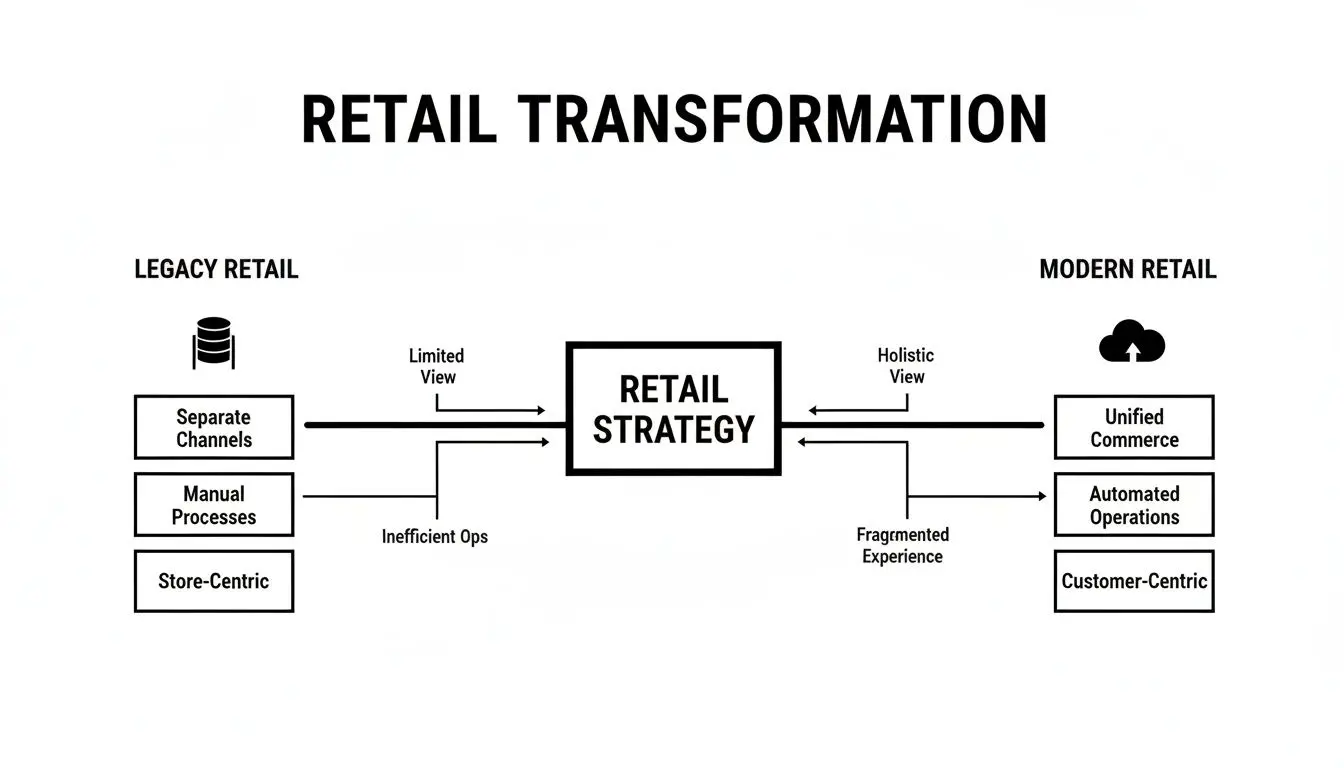
This visual represents how a modern retail architecture uses APIs to break down isolated data silos, creating a unified, cloud-based system where data flows freely between core functions.
Balancing Custom Development and Off-the-Shelf Solutions
Adopting this blueprint does not require an all-or-nothing approach. A fully custom-built microservices architecture offers maximum flexibility but demands significant engineering investment and operational overhead. Conversely, relying solely on off-the-shelf SaaS products can lead to vendor lock-in and functional limitations.
The most practical path is often a hybrid model. Core, differentiating business logic may be developed as custom microservices. Commodity functions, such as payment processing or content management, can be handled by best-in-class third-party solutions, all connected via APIs. This strategic balance allows retailers to focus their engineering talent where it creates the most competitive advantage, building a technology stack that is both powerful and maintainable. For CTOs and IT managers, the goal is to architect a system that serves the business without creating unmanageable complexity.
Integrating AI and Data Analytics for Intelligent Operations
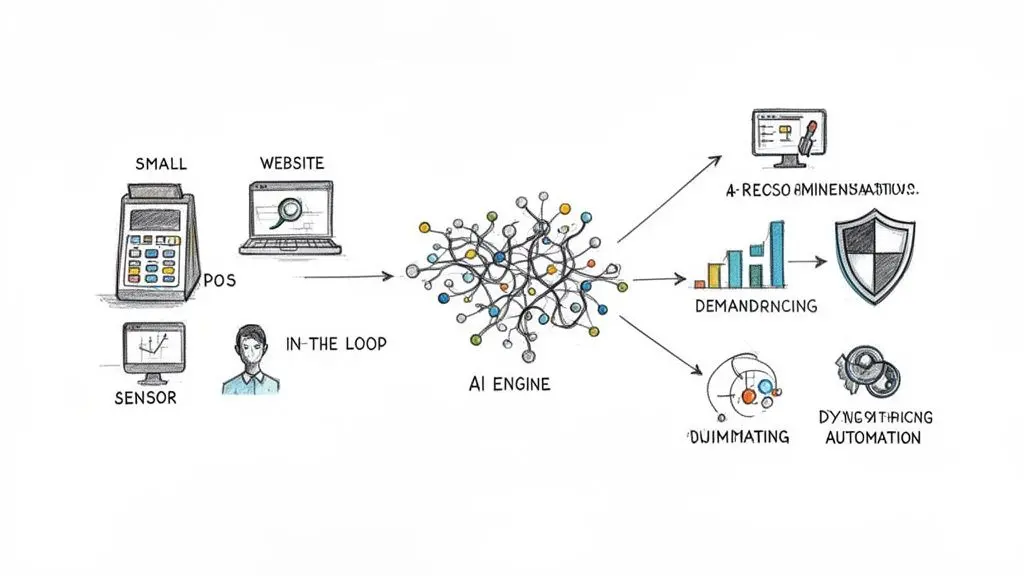
A modern, decoupled architecture provides the foundation for a solid digital retail transformation, but the intelligent layer built upon it creates a true competitive advantage. Merely collecting data is insufficient. The value lies in using artificial intelligence and advanced analytics to turn raw data into automated, intelligent actions that drive efficiency and revenue. This means moving beyond vague claims of ‘personalisation’ to build specific systems that solve concrete business problems.
This shift is accelerating globally. In the Asia Pacific region, for example, significant investments in cloud and AI are driving retail innovation. Cloud platforms accounted for 36.72% of digital transformation spending in retail in 2023, providing the scalable infrastructure for data lakes and AI services that have improved demand forecasting by as much as 30%. This trend is part of a market projected to reach USD 535.94 billion by 2031. You can find additional insights into the retail transformation market to explore the data further.
From Raw Data to Actionable Intelligence
The first step is building a robust data pipeline that consolidates information from previously siloed systems, creating the single source of truth required to power any intelligent application.
Once data is unified, AI can be implemented for high-value use cases:
- AI-Powered Demand Forecasting: Machine learning models can analyse numerous variables—seasonality, competitor pricing, local events, weather patterns—to predict demand with greater accuracy than historical sales data alone. This reduces costly overstocking and stockouts.
- Dynamic Pricing Engines: These systems automatically adjust product prices in real-time based on market conditions, competitor actions, inventory levels, and demand signals, allowing retailers to maximise margins without constant manual intervention.
- Hyper-Personalised Recommendations: Modern systems use embeddings and vector search to represent products and user preferences as complex mathematical vectors. This enables the system to understand nuanced, conceptual relationships and recommend items that are genuinely similar, not just frequently purchased together.
Automating Operations with Intelligent Agents
Beyond customer-facing features, AI agents can automate routine internal tasks, freeing up teams for more complex, strategic work. These agents, often powered by Large Language Models (LLMs) connected via APIs, can be configured to handle specific workflows. For example, an AI agent could manage initial customer service inquiries, resolving common issues like order status lookups. Another could be tasked with real-time fraud detection, flagging suspicious transactions based on patterns a human would likely miss. You can learn more about how data powers these systems in our guide to business analytics software.
Implementing AI is about augmenting human decision-making, not replacing it. The most effective systems use a human-in-the-loop control pattern, where the AI handles the bulk of the work but escalates critical or ambiguous decisions to a human operator for final approval.
Avoiding the Pitfalls of Naive AI Adoption
Integrating AI into operations introduces significant technical and operational risks if not managed carefully. A naive approach that treats AI as a “black box” can lead to uncontrolled costs, compliance issues, and unreliable performance.
Effective implementation requires a strong governance framework and deep technical oversight:
- Cost and Performance Observability: API calls to LLMs can become expensive quickly. It is essential to have observability tools to monitor usage, along with technical controls like rate limits and caching to manage costs without degrading performance.
- Privacy by Design: AI models, particularly those handling customer data, must be designed with privacy as a core architectural principle. This includes data minimisation and anonymisation techniques to ensure compliance with regulations like GDPR.
- Reliability and Fallbacks: AI systems can fail or produce unexpected outputs. A robust implementation must include fallback logic. If an AI service is unavailable or returns an error, the system should gracefully degrade to a simpler, deterministic workflow.
This pragmatic, engineering-led approach ensures that AI systems are not only powerful but also reliable, cost-effective, and secure, turning AI into a core component of a resilient digital retail transformation strategy.
A Phased Roadmap for Incremental Transformation
The prospect of a complete digital retail transformation can seem overwhelming, often leading to high-risk, “rip and replace” projects that are delayed for years. This “big bang” approach is frequently plagued by escalating costs, extended timelines, and significant operational disruption. A more pragmatic strategy involves breaking the transformation into logical, incremental phases.
This approach de-risks the entire initiative. Each stage is designed to deliver measurable business value, build momentum, and create a stable foundation for subsequent steps. Instead of a single, monolithic project, the transformation becomes a series of manageable, value-driven milestones.
Phase 1: Establish a Solid Data Foundation
Before building advanced features, the underlying data problem must be solved. Most retailers have customer and product data scattered across disconnected POS, CRM, and e-commerce systems. The initial task is to consolidate it.
Key actions in this phase include:
- Data Source Auditing: Map every system that holds customer, order, and product data.
- Centralised Data Storage: Implement a central data lake or warehouse to serve as the single hub for all information.
- ETL Pipeline Development: Build robust Extract, Transform, Load (ETL) pipelines to automatically pull, clean, and standardise data as it flows into the central repository.
The sole objective here is to create a single source of truth. Success is measured not by new customer-facing features but by internal metrics, such as a reduction in data discrepancies or faster generation of accurate reports. This foundational work is non-negotiable.
Phase 2: Decouple the Frontend Experience
With a unified data layer in place, the rigid link between backend systems and the customer-facing experience can be broken. This phase focuses on implementing the core components of a headless architecture, providing the freedom to innovate on the user experience without modifying core business logic.
This typically involves two key technical projects:
- Headless CMS Implementation: Adopt a content management system that delivers content via an API, completely separating it from the frontend presentation code. This allows marketing teams to manage content without depending on development cycles.
- API Gateway Deployment: Introduce an API gateway to act as a secure and managed entry point for all backend services. This simplifies how frontend applications access data and ensures security.
The primary key performance indicator (KPI) for this phase is development velocity. A successful decoupling should result in a measurable decrease in the time required to launch new features or update a user interface.
Phase 3: Introduce Intelligent Services
With a solid data and architectural foundation, high-value, AI-driven capabilities can be layered in. Because the systems are now decoupled, these new intelligent services can be integrated as modular components rather than being hardwired into a monolithic application.
Effective starting points for AI often include:
- AI-Powered Search: Replace a basic keyword search with a semantic search engine that understands user intent.
- Personalised Recommendations: Use the unified customer data from Phase 1 to power a recommendation engine that delivers relevant product suggestions.
This incremental approach to AI allows for testing, measuring, and refining models on specific business problems without significant risk. The global trend is clear. India, for example, is set to become a major force in retail transformation, with 61.75% of deployments using the cloud to power such advanced capabilities. Since 2020, 97% of firms there have accelerated their digital plans, using cloud-native POS to achieve efficiency gains of 20-30%. You can explore more data on how cloud adoption is fueling retail growth.
By following this phased roadmap, a daunting transformation becomes a logical and predictable progression of value-driven milestones.
Navigating Compliance, Security, and Governance
A genuine digital retail transformation is an exercise in risk management. As retail systems become more distributed and data-driven, the attack surface for cyber threats and compliance failures expands. A reactive security posture is insufficient. Robust security and compliance must be foundational architectural choices, integrated into every system from the outset. This proactive approach is essential for building customer trust and avoiding the significant financial and reputational damage of a data breach or regulatory fine.
Embracing Privacy by Design
Modern data protection regulations, particularly GDPR, mandate a privacy-by-design approach. This principle requires that data protection be considered at the beginning of any system design process, not as an afterthought. For technical leaders, this translates into concrete architectural requirements.
This means building systems that are inherently secure. Key practices include:
- Data Minimisation: Architect systems to collect and process only the data that is absolutely necessary for a specific, defined purpose. If a feature does not require a piece of personal information, the system should not capture it.
- Encryption Everywhere: All sensitive data must be encrypted both at rest (in databases) and in transit (as it moves between services).
- Secure Data Handling: Implement clear, automated protocols for data retention, anonymisation, and deletion to ensure data is not held longer than necessary and user requests can be properly handled.
Privacy is an architectural choice, not a feature. Designing systems that inherently limit data exposure is far more effective and less costly than attempting to patch privacy vulnerabilities after a product has been built. To explore this concept further, you can read more about implementing privacy by design and by default in our detailed guide.
Securing a Distributed, API-Driven Architecture
In a modern, headless retail architecture, APIs are the primary gateways for data exchange, making them a prime target. Inadequate API security is a significant vulnerability.
Effective API security involves multiple layers of protection:
- Authentication: Verify the identity of the user or service making a request. OAuth 2.0 is the industry-standard protocol for secure access without sharing credentials.
- Authorisation: Once identity is confirmed, ensure the user has the necessary permissions to perform the requested action. This prevents legitimate users from accessing data they should not be able to see.
- Rate Limiting and Throttling: Implement strict controls on the number of requests a single user or IP address can make in a given period. This is a primary defence against denial-of-service (DoS) attacks and data scraping bots.
Preparing for Evolving Regulations
The regulatory landscape is constantly changing. For compliance and IT managers, new directives like NIS2 and the Digital Operational Resilience Act (DORA) are raising the standards for cybersecurity and operational resilience. While the specifics of each regulation vary, the core principles are consistent. They demand a proactive, not reactive, security posture.
This requires building:
- Resilient Systems: Architecting systems that can withstand and recover from disruptions.
- Incident Reporting: Establishing clear protocols for timely reporting of security incidents to the appropriate authorities.
- Third-Party Risk Management: Vetting and continuously monitoring the security of all third-party vendors and partners.
A superficial approach, such as running a vulnerability scan once a quarter, is dangerously inadequate. True governance requires continuous monitoring, regular threat modelling, and a holistic understanding of the entire technology ecosystem.
Bringing Transformation to Life: A Real-World Walkthrough
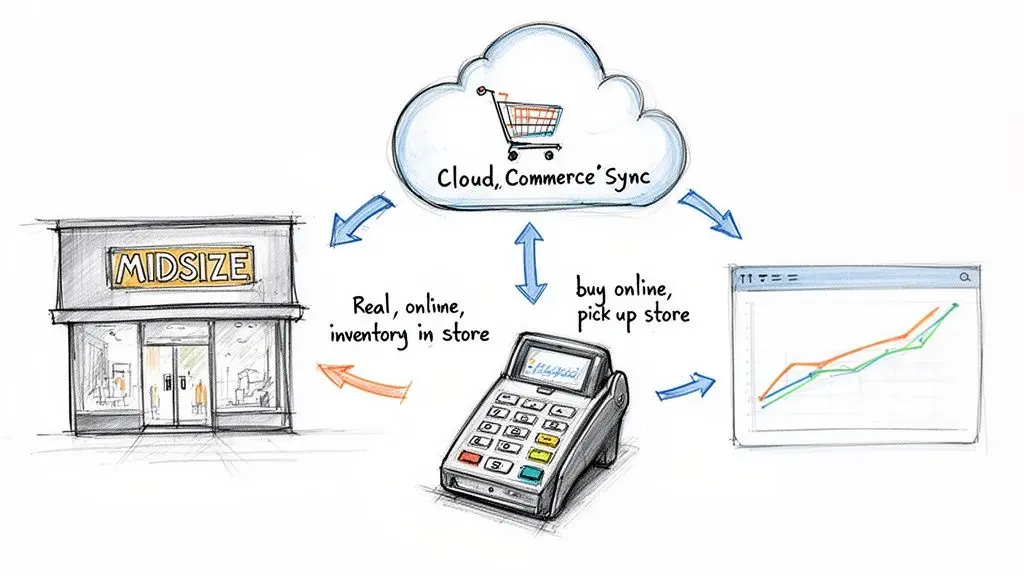
To make these concepts tangible, let’s walk through a practical implementation for a hypothetical midsize retailer with several physical stores and a basic e-commerce site. This retailer faces common challenges: siloed inventory data, a disconnected customer experience between online and physical stores, and a lack of data to inform business decisions. Their journey illustrates how incremental changes can deliver value at each stage.
Step 1: Unifying Inventory with a Modern POS
The most critical bottleneck is inventory visibility. The existing point-of-sale (POS) systems do not communicate with the e-commerce platform, leading to stock mismatches and lost sales. The first project is to replace the outdated POS terminals with a modern, cloud-native system. This new system is built around APIs, allowing it to sync inventory data in real-time across all stores and the central e-commerce database.
The immediate result is a single, reliable source for all inventory data. This foundational step unlocks omnichannel capabilities and reduces operational complexity for both store and e-commerce teams.
Step 2: Enabling Omnichannel with Headless Commerce
With unified inventory data available via APIs, the retailer can now address its disconnected customer experience. Instead of a high-risk “rip and replace” of the entire e-commerce platform, they adopt a headless commerce architecture. This involves decoupling the customer-facing website (the “head”) from the backend systems. A technical partner like Devisia would architect this by implementing an API gateway to manage data flow between the new frontend and the existing backend.
This new structure enables high-value omnichannel features:
- Buy Online, Pick Up In-Store (BOPIS): Customers can view real-time, store-level stock and choose to collect online orders at a local store.
- Ship from Store: The system can intelligently route online orders to the nearest store with the item in stock, reducing delivery times and shipping costs.
- Unified Customer Profiles: Customer data from online and in-store purchases are merged, creating a single, comprehensive view of their shopping history.
Step 3: Integrating an AI-Powered Analytics Dashboard
The final phase puts this newly connected data to use. An AI-powered analytics dashboard is integrated, pulling data from the POS, e-commerce platform, and CRM into a central visualisation tool. This gives managers insights that were previously inaccessible. They can now identify cross-channel sales trends, understand regional variations in customer behaviour, and optimise stock levels based on predictive forecasting.
This data-first approach is becoming standard. China’s retail evolution, driven by policies like ‘Make in China 2025’, has positioned the APAC region as a leader, with retailers using AI and IoT to improve inventory accuracy by 30%. This trend is reflected in the fact that 63% of retailers have adopted digital strategies, with 97% accelerating their plans. You can explore more insights into retail digital transformation trends to see the broader context.
This example demonstrates how a pragmatic, incremental approach, guided by a skilled technical partner, can transform a business. Each phase builds on the previous one, delivering measurable returns while creating a scalable foundation for future growth.
Wrapping Up: A Pragmatic View for Technical Leaders
A digital retail transformation is not a project with a defined end date; it is an ongoing strategic process. For technical leaders, the objective is not to chase the latest trends but to build a resilient, adaptable ecosystem that delivers measurable value over the long term. This requires a deliberate, engineering-led approach where maintainability is paramount.
The core principles are straightforward. First, prioritise a flexible, modular architecture based on headless, API-first principles. Decommissioning rigid monoliths is the single most important step for future agility. Second, use AI and data to solve specific, well-defined business problems, always with strong governance and cost controls in place. Without these, you risk accumulating technical debt and escalating expenses.
Critically, this transformation must be executed via an incremental, phased roadmap. This approach de-risks the initiative and delivers value quickly, building momentum for the long term. Finally, security and privacy cannot be afterthoughts; they must be integrated into the architecture from day one as non-negotiable requirements.
A partner like Devisia provides the deep technical guidance needed to navigate this journey, focusing on a robust architecture that generates measurable ROI. The goal is not merely to complete a project but to build a clean, maintainable system that empowers your business to adapt and thrive long after the initial implementation is complete.
Frequently Asked questions
We have a lot of legacy tech. Where do we even start?
If you are dealing with significant legacy debt, the first practical step is to consolidate your data. Before considering new customer-facing features, you must address the underlying data fragmentation. Start by auditing every system that holds customer, product, and order information. The goal is to build data pipelines that pull from these disparate sources into a central repository, such as a data lake, creating a single source of truth. This foundational work eliminates data discrepancies, enables accurate reporting, and de-risks all subsequent phases of your digital retail transformation.
How do we measure the ROI of going headless?
Measuring the ROI of headless commerce extends beyond direct revenue attribution. The primary value lies in the operational and strategic flexibility gained. You should track metrics that reflect this newfound agility.
- Development Velocity: How long does it take to launch a new feature or modify a user interface? A successful headless implementation will significantly reduce these development cycles.
- Cost of Change: Track the engineering hours required to modify the system. When your frontend and backend are decoupled, the cost and complexity of future integrations or component swaps should decrease substantially.
- Channel Expansion Speed: How quickly can you launch a new touchpoint, such as a mobile app or an in-store kiosk? A headless architecture should make this process dramatically faster.
What are the biggest hidden risks of using AI?
The two biggest risks in AI integration are cost overruns and operational unreliability. Many teams treat AI as a simple plug-in, overlooking the engineering required to make it dependable. Without robust monitoring, API calls to large language models can lead to unpredictable, spiralling costs. Equally critical is planning for failure. AI systems can and will produce errors or become unavailable. A solid implementation must include fallback logic that automatically switches to a simpler, non-AI workflow to maintain business continuity. Ignoring these realities can turn a promising AI project into a costly, unstable liability.
A successful transformation requires a partner that understands the technical realities of building maintainable, scalable systems. Devisia provides the deep engineering expertise to guide your business through a pragmatic, value-driven journey. Learn more at https://www.devisia.pro.