
Privacy by design and by default are not late-stage compliance tasks; they are a foundational architectural philosophy. This approach integrates data protection into the core of your software systems from the outset, rather than treating it as an add-on feature. It establishes privacy as a non-functional requirement that informs every decision, from initial discovery to deployment and maintenance.
Beyond Compliance: From Feature to Foundation
In software engineering, treating a foundational requirement as a last-minute feature inevitably creates technical debt. When that requirement is privacy, the debt is not just technical but also financial and reputational.
The problem is that many organizations still view data protection through the narrow lens of compliance—a checklist to satisfy regulations like the GDPR. This reactive stance is both costly and ineffective. Bolting privacy measures onto a pre-existing system leads to brittle, complex solutions that are difficult to maintain and often fail to address root vulnerabilities.
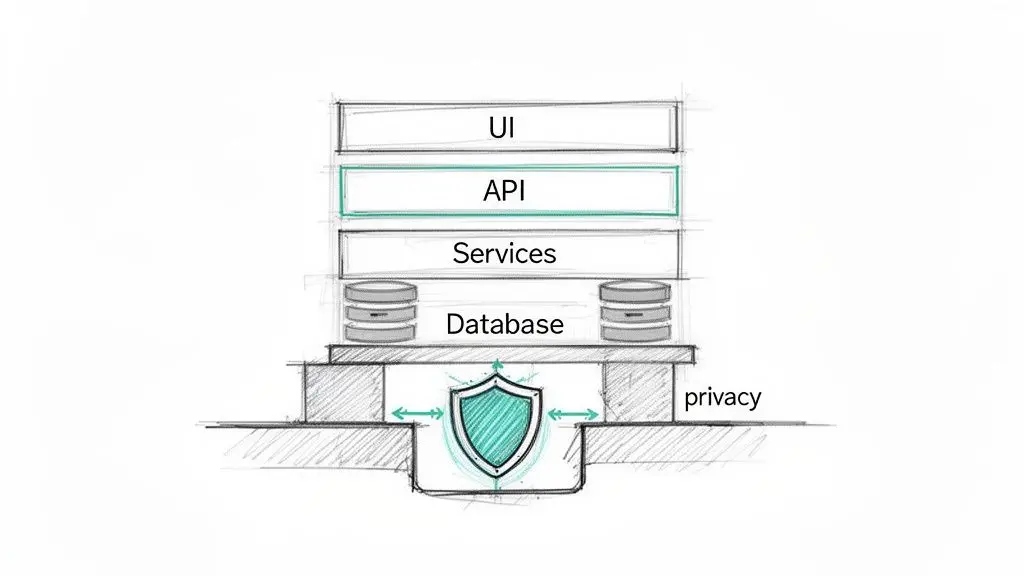
For technical leaders, this mode of operation introduces significant risk:
- Increased Development Costs: Retrofitting privacy controls into an existing architecture requires far more resources than designing them from the start. It involves complex refactoring, extensive regression testing, and potential disruption to live services.
- Degraded User Experience: Last-minute fixes, such as intrusive consent banners or crippled functionality, can alienate users and erode trust in the product.
- Systemic Vulnerabilities: Superficial patches often fail to address underlying architectural weaknesses, leaving systems exposed to data breaches with potentially catastrophic business consequences.
The Required Shift in Mindset
The principle of privacy by design demands a proactive approach. It means privacy considerations must be integral to requirements gathering, system design, and technology selection. It’s about asking critical questions before a single line of code is written: What data is truly essential? How will we isolate it? How will we protect it throughout its lifecycle?
Privacy by default, in turn, ensures that the most data-protective settings are enabled automatically, without requiring any user action. This user-centric approach demonstrates respect for personal data and builds trust from the first interaction. In practice, it means the default state of your application is its most secure state.
Privacy is not a feature to be added; it is a non-functional requirement that defines the integrity of the entire system. Failing to integrate it at an architectural level is like building a skyscraper and trying to add the foundation at the end.
Ultimately, adopting privacy by design and by default is a strategic decision. It shifts data protection from a cost center managed by the legal department to a core competency of the engineering team. This change not only mitigates risk but also becomes a powerful differentiator, fostering the user trust essential for building durable and reliable digital products.
GDPR and the Business Case for Proactive Privacy
While the technical arguments for proactive privacy are compelling, the legal and business drivers are equally powerful. Privacy is no longer a “nice-to-have”; it is a legal necessity in many jurisdictions and a significant competitive advantage globally.
The General Data Protection Regulation (GDPR) was a catalyst for this shift, moving privacy from a reactive compliance task to a core engineering discipline. For any company processing data of EU residents, this is not a suggestion—it is a legal mandate.
The Legal Mandate of Article 25
Article 25 of the GDPR is the legal bedrock for privacy by design and by default. It obligates data controllers to implement “appropriate technical and organisational measures” — such as pseudonymisation — from the earliest stages of design to integrate data protection principles directly into processing activities.
For engineering teams, this became a hard requirement on May 25, 2018. The consequences of non-compliance are clear. By mid-2023, total GDPR penalties had reached billions of euros, with a significant percentage of cases involving failures to adhere to these core design principles.
Failing to architect for privacy is not just a design flaw; it is a direct violation with severe financial repercussions. Fines can reach up to €20 million or 4% of a company’s global annual turnover, whichever is higher.
From Regulatory Burden to Business Asset
Viewing this obligation solely through the lens of avoiding fines misses the larger strategic opportunity. A proactive privacy stance is an investment in trust, resilience, and operational efficiency. It reframes a legal burden into a tangible business advantage.
Consider the benefits:
- Enhanced Cybersecurity Posture: Privacy and security are intrinsically linked. Principles like data minimisation—collecting only what is absolutely necessary—directly reduce a system’s attack surface. Less data means less risk of a damaging breach.
- Competitive Differentiation: Customers are increasingly aware of their data rights. A product that demonstrates respect for privacy by default builds immediate trust and becomes a powerful selling point that distinguishes it from competitors who treat privacy as an afterthought.
- Reduced Long-Term Costs: It is invariably cheaper to build privacy in from the start than to retrofit it later. Addressing privacy flaws post-launch involves expensive code refactoring, high-risk data migrations, and potential service downtime. A proactive approach avoids this accumulation of technical and compliance debt.
Adopting privacy by design is not just about risk mitigation; it’s about building a more robust, trustworthy, and efficient product. It transforms a legal requirement into a cornerstone of product innovation and risk management.
This approach creates a virtuous cycle. A strong privacy foundation reduces legal exposure and protects the bottom line. It builds user trust, which in turn drives adoption and loyalty. And it leads to cleaner, more maintainable architecture, lowering operational costs over the long term. For a deeper look into record-keeping obligations, check out our guide on GDPR Article 30 for engineering teams.
The Seven Foundational Principles of Privacy by Design
The concept of privacy by design is structured around seven foundational principles. Developed by Dr. Ann Cavoukian in the 1990s, this framework provides a practical guide for translating abstract privacy goals into concrete engineering decisions.
For technical leaders, these principles serve as a compass for making architectural choices that prevent privacy failures rather than merely reacting to them. This is not about ticking a compliance box; it’s about a fundamental shift in how software is built.
1. Proactive not Reactive; Preventative not Remedial
This is the central tenet. It reframes privacy from a damage-control exercise into a core design constraint. The goal is to anticipate privacy risks and design them out of the system from the beginning, rather than waiting for a data breach to occur and then scrambling to patch the vulnerabilities.
For a software team, this means conducting a Data Protection Impact Assessment (DPIA) during the discovery phase, not as a last-minute check before launch. It means choosing architectural patterns and technologies that inherently limit data exposure.
2. Privacy as the Default Setting
This principle is simple yet powerful: the most privacy-protective setting must be the default. No user should have to navigate complex menus to secure their data. The system must be secure by default.
A practical example is a SaaS sign-up form. Instead of a pre-ticked box that opts users into marketing communications, that box must be unticked by default. The same applies to the tech stack. A newly generated API key should have the minimum necessary permissions, forcing developers to consciously and explicitly grant additional access.
3. Privacy Embedded into Design
Privacy cannot be an afterthought or a feature bolted on at the end. It must be integrated into the system’s architecture and business logic with the same priority as performance or availability.
This means privacy considerations influence every decision, from database schema design (e.g., separating PII from application data) to UI implementation (e.g., providing clear, in-context privacy notices). The entire system is engineered with data protection as a core, non-functional requirement.
4. Full Functionality — Positive-Sum, not Zero-Sum
A common misconception is that privacy and functionality are in opposition—a zero-sum game where one must be sacrificed for the other. This principle challenges that notion, encouraging the development of creative solutions that achieve both.
For example, instead of collecting raw GPS coordinates for a location-based feature, could geohashed or aggregated data deliver the same user value without exposing individual locations? The engineering challenge is not to choose between privacy and features, but to innovate in a way that delivers both.
5. End-to-End Security — Full Lifecycle Protection
Data must be protected throughout its entire lifecycle, from the moment of collection to the moment of secure deletion. This principle ensures there are no weak links in the data chain.
This encompasses:
- Secure collection: Encrypting data in transit using strong, modern protocols.
- Secure storage: Using encryption at rest and implementing strict access controls.
- Secure processing: Ensuring that analytics or data transformations do not inadvertently create new privacy risks.
- Secure destruction: Using methods like cryptographic erasure to ensure that when data is deleted, it is irrecoverable.
6. Visibility and Transparency — Keep it Open
Trust is built on transparency. Users, customers, and regulators must be able to verify that a system operates as claimed. This requires clear, open, and accountable practices.
This means a privacy policy written in plain language, not legalese. It means documented data flows and auditable logic for data processing. In the context of AI, this transparency extends to clarity about training data and the mechanisms behind automated decisions.
7. Respect for User Privacy — Keep it User-Centric
Ultimately, privacy by design is about putting the user first. The system’s architecture and user interface should empower individuals, giving them meaningful control over their own information.
This translates to providing clear privacy options, honoring user choices, and using their data only for the specific, legitimate purposes they have agreed to. It is a user-centric mindset that respects individual autonomy and builds lasting trust.
Integrating Privacy into Your Software Development Lifecycle
Truly embedding privacy by design and by default requires moving beyond principles and into process. It involves treating privacy not as a one-time audit but as a continuous discipline woven into every stage of the software development lifecycle (SDLC).
A reactive approach almost guarantees the creation of technical debt and increased risk. A proactive one, however, builds resilience from day one. By shifting privacy considerations as far left as possible in the development process—where changes are cheapest and most effective—it ceases to be a compliance hurdle and becomes a driver for quality engineering.
Discovery and Requirements
This is the foundational stage where privacy risks are first identified and avoided. Neglecting privacy here means building on a flawed premise. The goal is to define what data you need and why long before writing any code.
Key actions during this phase include:
- Conducting a Data Protection Impact Assessment (DPIA): A formal process to systematically analyze, identify, and minimize the data protection risks of a project. It forces justification for every piece of data you plan to collect and process.
- Creating Data Flow Diagrams (DFDs): Visualize how data moves through the system. Map every touchpoint, from collection and storage to processing and deletion. This is a critical tool for spotting potential vulnerabilities early.
- Applying Data Minimisation: This is the most important principle at this stage. Challenge every single data point. Ask the hard question: “Is this data absolutely essential for the feature to function?” If the answer is not a clear “yes,” do not collect it.
Architecture and Design
With clear requirements, the focus shifts to designing a system that inherently protects data. Architectural decisions made here have long-lasting consequences for the application’s security and privacy. This is where the principles of proactivity, default privacy, and embedded design become the bedrock of your architecture.
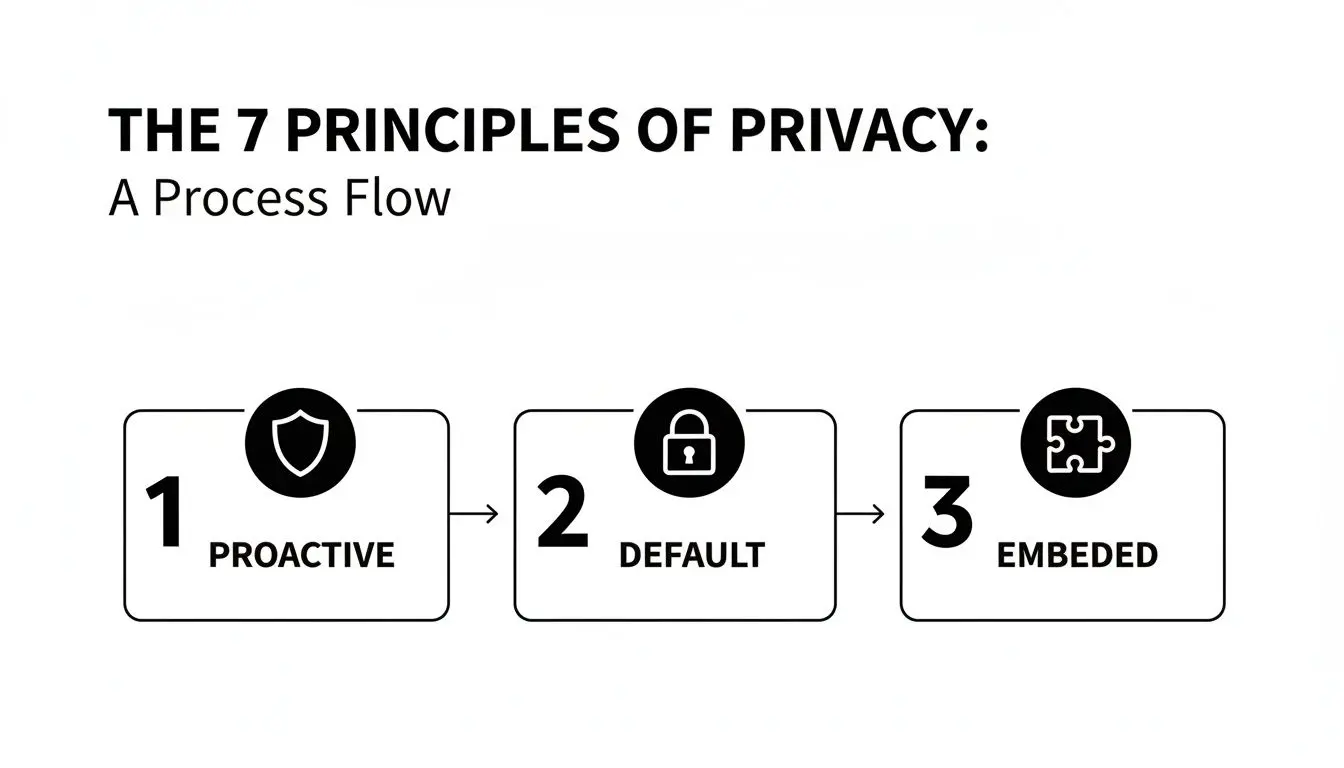
These three concepts translate directly into architectural choices that prevent risks before they can materialize.
Important design patterns to consider include:
- Pseudonymisation and Anonymisation: Design data models to separate personally identifiable information (PII) from other data wherever possible. Use techniques like hashing or tokenization to process data without exposing raw sensitive information.
- Secure-by-Default Configurations: Ensure all system components, from databases to third-party APIs, are configured with their most secure settings out of the box. For example, a new user account should have the strictest privacy settings enabled automatically, not as an opt-in.
A system’s default state reflects its true priorities. If privacy isn’t the default, it isn’t a priority. This simple architectural rule is a powerful litmus test for your commitment to user trust.
Implementation
During the coding phase, developers translate the privacy-aware architecture into secure, robust code. This is where theoretical designs become tangible controls. A strong engineering culture is vital to ensure these practices are followed consistently. You can learn more by reading our practical guide on creating a code of conduct for engineering and AI teams.
Key development practices include:
- Secure Coding Standards: Adhere to established guidelines like the OWASP Top 10 to prevent common vulnerabilities such as injection attacks or broken access control.
- Privacy-Enhancing Libraries: Use well-vetted, trusted libraries for critical functions like encryption and authentication rather than building them from scratch.
- Robust Access Controls: Implement Role-Based Access Control (RBAC) or Attribute-Based Access Control (ABAC) at both the API and data layers. Ensure a user or service can only access the specific data required for its legitimate function.
Testing and Deployment
The final stages are about verification. Privacy controls must be tested as rigorously as functional requirements. Privacy bugs can be as critical as any other bug.
Essential activities in this phase are:
- Vulnerability Scanning and Penetration Testing: Actively probe the application for weaknesses. Use a mix of automated tools (SAST, DAST) and manual penetration tests to uncover flaws that could compromise user data.
- Configuration Audits: Before deploying, verify that production environments have not drifted from their secure-by-default configurations. Ensure debug modes are disabled and all secrets are managed securely.
- End-to-End Data Lifecycle Tests: Create test cases that follow data through its entire journey. Confirm that it is correctly processed, protected at each stage, and can be securely and completely deleted upon request.
Architectural Patterns for Privacy in SaaS and AI Systems
Translating privacy by design and by default into robust software requires concrete architectural patterns. For modern SaaS and AI systems, these patterns are what turn privacy from a compliance checkbox into an intrinsic property of the platform.
Effective privacy architecture is not about a single tool. It is a deliberate combination of data segregation, stringent access controls, and specialized techniques for unique workloads like machine learning. The goal is to build a system where privacy is an inherent quality, not an add-on.
Multi-Tenancy and Data Segregation in SaaS
In any multi-tenant SaaS platform, the primary privacy challenge is preventing data leakage between tenants. A breach in one customer’s account must never expose the data of another. Relying solely on application-level logic to enforce this separation is naive and high-risk.
True segregation must be implemented at the database layer. The most common patterns include:
- Separate Databases: Each tenant has a dedicated database instance. This offers the strongest isolation but comes with higher operational overhead and costs. It is best suited for high-value enterprise clients who require it.
- Separate Schemas: All tenants share a database instance, but each has a distinct schema. This provides strong logical separation with a better cost profile than separate databases.
- Shared Schema with Discriminator Column: All tenants share the same tables, and a
TenantIDcolumn is used in every query to filter data. While cost-effective, this pattern requires iron-clad, automated query enforcement to prevent a developer from accidentally omitting theWHERE TenantID = ?clause—a mistake that could expose all customer data at once.
The cardinal rule of multi-tenancy is to never trust the application layer alone to enforce data boundaries. Segregation must be enforced as close to the data as possible, ideally at the database level, to create a reliable defense-in-depth strategy.
Enforcing True Role-Based Access Control
Role-Based Access Control (RBAC) is often implemented superficially, for instance, by merely hiding a button in the UI. This is dangerously insufficient. True RBAC must be enforced at the API and data layers, ensuring that even a direct, authenticated API call cannot bypass permission checks.
A robust RBAC implementation follows this pattern:
- Centralized Policy Definition: Roles and permissions (e.g.,
user_can_read_invoice,admin_can_delete_user) are defined in a single, auditable location. - API Gateway Enforcement: An API gateway or middleware intercepts every incoming request. It verifies the user’s token and checks their permissions against the policy before the request reaches the application logic.
- Database-Level Checks: For highly sensitive operations, row-level security (RLS) policies in the database can provide a final layer of defense, making it impossible for a user to access or modify rows they are not explicitly permitted to.
Privacy Patterns for AI and LLM Systems
AI systems, particularly those using Large Language Models (LLMs), introduce novel privacy challenges. A single poorly crafted prompt could trick a model into leaking confidential information it was trained on.
Effective architectural patterns for AI include:
- Using Embeddings for Sensitive Data: Instead of sending raw, sensitive text (like customer support tickets) to an LLM, first convert it into numerical vector embeddings. Similarity searches and other operations can then be performed on these embeddings without exposing the original PII to the model or third-party APIs.
- Implementing AI Guardrails: An AI guardrail acts as a specialized firewall between users and the AI model. It intercepts both incoming prompts and outgoing responses, scanning for and blocking prompts that request sensitive data or model responses that contain PII, confidential keywords, or toxic content. To dive deeper into managing these risks, explore our comprehensive AI Risk & Privacy Checklist.
- Securing Tool-Calling Agents: When AI agents can call external tools or APIs, they must operate under a strict least-privilege security model. Each agent should have its own set of sandboxed API keys with narrowly scoped permissions. This prevents a compromised agent from accessing unintended parts of the system.
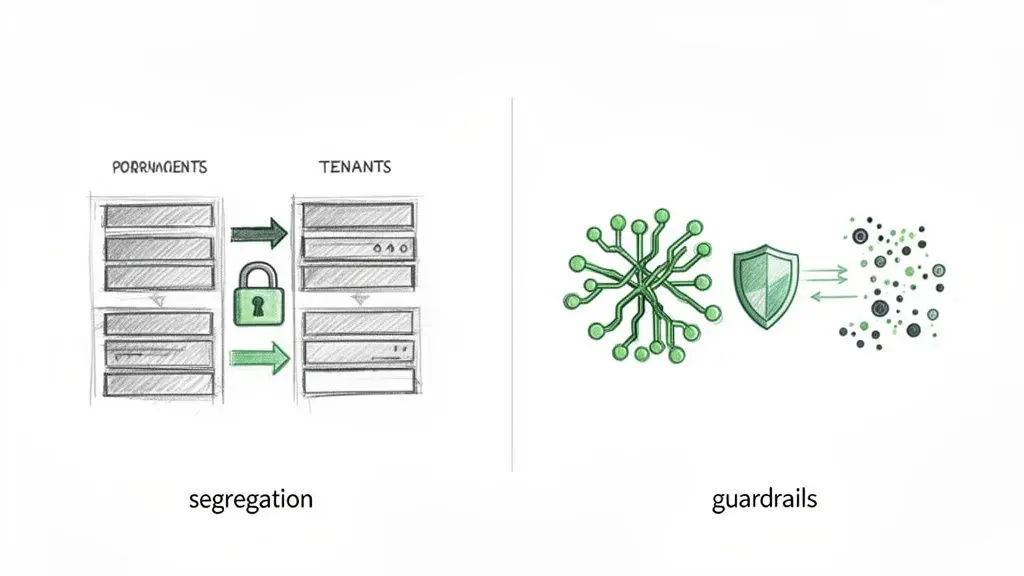
Each of these patterns involves trade-offs in complexity, cost, and performance. However, implementing them proactively is far less expensive than managing the fallout from a privacy failure. By choosing the right architectural patterns, you embed privacy directly into your system’s DNA.
A Practical Checklist for Engineering Teams
Knowing the principles is one thing; embedding them into a team’s daily workflow is another. This checklist is not for a compliance audit. It is a practical guide to help engineering, product, and design teams ask the right questions at the right time throughout the software development lifecycle (SDLC).
Discovery and Requirements
This is the best opportunity to prevent privacy debt. Mistakes made here are exponentially more expensive to fix later.
- Data Minimisation: Have we challenged every piece of data we intend to collect? Can we deliver the core feature with less?
- Purpose Limitation: Is the specific, legitimate purpose for each data point documented and agreed upon? Vague justifications are insufficient.
- Data Mapping: Have we traced the entire lifecycle of personal data, from collection to deletion, including all third-party services and API calls?
- DPIA Trigger: Does the planned processing trigger the need for a formal Data Protection Impact Assessment (DPIA) under GDPR?
Architecture and Design
The architectural decisions made here will define your privacy posture for years to come.
Your system’s default settings are a direct reflection of your company’s values. If the most private option isn’t the default, you are communicating that user privacy is not a priority.
- Default Settings: Are all user-facing settings and internal configurations set to the most private option out of the box?
- Data Segregation: In a multi-tenant system, is customer data properly isolated at the database level (e.g., using separate schemas or Row-Level Security)?
- Pseudonymisation: Can we achieve the objective using tokens, hashes, or other techniques that avoid exposing raw personally identifiable information (PII)?
Implementation and Testing
This is where architectural blueprints become secure, working code.
- Secure Coding: Are developers actively following established security standards like the OWASP Top 10 to prevent common vulnerabilities?
- Access Control: Is Role-Based Access Control (RBAC) enforced at the API gateway and database layers, not just in the UI?
- Encryption: Is our encryption strategy consistently applied for data at rest (in storage) and in transit (across networks)?
- AI Guardrails: For any AI features, are guardrails in place to prevent both malicious prompt injection and accidental PII disclosure in model responses?
Deployment and Maintenance
Privacy is an ongoing discipline, not a one-time launch feature.
- Secure Configuration: Have we audited our production environments? Are debugging tools disabled? Are secrets managed by a proper secrets manager?
- Data Deletion: Do we have a reliable, automated, and verifiable process for honoring data deletion requests completely?
- Incident Response: Is our incident response plan tested regularly? In a breach, muscle memory is required, not a document.
Frequently Asked Questions
When implementing privacy by design and by default, technical and business leaders often encounter the same practical questions. Here are clear answers to common queries from CTOs, founders, and compliance managers.
What’s the Real Difference Between Privacy by Design and by Default?
Think of it like constructing a building. Privacy by Design is the architectural blueprint. It is the proactive work done upfront to embed data protection into the system’s foundation, influencing every choice from data models to API structures.
Privacy by Default is the state of the building when you hand over the keys. It is the user-facing outcome of that blueprint. It ensures that when a user first interacts with the system, their settings are automatically configured for the highest level of privacy without requiring any action on their part.
For example, your design work might involve creating a feature to share user activity. The default implementation ensures this feature is switched off when a new account is created.
How Does This Apply When Using Third-Party APIs?
Your responsibility for data protection does not end at your system’s boundary. When you integrate a third-party API, you remain accountable for the data you transmit.
Key considerations include:
- Data Minimisation: Send only the absolute minimum data required for the API call to function. Do not pass an entire user object when the API only needs a user ID.
- Contractual Safeguards: Your vendor agreements must clearly define their data protection responsibilities, including how they process data and their obligations in the event of a breach.
- Security Scrutiny: Vet the API’s security practices as if they were your own. Assess their encryption standards and access control mechanisms. Treat the third-party service as a direct extension of your own architecture.
Is This Only Relevant for GDPR Compliance?
No. While Article 25 of the GDPR established privacy by design and by default as a legal mandate for processing EU residents’ data, the principles themselves are now a global best practice. Similar concepts are foundational to regulations worldwide, from Canada’s PIPEDA to Brazil’s LGPD.
Beyond compliance, these principles are simply good engineering and risk management. Implementing them reduces the likelihood of a damaging data breach, builds critical user trust, and lowers the long-term cost of system maintenance. It is a strategic engineering decision, not just a legal requirement.
Building reliable digital products with privacy at their core is a complex but essential task. At Devisia, we help businesses turn their vision into maintainable software and AI-enabled systems, with a clear focus on pragmatic architecture and measurable value.
Learn how we can build your next platform with privacy as a foundational choice.