The stand up meeting, or Daily Scrum, is a daily synchronization point for a software development team. Its purpose is to identify and resolve impediments quickly, ensuring the team’s work aligns with sprint objectives. However, many teams find their stand ups devolve into rote status reporting, draining energy instead of creating focus. This guide provides a pragmatic approach for technical leaders to implement a stand up meeting that actively drives project momentum.
The Problem: Why Most Daily Stand Up Meetings Fail
For teams building complex software systems, a mismanaged stand up meeting introduces significant operational risk. It’s not merely another calendar entry; it is the team’s primary daily risk mitigation and alignment mechanism.
The core problem is a drift from purpose. Instead of a high-bandwidth communication channel for unblocking work, the meeting becomes a low-value ritual. Small misalignments, hidden dependencies, and unresolved technical blockers are not surfaced. Over a sprint, these minor issues compound, leading to delivery delays, reduced code quality, and accumulating technical debt.
Communication Architecture, Not a Status Report
A CTO or product leader should view the stand up as a critical component of the team’s communication architecture. It is the engine that maintains development velocity by creating a daily, high-fidelity feedback loop.
A properly executed stand up fosters a culture of collective ownership and proactive problem-solving. It transforms a group of individual contributors into a cohesive unit focused on a shared technical objective.
The tangible benefits include:
- Early Impediment Detection: It serves as the earliest possible warning system for technical hurdles, cross-team dependencies, or environmental issues that threaten progress.
- Sprint Goal Alignment: It ensures every team member has a clear, shared understanding of immediate priorities and how their current work contributes to the sprint goal.
- Improved Predictability: By systematically identifying and resolving blockers, teams can more accurately forecast their delivery capacity within a sprint.
- Enhanced Accountability: The public commitment to tasks encourages team members to own their work and, critically, to request assistance when facing challenges.
The Real Cost of Ineffective Stand Ups
In modern software development, agile practices are standard. A report indicates that 87% of all Scrum teams use the daily stand up, making it a ubiquitous practice. Discover more insights on meeting statistics. The prevalence of this meeting means its failure mode carries a high cost.
The cost is not just the 15 minutes per person per day. The true cost is the erosion of focus, creeping disengagement, and the gradual loss of momentum that follows a pointless meeting. It is a failure to protect the team’s most valuable assets: time and focused engineering effort. For organizations like Devisia building scalable SaaS platforms and AI integrations, optimizing this process is fundamental to operational excellence.
Designing a Stand Up Meeting That Delivers Value
Most ineffective stand ups follow the classic “yesterday, today, blockers” format. The naive implementation of this model puts the focus on individual activity reporting, not on the collective progress toward the sprint goal. This often results in a series of status updates directed at a manager rather than a collaborative planning session.
A more effective approach is blocker-centric and forward-looking. It reframes the meeting as a daily problem-solving session focused on advancing work items through the development pipeline. The guiding principle is to focus on the work, not the worker.
This shift changes the dynamic from individuals reporting up to a manager to the team collaborating to move work across the board. This methodology directly addresses the risk of tasks becoming stalled and ensures that work closest to completion receives the necessary team focus.
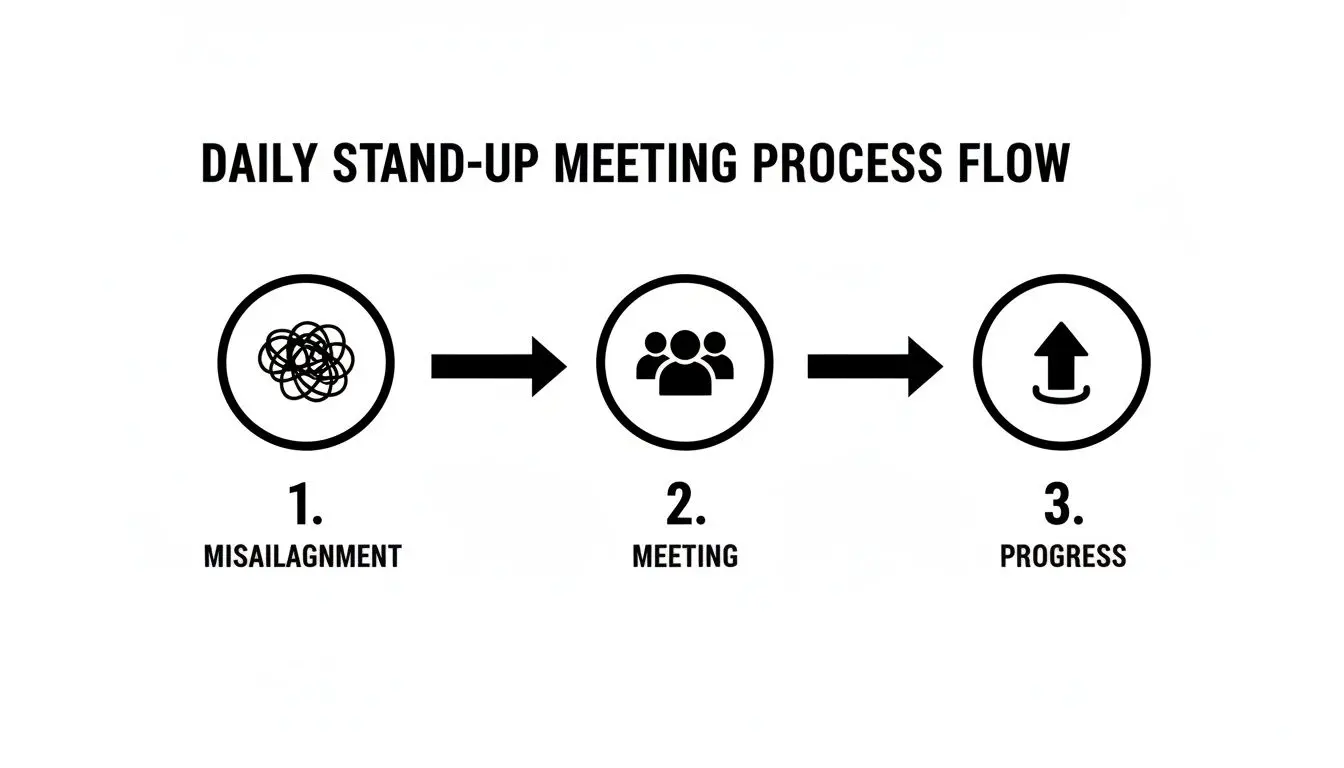
The stand up is the critical intervention point where potential misalignment is converted into focused, forward momentum.
The Role of the Facilitator
The facilitator’s function is not that of a project manager. Their primary responsibility is to be the guardian of the meeting’s purpose and its strict 15-minute timebox. They guide the conversation, ensuring it remains focused on identifying and addressing impediments.
Effective facilitation involves several key actions:
- Enforce Punctuality and Pace: Start on time, every time. Maintain a sense of urgency.
- Protect the Timebox: Be prepared to politely interrupt technical deep-dives. A useful phrase is, “This is an important technical discussion. Let’s create a follow-up immediately after this meeting for the relevant people.”
- Foster Collaborative Problem-Solving: Use prompts that frame the work as a team effort. Instead of “What are you working on?”, ask, “What is required to move this ticket to the ‘Done’ state today?”
A successful facilitator becomes less necessary over time as the team internalizes these disciplines.
A Practical, Blocker-Focused Agenda
An effective stand up requires a structured, repeatable agenda. The most robust method is to “walk the board” from right to left (from closest to “Done” to newest). This prioritizes finishing work over starting new work, a core principle for maintaining development flow.
A sample script for the facilitator:
- Re-state the Sprint Goal: “Quick reminder: our sprint goal is to deploy the new authentication module. Let’s align our efforts on that.”
- Walk the Board (Right to Left): “Starting with the ‘In Review’ column, what is needed to get these two pull requests merged and deployed?”
- Identify Blockers and Stale Work: “This ticket has not moved in 48 hours. What is the current impediment, and who can assist in resolving it?”
The objective is to make the stand up a daily mechanism for continuous improvement. By focusing on flow and blockers, the meeting becomes an essential tool for maintaining momentum, much like the principles used in Kaizen projects. Learn more about how to apply continuous improvement to maintain existing systems in our detailed guide.
This framework must be adapted to the team’s context. For a feature launch, the focus might be on integration points. For a legacy system refactor, the conversation may center on risk mitigation and validation strategies. The format is a tool; its value lies in its application to the work at hand.
Comparison of Stand Up Agenda Models
The traditional “Three Questions” model is a common starting point, but a blocker-focused approach often yields higher value by directly addressing sources of delay. This comparison outlines the trade-offs.
| Agenda Component | ’Three Questions’ Model | Blocker-Focused Model | Implementation Considerations |
|---|---|---|---|
| Primary Focus | Individual activity and status reporting. | Team progress, workflow, and impediment resolution. | Blocker-Focused: Better for teams prioritizing delivery speed and flow efficiency. |
| Conversation Trigger | ”What did you do yesterday? What will you do today? Blockers?" | "What’s needed to advance this ticket? What is blocking this column?” | Three Questions: Can be useful for onboarding new or junior teams. |
| Meeting Flow | Round-robin, individual by individual. | Follows the work across a Kanban or Scrum board, right-to-left. | Blocker-Focused: Requires a well-maintained and visible task board. |
| Primary Outcome | A summary of individual tasks. Risk of reporting to a manager. | An actionable plan for unblocking work and progressing toward the sprint goal. | Blocker-Focused: Encourages collective ownership and is better for mature teams. |
While the classic model can help instill a daily rhythm, most experienced software teams find that transitioning to a blocker-focused, board-centric conversation makes the stand up a more valuable and tactical event.
Executing the Stand Up in Remote and Hybrid Environments
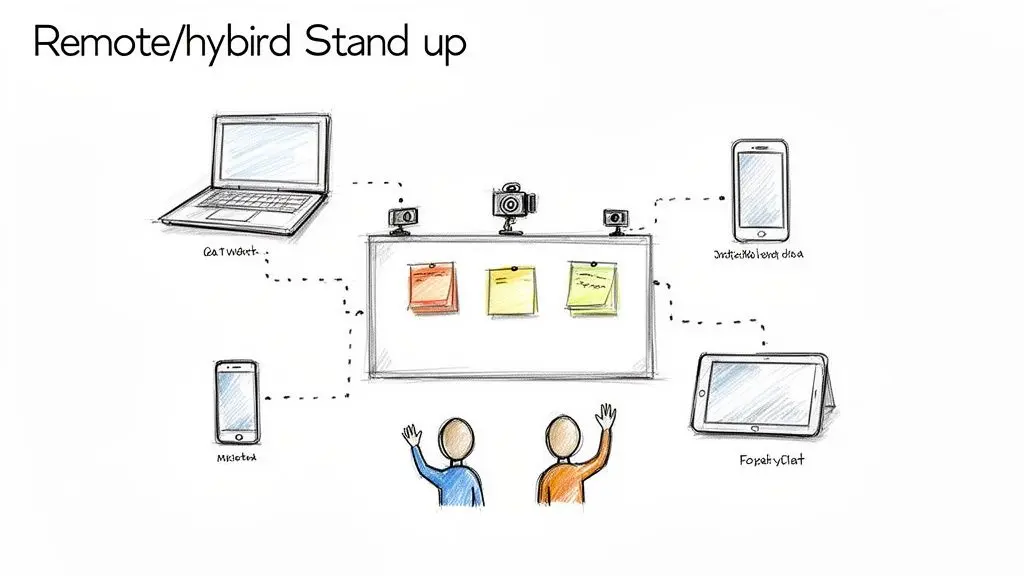
Distributed teams face unique challenges in maintaining high-fidelity communication during a stand up. Without intentional design, a remote stand up can quickly degrade into a disengaged, cameras-off ritual where individuals report into a void.
The solution requires adapting both the process and the technical environment to mitigate the loss of non-verbal cues and ambient awareness present in co-located settings.
Establishing Remote Meeting Protocols
Clear, non-negotiable rules of engagement are required to ensure respectful and efficient communication. These protocols create an inclusive environment for all participants, regardless of location.
Core protocols should include:
- Cameras On: This is the most critical rule. Visual presence is a fundamental component of engagement and allows the team to perceive non-verbal cues that are essential for effective collaboration.
- Dedicated Focus: Participants should join from a quiet location and avoid multitasking. The stand up’s brevity and importance demand full attention.
- Structured Turn-Taking: Utilize the “raise hand” feature in video conferencing tools to prevent interruptions and ensure an orderly flow of conversation.
These ground rules function as a team charter for synchronous communication. For guidance on establishing broader team norms, see our guide on building a code of conduct for engineering and AI teams.
Integrating Asynchronous Updates
To maximize the value of synchronous time, supplement the live meeting with asynchronous updates. This hybrid approach reserves live interaction for complex problem-solving rather than simple status reporting.
Use synchronous time for high-value collaboration and problem-solving. Use asynchronous channels for routine status updates that do not require real-time discussion. This respects the team’s focus and keeps the live meeting centered on impediment resolution.
A practical implementation is to have team members post a brief summary of their progress and any identified blockers in a dedicated Slack or Teams channel 30 minutes prior to the stand up.
This pre-briefing ensures all participants arrive with context. The live meeting can then proceed directly to addressing the most critical issues, transforming it from a reporting exercise into a tactical working session.
How to Diagnose and Correct a Failing Stand Up
Even well-intentioned teams can develop bad habits, or anti-patterns, that degrade the effectiveness of their stand up. Identifying these anti-patterns is the first step toward correction. A dysfunctional stand up is often a symptom of deeper issues, such as a lack of psychological safety, unclear goals, or a weak sense of collective ownership.
Anti-Pattern: The Status Report to the Manager
This is the most common failure mode. Each team member turns to the manager or team lead and provides a direct update. Peer-to-peer collaboration is lost, and the meeting becomes a series of one-on-one reports conducted in public.
This pattern emerges when a manager positions themselves as the central hub for information.
Correction: The facilitator must actively restructure the interaction. In a co-located meeting, the manager can physically step back from the center of the group. In a remote setting, the facilitator must explicitly direct questions toward the work on the board (“What is the next step for this ticket?”) rather than the person (“What are you doing today?”).
Anti-Pattern: The Endless Problem-Solving Session
The stand up is hijacked by a technical deep-dive between two or three engineers, while the rest of the team disengages. This violates the 15-minute timebox and disrespects the time of uninvolved team members.
A stand up is for identifying impediments, not for solving them in real-time. Its purpose is to make problems visible so the appropriate individuals can address them immediately after the meeting.
Correction: The facilitator must intervene politely but firmly:
- Acknowledge: “This appears to be a critical technical discussion.”
- Defer: “Let’s create a follow-up for the relevant people immediately after this. Can you two sync up and post the resolution in the team channel?”
- Redirect: “Excellent. Now, let’s move to the next item on the board.”
This maintains the meeting’s focus while ensuring the technical issue receives the necessary attention.
Anti-Pattern: The Disengaged, Silent Team
Updates are brief and mumbled, no questions are asked, and blockers are never raised. The meeting lacks energy and feels passive. This is a significant indicator of low psychological safety or profound disengagement from the sprint goals.
Silence often signals that team members do not feel safe admitting they are stuck or challenging an assumption.
Correction: This requires a deliberate effort to rebuild trust. Rotate the facilitator role to increase ownership. When a blocker is raised, the team lead should publicly praise the action, framing it as a valuable contribution to the team’s success, not a personal failure. Over time, this reinforces that transparency is valued and necessary.
Diagnostic Checklist for Stand Up Anti-Patterns
Use this checklist to diagnose the health of your stand up meeting. Connect observed symptoms with root causes and implement concrete corrective actions.
| Symptom (Anti-Pattern) | Potential Root Cause | Corrective Action to Implement |
|---|---|---|
| The Status Report | Manager-centric culture; Lack of peer-to-peer accountability. | Manager should reduce their verbal participation. Facilitator redirects questions to the team/board, not individuals. |
| Problem-Solving Hijack | No clear “parking lot” process; Disrespect for the timebox. | Facilitator must actively defer deep discussions. Establish a clear process for post-meeting follow-ups. |
| The Silent Team | Low psychological safety; Unclear sprint goals or lack of ownership. | Rotate the facilitator role. Publicly praise blocker-raising. Re-clarify sprint goals and connect tasks to team objectives. |
| Running Over Time | Too many attendees; Unfocused updates; No active facilitator. | Enforce the 15-minute rule strictly. Limit attendance to the core delivery team. Use the “walk the board” method to maintain focus. |
| Zombie Stand Up | Team members are disengaged or multitasking. | Change the time or format. Ask a powerful focusing question like, “What is our single biggest risk to the sprint goal today?” |
| No Blockers Ever | Fear of admitting weakness; Team misunderstands what a “blocker” is. | Redefine blockers to include “risks” and “impediments.” Lead by example by sharing your own blockers. |
Treat these anti-patterns not as failures, but as data points indicating an opportunity for process improvement.
Measuring the Impact of Your Stand Up Meeting
To validate that your stand up is adding value, you must move beyond subjective feelings and use metrics that connect the meeting to development outcomes. The stand up generates a daily stream of data about the health and predictability of your engineering process. This data typically resides within your project management tools (e.g., Jira, Azure DevOps).
From Anecdotes to Quantitative Data
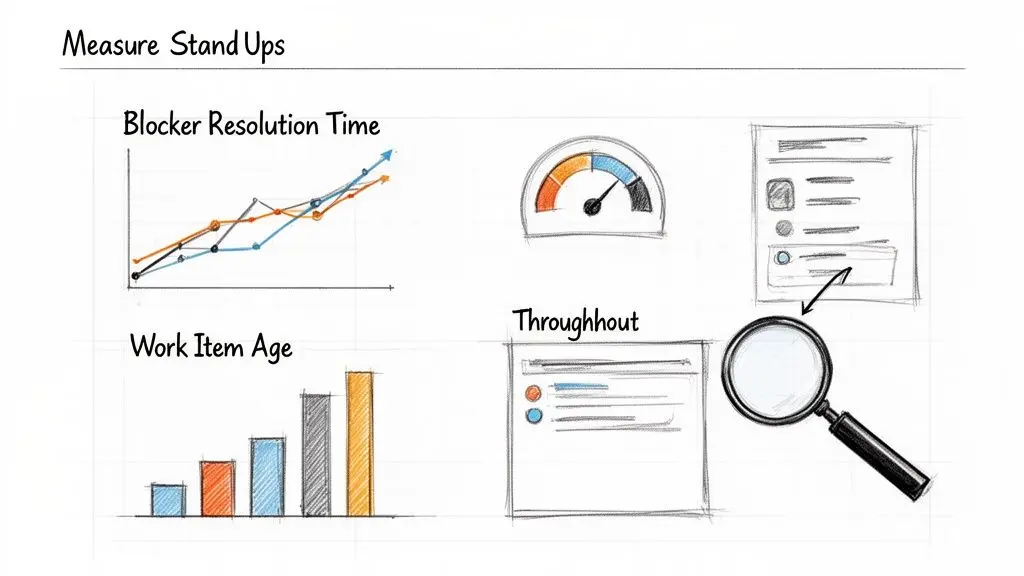
Focus on quantitative signals that provide an objective view of your workflow. These metrics reveal whether your stand up is effectively surfacing and resolving impediments.
Start with two high-impact metrics:
- Blocker Resolution Time: Measures the average duration from when an impediment is raised in a stand up to when it is resolved. A consistently low number (e.g., under 24 hours) indicates an effective problem-solving process.
- Work Item Age: Tracks the total time a task spends in any “in-progress” state. If items consistently age beyond a few days without advancing, it signals hidden dependencies or a lack of focus that the stand up should be identifying.
Tracking these metrics transforms the stand-up from a simple status update into a critical diagnostic tool. It provides empirical evidence of your team’s ability to maintain flow, allowing leaders to pinpoint systemic issues rather than just reacting to daily crises.
Connecting Metrics to Systemic Health
These metrics are leading indicators of your team’s agility and operational health. A rising Blocker Resolution Time, for example, may indicate external dependencies that require intervention from senior leadership. Understanding the function of a Program Management Officer can provide context for managing such cross-team dependencies.
Similarly, a high average Work Item Age suggests the team may be violating Work-In-Progress (WIP) limits—a common cause of context switching and reduced throughput. The stand up is the ideal forum to address this by shifting the focus from starting work to finishing work.
Measuring the stand up’s impact fosters a culture of accountability and data-driven continuous improvement.
Conclusion for Technical Leaders
For a CTO, Engineering Manager, or Product Leader, the daily stand up meeting is a strategic tool for managing risk and ensuring team alignment. Its value is not in status reporting but in the aggressive identification and resolution of impediments that threaten delivery momentum.
Achieving this requires a disciplined format, active facilitation, and a relentless focus on unblocking the flow of work. Anything less transforms the meeting into a daily tax on engineering productivity.
Treat your stand up as a core component of your team’s communication architecture and a living process subject to continuous refinement. The goal is to create a focused, high-energy checkpoint that accelerates the team and reinforces a culture of collective ownership. This daily synchronization is your first line of defense against friction and your most effective tool for maintaining high development velocity.
Frequently Asked Questions
Should managers or stakeholders attend the daily stand-up?
As a general rule, no. The daily stand up is a meeting for the delivery team, conducted by the delivery team. The presence of managers or stakeholders alters the dynamic, often causing team members to filter their updates and hesitate to raise blockers. This undermines psychological safety.
If a stakeholder’s attendance is unavoidable, they should participate as a silent observer. Their questions are better addressed in other forums, such as sprint reviews or dedicated status meetings, to protect the integrity of the stand up.
How should technical deep-dives be handled?
When a discussion evolves into a detailed technical problem-solving session, the facilitator must intervene to preserve the meeting’s timebox and focus.
A simple, effective script is: “This is a critical conversation that may not require everyone’s input. Can the relevant people sync up immediately after this meeting and post the outcome in the team channel?”
This approach validates the importance of the issue while respecting the time of the entire team, ensuring the problem receives focused attention from the correct individuals without derailing the stand up.
How do you run a stand up with a team across multiple timezones?
Forcing a synchronous meeting across widely dispersed timezones is impractical and leads to burnout. The most effective approach is to adopt an asynchronous model.
Establish a dedicated channel in a tool like Slack or Microsoft Teams with a clear template for daily updates. Set a firm deadline for posting (e.g., by 10:00 AM in each individual’s local timezone). This maintains a daily communication rhythm without requiring attendance at inconvenient hours. This asynchronous check-in can be supplemented with a single, weekly synchronous meeting to address higher-level strategic topics and maintain team cohesion.
At Devisia, we see optimized internal processes as fundamental to building reliable and scalable software. If you are looking to develop a digital product with a team that prioritizes clear communication and disciplined delivery, we should talk. Learn more about our approach to custom software development.