A Program Management Officer is not another layer of management bureaucracy. In a modern tech company, this role provides the strategic governance required to connect multiple, complex engineering projects to core business outcomes.
While a project manager focuses on delivering a single initiative, a Program Management Officer ensures that an entire portfolio of projects—such as building a new SaaS platform, integrating an LLM, and overhauling a legacy system—are orchestrated to create cohesive, measurable value. Without this function, well-executed individual projects often fail to achieve their intended strategic impact.
The Problem: When Project Execution Becomes Disjointed
As technology companies scale, they inevitably face a coordination breakdown. Project execution becomes chaotic. Engineering teams operate in silos, leading to predictable and costly problems:
- Resource Contention: Critical engineers are simultaneously allocated to multiple “top-priority” projects, causing bottlenecks and slowing down all initiatives.
- Strategic Misalignment: Projects are completed on time and within budget—a tactical success—but fail to advance the company’s strategic objectives, such as market expansion or technical debt reduction.
- Lack of Portfolio Visibility: Leadership has no unified view of cross-project dependencies, risks, or true progress. This makes informed capital allocation and strategic pivots impossible.
This is the specific operational gap a Program Management Officer is designed to close. Their function is to rise above the day-to-day execution of individual projects and provide strategic governance and alignment for the entire portfolio.
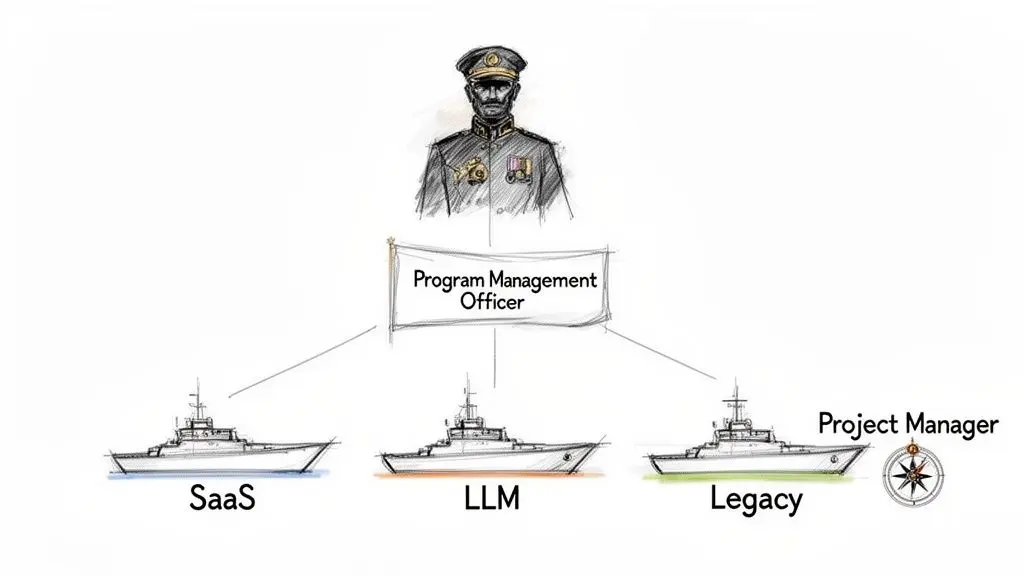
Architectural Analogy: Fleet Admiral vs. Ship Captain
An effective way to understand the distinction is through a naval analogy.
A project manager is a ship captain. Their mission is clear and focused: navigate a single vessel from Port A to Port B safely, on schedule, and within its allocated budget. The role is tactical, hands-on, and centered on the successful delivery of one asset.
A Program Management Officer is the fleet admiral. They do not steer any single ship. Their responsibility is to coordinate the entire fleet—each with its own captain and mission—to achieve a larger strategic objective, such as winning a campaign. The admiral ensures all ships move in concert, share intelligence, and support each other to achieve an outcome that no single ship could accomplish alone.
The Strategic Value in Modern Technology Stacks
In software and AI development, this role is indispensable for managing the inherent complexity of modern initiatives. With global IT spending projected to reach $5.43 trillion in 2025, ensuring that capital is deployed effectively is a critical fiduciary responsibility.
A Program Management Officer ensures this investment translates directly into measurable business outcomes, connecting technical execution to financial accountability. You can find more on these trends in IT project management statistics on Runn.io.
A Program Management Officer bridges the gap between individual project outputs and desired business outcomes. They don’t just ask, “Was the project successful?” They ask, “Did the collection of projects achieve the intended strategic impact?”
Core Functions and Required Competencies
The “fleet admiral” analogy clarifies the strategic level at which a Program Management Officer operates, but their daily function is grounded in a specific set of disciplines. They are not merely coordinators; they are the organizational architects responsible for ensuring a portfolio of complex technical projects delivers cohesive, measurable value. The role is a constant balancing act between high-level strategy and ground-level execution constraints.
The function centers on three critical domains: strategic planning, financial oversight, and dependency management. Failure in any one of these areas puts the entire program at risk, potentially turning a collection of well-run projects into a costly, disjointed failure. This is what separates a Program Management Officer from a senior project manager.
Strategic and Financial Governance
At its core, the Program Management Officer role is about translating high-level business goals into a coherent, multi-project execution roadmap. This extends beyond creating a master timeline; it involves continuous alignment and rigorous financial scrutiny.
Key responsibilities include:
- Program Planning: Defining the overarching scope, objectives, and success metrics for the entire program, not just for its constituent projects. This establishes the “why” that guides all technical work.
- Financial Oversight: Managing the program-level budget, tracking return on investment (ROI), and ensuring resources are allocated to projects that deliver maximum strategic value.
- Benefits Realization: Establishing a framework to measure whether the program is delivering its promised outcomes—such as increased market share, reduced operational costs, or improved system reliability.
A Program Management Officer is ultimately accountable for the business case of the entire program. They must constantly ask, “Is this portfolio of projects still the most effective way to achieve our strategic goals with our available resources?”
Technical and Interpersonal Skills
Success in this role requires a specific blend of technical and interpersonal competencies. Technical credibility is essential for overseeing complex software and AI projects, while strong negotiation skills are necessary to navigate the organizational politics that can derail them.
Hard Skills (The “What”):
- PPM Tool Mastery: Fluency in Project Portfolio Management (PPM) software and tools like Jira is required to track progress, dependencies, and resource allocation across multiple engineering teams.
- Financial Modeling: The ability to build and manage complex budgets, forecast costs, and calculate the financial impact of program-level decisions is non-negotiable.
- Risk Analysis: A Program Management Officer must be skilled at identifying, quantifying, and developing mitigation plans for program-level risks, from technical debt to regulatory changes under GDPR or NIS2.
Soft Skills (The “How”):
- Strategic Thinking: The ability to look beyond immediate project deadlines and understand how market shifts or internal reorganizations impact the program’s long-term value.
- Negotiation and Influence: The skill to mediate resource conflicts, secure buy-in from senior leadership, and align stakeholders with competing priorities, often without direct line authority.
- Clear Communication: The ability to explain complex technical dependencies and financial trade-offs to non-technical executives in a clear, pragmatic manner.
Program Management Officers in IT are pivotal for strategic planning and performance monitoring. Professionals with PMP certification—often a proxy for this skill set—earn 33% higher median salaries. This premium reflects the high value placed on skills like analyzing program data, identifying trends, and making data-driven optimizations—competencies essential for managing complex integrations involving embeddings, vision models, and human-in-the-loop controls. You can find more insights on project management career trends on monday.com.
Navigating Real-World Trade-Offs: An Architectural Example
Consider a common scenario: a company is executing a program to launch an AI-powered analytics platform. One project team is building the user-facing front-end. A second, interdependent team is integrating a new machine learning model into the back-end.
The back-end team encounters an unexpected data quality issue, delaying the AI model integration. This creates a resource conflict: the front-end team is now blocked, waiting for APIs that do not exist. A project manager sees this as a single-project delay.
A Program Management Officer analyzes the program-level impact and makes a strategic decision. They might reallocate the blocked front-end team to accelerate a different project within the program—such as implementing a data privacy feature required for compliance—thereby keeping the team productive and reducing overall schedule risk. This decision requires a simultaneous grasp of technical dependencies, financial implications, and strategic priorities. That synthesis is the essence of the Program Management Officer role.
Implementing Effective Program Governance
For most founders and CTOs, the realization that a Program Management Officer (PMO) is needed is not a proactive strategic decision but a reactive necessity. It occurs when multiple projects become entangled in dependencies, engineering teams are chronically over-allocated, and strategic initiatives fail to deliver cohesive value.
This is a clear signal that informal coordination has reached its operational limit. The organization no longer just needs project management; it requires a governance layer to manage the entire portfolio.
Implementing this function is not about simply adding a new role to the org chart; it involves changing the company’s operational model. It requires a clear mandate, unambiguous executive support, and the establishment of lightweight frameworks that enable teams rather than hinder them. A superficial or rushed implementation will only create more bureaucracy and chaos.
A Phased Implementation Approach
A “big bang” rollout of a PMO function is a common mistake that leads to organizational resistance. A pragmatic, incremental approach is more effective, allowing the function to prove its value and adapt its scope over time.
-
Define the Mandate: First, identify the primary problem the PMO is being created to solve. Is it resource contention? Unmanaged cross-project risks? A disconnect between engineering output and business objectives? The answer forms the basis of the PMO’s charter—a concise document outlining its authority, responsibilities, and success metrics.
-
Secure Executive Buy-In: Use the charter to gain C-suite support by focusing on tangible business outcomes: reducing project delays, optimizing the allocation of expensive engineering talent, and gaining clear visibility into the ROI of technology initiatives. Without genuine top-down support, a PMO becomes a “toothless tiger,” unable to resolve cross-departmental conflicts.
-
Establish Governance Frameworks: Start with simple, high-impact frameworks. A unified reporting dashboard, a standardized risk register, or a cross-project dependency map can provide immediate value. The goal is to introduce standards that reduce friction, not create bureaucracy.
-
Select Appropriate Tooling: Choose tools that fit the organization’s current scale and complexity. A startup may achieve sufficient visibility with well-configured Jira dashboards. A larger organization might require a dedicated Project Portfolio Management (PPM) tool. The key is to prioritize clarity over administrative overhead.
These core functions form a clear hierarchy of control.
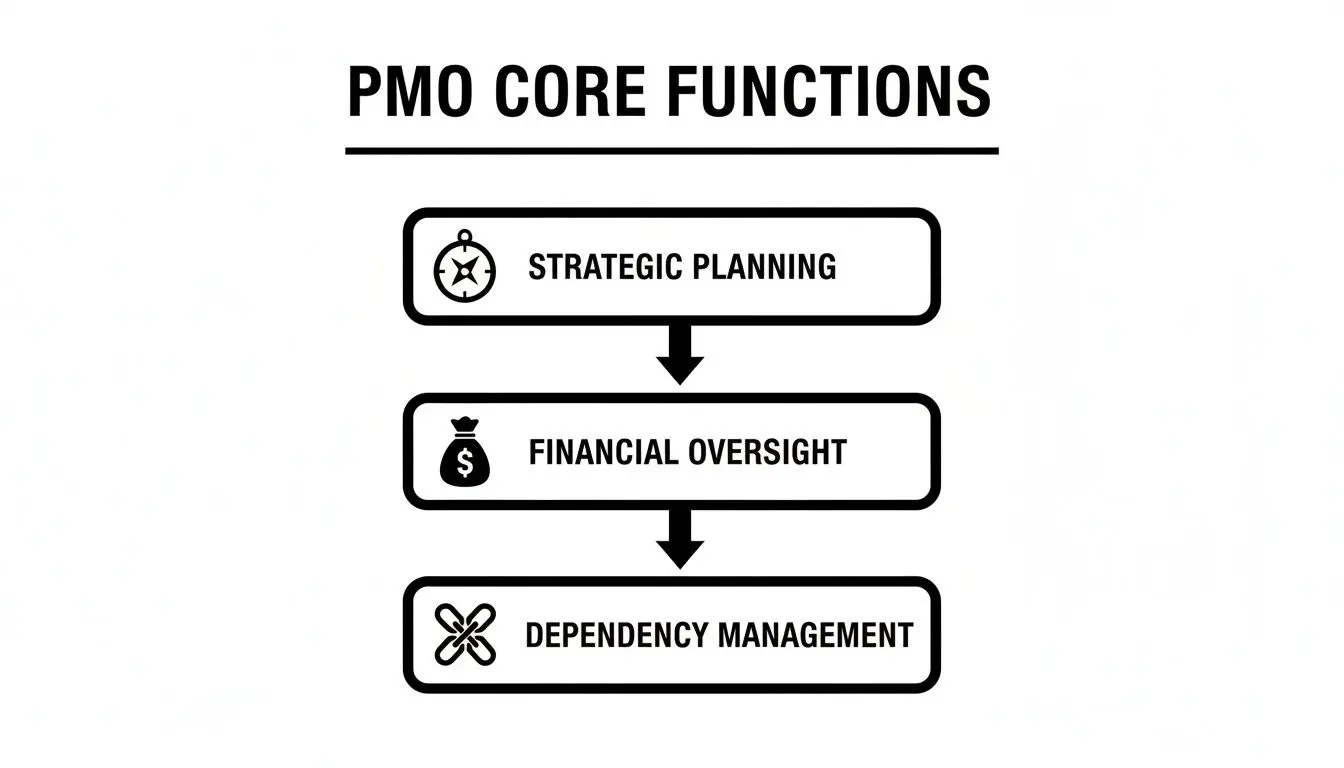
This structure clarifies that a PMO’s value originates from strategic alignment. From there, it cascades down through financial discipline and the tactical management of dependencies.
Integrating the PMO Into the Organizational Structure
The optimal placement of a PMO depends on organizational size and complexity. In a lean startup, it might be a single senior individual reporting to the CTO. In a mid-sized company, it could be a small team overseeing key product lines. In an enterprise, a formal, centralized PMO department is common.
Regardless of the structure, the PMO must have a direct line of communication to both technical and business leadership to be effective.
The greatest implementation risk is creating a “reporting-only” PMO. This is a function that collects status updates and generates dashboards but lacks the authority to make decisions, reallocate resources, or enforce governance. It becomes pure administrative overhead, signaling problems without the power to help solve them.
Effective program governance enables better, faster decisions at the portfolio level, bringing order to complex execution environments. For organizations focused on continuous improvement, establishing this function is a logical step in operational maturity. You can learn more about applying this mindset from our article on what Kaizen projects are and why they work for maintaining systems.
By carefully implementing a PMO with a clear mandate and genuine authority, technical leaders can transform project chaos into strategic, value-driven execution.
The Modern PMO Toolkit and Methodologies
A Program Management Officer equipped with the wrong tools or rigid, outdated methodologies can create more friction than value. Their impact comes from selecting frameworks and systems that provide leadership with clarity and control without burdening engineering teams with excessive administrative overhead.
The objective is pragmatic governance, not bureaucracy.
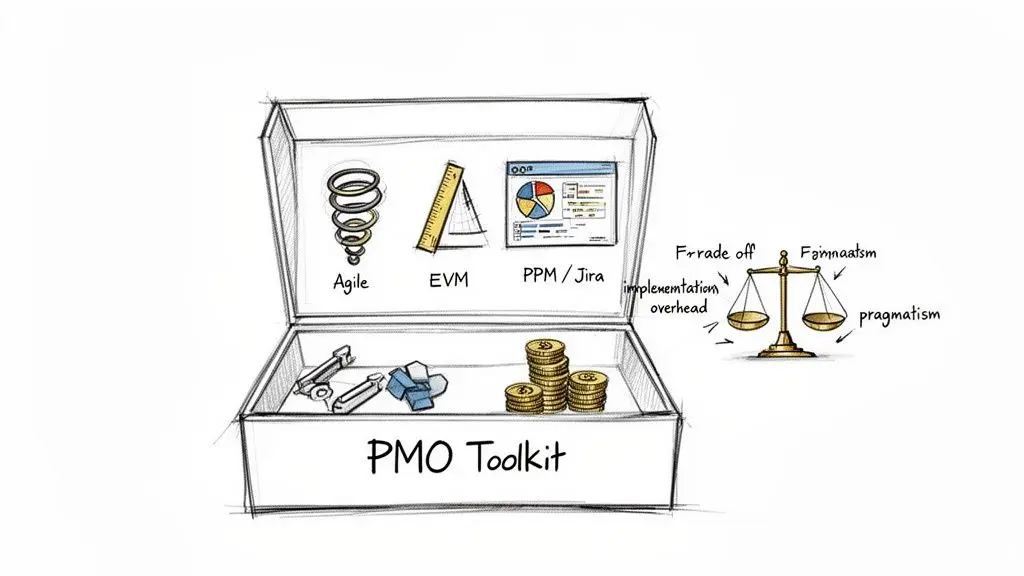
This requires moving away from a one-size-fits-all approach. While a full-scale Project Portfolio Management (PPM) suite may be essential for a large enterprise, its implementation overhead could cripple a smaller company’s productivity. In such cases, well-configured Jira dashboards combined with a lightweight financial tracker often provide a better trade-off between visibility and agility.
Methodologies For Strategic Oversight
The right methodology provides a shared language and a consistent framework for measuring progress across disparate projects. For modern software and AI programs, two methodologies are particularly relevant, though they address different problems.
-
Scaled Agile Frameworks (e.g., SAFe, LeSS): When multiple agile teams are working on interdependent components of a larger system, these frameworks provide the necessary guardrails for coordination. They help a Program Management Officer synchronize sprints, map cross-team dependencies, and align teams on program-level objectives. The key is selective implementation—adopting only the ceremonies and roles that solve specific, existing coordination problems.
-
Earned Value Management (EVM): Often dismissed as a relic of traditional project management, EVM is a powerful and objective tool for financial oversight at the program level. It integrates scope, schedule, and cost data to provide a clear, quantitative picture of performance. By comparing Planned Value (PV), Earned Value (EV), and Actual Cost (AC), a PMO can accurately forecast budget and schedule deviations long before they become crises.
A Program Management Officer must be a pragmatist. Value is not derived from dogmatic adherence to a single methodology. It comes from skillfully blending elements from different frameworks to fit the organization’s specific context and maturity.
Essential Software Categories
While methodologies provide the “how,” software provides the operational backbone. An effective PMO toolkit is typically built around a few key software categories, each serving a distinct governance function.
Project Portfolio Management (PPM) Systems These are the command centers for program oversight. A robust PPM tool like Monday.com or Planview provides a consolidated view of all projects in the program, allowing the PMO to track timelines, resource allocation, and budget consumption at a high level. They are indispensable for identifying portfolio-level risks and making data-driven decisions about resource allocation.
Financial Tracking and Analysis Tools This capability extends beyond simple budget spreadsheets. A PMO requires tools for proper financial modeling, including tracking capital vs. operational expenditures (CapEx/OpEx), calculating ROI, and running what-if scenarios to assess the financial impact of potential delays or scope changes. This is how the PMO translates technical progress into a language the CFO understands.
Risk and Compliance Registers In today’s regulatory environment, particularly with frameworks like GDPR and NIS2, systematic risk management is not optional. Dedicated registers are essential for identifying, assessing, and tracking mitigation efforts for program-wide risks. These tools provide an auditable trail, ensuring that compliance is an integral part of the delivery process, not an afterthought. You can see a practical example in our free AI Risk & Privacy Checklist.
The modern Program Management Officer role demands a potent mix of analytical skill, problem-solving, and hands-on experience with these tools and methodologies. Recent BLS data forecasts 77,000 new project-related roles each year through 2033, with IT program management growing 99% faster than the national average, largely fuelled by complex cloud and AI initiatives.
As the role continues to evolve within PPM, this growth highlights just how critical a well-defined and expertly managed toolkit has become.
To make this concrete, here are key performance indicators a Program Management Officer tracks to measure the health and value of a technology program.
Key Performance Indicators for Program Success
| KPI Category | Specific Metric | What It Measures |
|---|---|---|
| Financial Health | Cost Performance Index (CPI) & Schedule Performance Index (SPI) | The efficiency of budget and time utilization. An index over 1.0 is favorable; under 1.0 is not. |
| Financial Health | Budget Variance (Actual Cost vs. Planned Value) | The raw delta between what was planned to be spent and what was actually spent. |
| Delivery & Progress | On-Time Completion Rate | The percentage of projects or major milestones delivered by their original deadline. |
| Delivery & Progress | Program Increment (PI) Objective Completion | In agile environments, the percentage of committed PI objectives that were successfully delivered. |
| Risk & Compliance | Number of Unmitigated High-Severity Risks | The program’s exposure to critical threats that have not yet been effectively addressed. |
| Stakeholder Value | Net Promoter Score (NPS) or Stakeholder Satisfaction | The perception of key stakeholders regarding the value and execution of the program. |
| Strategic Alignment | ROI or Realized Business Value | The tangible financial or operational benefits delivered by the program versus its total cost. |
Tracking these metrics elevates the PMO’s function from simple coordination to strategic value delivery, giving leadership a clear, quantitative view of how their investment is performing.
How to Write a PMO Job Description That Attracts Top Talent
To attract a high-caliber Program Management Officer, a generic job description is insufficient. Top candidates are not looking for a list of administrative tasks; they are looking for strategic challenges. The job posting is the first signal of the role’s importance and the organization’s operational maturity.
A vague, jargon-filled description will attract project managers seeking a title promotion. A precise, outcome-focused description will attract strategic leaders who understand how to manage complex technology portfolios. The goal is to articulate the problem they will solve, not just the duties they will perform.
Role Summary: The Strategic Hook
Begin with a concise summary that frames the role around its strategic impact. Avoid generic phrases like “oversee projects.” Instead, connect the position directly to a critical business objective.
Weak Example: “We are looking for a Program Management Officer to manage a portfolio of IT projects, ensuring they are delivered on time and within budget.”
Strong Example: “As a Program Management Officer, you will establish and operate the strategic governance framework for our portfolio of software development and AI initiatives. Your primary objective is to ensure these interdependent projects collectively deliver on our goals of enhancing platform reliability and accelerating market expansion, directly impacting company growth.”
The second example immediately communicates that the candidate will be a key player in corporate strategy, not merely a process administrator.
Key Responsibilities: Focusing on Outcomes
List responsibilities as outcomes, not tasks. This shifts the focus from “doing things” to “achieving results.” Incorporate technical and compliance-specific language to demonstrate an understanding of the modern technology landscape.
Frame responsibilities in this manner:
- Establish and operate a program governance framework that aligns our AI integration and SaaS platform development initiatives with key business objectives.
- Manage a multi-million-dollar program budget, providing financial oversight and ROI analysis to executive stakeholders to guide investment decisions.
- Identify and mitigate cross-project dependencies, resolving resource conflicts between teams working on MLOps pipelines and core application features.
- Ensure program-wide compliance with regulatory standards like GDPR and NIS2 by embedding privacy and security controls into the delivery lifecycle.
This level of detail signals that the role has genuine authority and deals with substantive, modern challenges, effectively filtering out candidates who lack experience in these critical domains.
Required Qualifications: Avoiding the Checklist Trap
Many job descriptions fail by becoming an unrealistic wish list of certifications and years of experience, deterring excellent candidates who may not meet every criterion. Focus on demonstrated ability over credentials.
A common mistake is listing an excessive number of certifications (PMP, PgMP, SAFe, etc.). While valuable, relevant experience is paramount. A candidate who has successfully governed a complex, multi-year program is far more valuable than one who has only passed certification exams.
A job description should be a magnet for the right talent, not a filter designed to exclude all but the “perfect” candidate. Prioritize demonstrated experience in solving problems similar to yours over an exhaustive list of qualifications.
For instance, instead of “PMP certification required,” consider “Demonstrated success in managing technology programs with budgets exceeding $5M; PMP or PgMP certification is a strong plus.” This signals what you truly value. It is also important to signal company values, such as the importance of ethical guidelines in engineering. You can learn more by reading our practical guide on a code of conduct for engineering and AI teams.
By crafting a job description that is strategic, outcome-oriented, and realistic, you move beyond merely filling a position. You initiate a conversation with the kind of Program Management Officer who can provide true leadership and drive measurable business value.
Actionable Takeaways for Technical Leaders
For founders and CTOs, the primary challenge is not just shipping projects; it’s converting a portfolio of technology initiatives into tangible business value. The emergence of resource conflicts, strategic drift, and poor portfolio visibility are clear indicators that simple project management is no longer sufficient. The Program Management Officer role is designed to provide the strategic oversight required to address these systemic issues.
However, creating the title on an org chart guarantees nothing. Success requires a fundamental shift in mindset—from tactical execution to strategic governance.
From Project Outputs to Program Outcomes
The most critical takeaway is this: a Program Management Officer is a strategic governance function, not a senior project manager. Their value is not measured by delivering individual projects on time and within budget. It is measured by ensuring the entire program—the collection of interconnected projects—achieves its stated business objectives. This distinction is fundamental to setting correct expectations and defining success.
A project manager asks, “Did we build the feature correctly?” A Program Management Officer asks, “Did building these features together achieve the market impact and ROI we were aiming for?” This shift in perspective is the foundation of effective program governance.
Mandate and Metrics Are Non-Negotiable
To avoid creating a “reporting-only” role that adds administrative overhead, you must provide the Program Management Officer with a clear and authoritative mandate. This includes the power to reallocate resources between teams, manage budgets at the program level, and hold project teams accountable to overarching strategic goals.
This authority must be paired with relevant performance metrics. Move beyond vanity metrics and focus on what truly measures program success:
- Return on Investment (ROI): Is the program delivering tangible business value that justifies its cost?
- Cost Performance Index (CPI): Are we using our budget efficiently across the entire portfolio?
- Benefits Realization: Are we achieving the non-financial objectives—such as improved system reliability or increased market penetration—that were used to justify the program’s existence?
Ultimately, a Program Management Officer is an investment in your organization’s ability to build scalable, value-driven software systems. By establishing this role with a clear mandate and the right metrics, you create a powerful mechanism for translating technical execution into measurable business success. It signals a commitment to long-term partnership and building technology that endures.
Conclusion: Key Questions for Technical Leaders
Here are the practical, real-world questions that technical leaders should consider when evaluating the need for a Program Management Officer.
When Is the Right Time to Hire a Program Management Officer?
The trigger is complexity, not employee headcount. The need for a Program Management Officer emerges when an organization is running multiple, interconnected projects that must align to a common strategic direction.
Key indicators include:
- Chronic contention for critical engineering and technical resources.
- Successful delivery of individual projects that fail to collectively advance strategic business goals.
- A lack of a single, coherent view of portfolio progress, risks, and dependencies for leadership.
For startups, this inflection point often occurs post-Series A or B funding, when the organization shifts from building a single product to scaling multiple initiatives simultaneously.
Can a Senior Project Manager Transition into a PMO Role?
Yes, but it requires a significant shift in perspective from tactical delivery to strategic oversight. A Project Manager focuses on executing a specific project within defined constraints. A Program Management Officer operates at a higher level, ensuring a portfolio of projects delivers a larger business outcome.
The core question evolves from “Are we executing this project correctly?” to “Are we executing the correct projects to achieve our strategic goals?” It is a pivot from managing execution to managing value.
To make this transition successfully, a project manager must develop expertise in financial analysis, enterprise risk management, and influencing stakeholders across the organization. This is not a transition that can be improvised; it requires mentorship, strategic training, and a clear mandate from leadership to operate at the program level.
How Does a PMO Govern Highly Uncertain R&D Programs, such as in AI?
For projects with high uncertainty, such as AI research and development, the Program Management Officer’s role adapts from control to structured enablement. Instead of enforcing rigid timelines and detailed scopes, the PMO establishes a governance framework that prioritizes learning and iterative progress.
This model includes:
- Setting clear research questions and hypotheses, not fixed deliverables.
- Defining success criteria for experiments (e.g., achieving a target model accuracy or reducing cost-per-inference).
- Managing an R&D budget with clear stage-gates for making continue/pivot/kill decisions.
- Ensuring that learnings from all experiments—both successful and unsuccessful—are systematically documented and communicated to business stakeholders.
In this context, the PMO does not manage the day-to-day research. They act as a stabilizing force, ensuring that exploratory work remains aligned with strategic objectives without stifling the innovation required for breakthroughs. They manage the investment and the risk, not the science.
At Devisia, we turn your business vision into reliable digital products and AI-enabled systems. With a product mindset focused on clear decisions, incremental delivery, and long-term maintainability, we provide the technical partnership you need to build meaningful, scalable software. Learn more at https://www.devisia.pro.