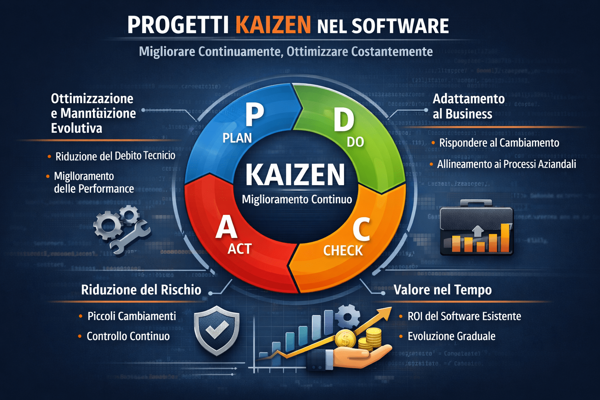
In the software and digital product world, attention is often focused on the initial development phase. However, the real complexity — and long-term value — emerges after go-live, particularly in modern SaaS development.
This is where Kaizen projects come into play.
What Is Kaizen?
Kaizen is a Japanese methodology that literally means “continuous improvement.” Unlike approaches based on major transformations or radical rewrites, Kaizen focuses on:
- small, incremental improvements
- continuity over time
- constant involvement of people and teams
- systematic observation of existing processes
When applied to software, Kaizen is not a technical framework, but a way of managing the evolution of a system, essential for high-quality SaaS development.
What a “Kaizen Project” Means in Software
A Kaizen project is not a project with a fixed end date. It is a structured, ongoing improvement journey focused on a system that is already in production.
Typical Kaizen activities include:
- performance optimization
- technical debt reduction
- process refinement
- progressive automation and AI integration in software
- reliability, AI security, and artificial intelligence governance enhancements
The goal is not to “add more,” but to make what already exists work better while ensuring a responsible AI approach.
Why Kaizen Is Especially Effective for Maintenance
1. Lower Operational Risk
Small, controlled changes are safer than large, disruptive transformations. Each improvement is:
- measurable
- reversible
- easy to validate
This is critical for mission-critical systems such as ERPs, CRMs, SaaS platforms, and integrations.
2. Continuous Alignment with the Business
Business needs constantly evolve: processes, priorities, volumes, and regulations change over time. A Kaizen approach allows software to:
- evolve alongside the organization
- avoid rigid solutions that age poorly
- respond to real, observed needs rather than assumptions
3. Prevents Natural System Degradation
Every system, if left unattended, tends to:
- slow down
- accumulate complexity
- become harder to understand
- become more expensive to change
Kaizen acts as continuous evolutionary maintenance, preventing degradation instead of reacting to it.
4. Optimizes Costs and Investments
From a financial perspective, Kaizen projects:
- spread costs over time
- reduce the need for sudden, large rewrites
- maximize the ROI of existing software
Very often, a small, targeted improvement delivers more value than a new feature that no one actually uses.
Kaizen vs “One-Shot” Projects
| Traditional Approach | Kaizen Approach |
|---|---|
| Fixed start and end | Continuous journey |
| Large releases | Incremental improvements |
| High risk | Controlled risk |
| Delivery-focused | Long-term value-focused |
| Reactive maintenance | Proactive evolution |
When Kaizen Is the Right Choice
A Kaizen approach is ideal when:
- the system is already in production
- the product works, but can work better
- the business context is constantly evolving
- stability is as important as innovation
- software is considered a long-term asset
In other words: when software is infrastructure, not an experiment.
Conclusion
Kaizen projects challenge a common assumption in digital development: not everything needs to be rewritten, and not every improvement requires a revolution.
Very often, real innovation lies in continuously improving what already delivers value, with method, discipline, and long-term vision.
This is where software stops being just technology and becomes a strategic business asset.