The software development V-model is a sequential process model where the execution of processes happens in a V-shape. It is a disciplined extension of the Waterfall model, systematically linking every development phase on the way down to a corresponding testing phase on the way up.
The process begins on the left side of the ‘V’, moving from high-level requirements to granular design. At the bottom, coding occurs. The process then ascends on the right side, moving through a sequence of verification and validation activities. The primary objective is to integrate rigorous quality control and testing into the project from the very beginning.
Why the V-Model Still Matters for Modern Technical Leaders

In an engineering culture dominated by Agile methodologies, structured processes like the V-Model can be easily dismissed as obsolete. However, this perspective overlooks its strategic value for specific high-stakes projects. For systems where failure carries significant financial, regulatory, or safety consequences, the V-Model provides a critical strategic tool. Its true power lies in its core principle of Verification and Validation, where every development action has an equal and opposite quality assurance reaction.
At its heart, this model enforces a symmetrical process where test planning is not an afterthought but an integral part of the initial design stages. This approach delivers a level of control and predictability that most iterative models cannot guarantee, making it essential for systems where requirements are fixed and auditable compliance is a primary concern.
Before diving deeper, here is a concise overview of the V-Model’s core characteristics.
V-Model Core Characteristics At a Glance
| Attribute | Description |
|---|---|
| Structure | Sequential, V-shaped flow. |
| Core Principle | Every development phase is paired with a testing phase. |
| Testing | Early test design, planned alongside requirements and design. |
| Flexibility | Low; requirements must be fixed upfront. |
| Best For | Projects with stable, well-understood requirements (e.g., regulated industries). |
| Key Focus | Verification and Validation, ensuring correctness and quality. |
This table provides a high-level summary, but the practical value is in how the two sides of the “V” interlock.
Unpacking Verification and Validation
To effectively leverage the V-Model, one must understand the distinction between its two arms:
- Verification (The Left Side): This phase focuses on building the product correctly. The guiding question is, “Are we building the product right?” It involves continuous checks against specifications at each design stage before any code is written.
- Validation (The Right Side): This phase is concerned with building the correct product. The question becomes, “Are we building the right product?” This involves testing the actual software against the original user needs and business requirements.
The V-Model’s strength is its built-in symmetry. By creating test cases during the design phases, you ensure that every requirement is testable from the start. This practice significantly reduces the risk of late-stage discoveries that can derail budgets and timelines.
This disciplined structure makes the software development V-model an indispensable choice for regulated industries where failure is not an option. For systems in finance, healthcare, or avionics, requirements are often fixed, and compliance (e.g., with GDPR, DORA, or medical device standards) is non-negotiable. The V-Model provides a clear, auditable trail from requirement to release, ensuring every specification is designed, built, and tested with precision. It is the framework for when reliability is an architectural necessity, not a feature.
Navigating the V-Model From Requirements to Release
The V-Model’s effectiveness comes from its disciplined, dual-path structure. It is not just a sequence of steps but a mirror, reflecting development activities against testing activities. The process involves descending the left side (the Verification path), executing implementation at the bottom, and then ascending the right side (the Validation path).
This diagram illustrates the parallel nature of the process. Note how every design phase on the left has a direct testing counterpart on the right.
The visual makes it clear: test planning is not an afterthought. It is integrated into the design process from the start, ensuring every requirement can be verified.
The Left Side: Verification and Design
The journey begins on the left, a path dedicated to verification. The objective is to ensure the system is being built right. Each step produces a more granular blueprint for developers.
-
Requirement Analysis: This is the foundation. Business analysts, architects, and product leaders collaborate to capture and document all functional and non-functional requirements. The output is a clear specification of what the system must do. Critically, the User Acceptance Test (UAT) plan is drafted at this stage.
-
System Design: With the “what” defined, the team specifies the “how.” This involves high-level system architecture, hardware specifications, and an outline of major software components. The deliverable is the System Design Specification. In parallel, the System Test plan is created to validate the entire system against these specifications.
-
Architectural Design: The system is broken down into its core modules. This phase defines their relationships, dependencies, and communication protocols. As this architectural blueprint is developed, the Integration Test plan is also created to confirm that these modules function correctly together. To explore this topic further, you can learn how to approach IT system integration effectively.
-
Module Design (Low-Level Design): This is the most granular design step. Each module is detailed, specifying its internal logic, data structures, algorithms, and interfaces. This detailed document is what developers use to write code. Concurrently, Unit Test cases are prepared to verify each component in isolation.
The Base of the V: Coding
At the bottom of the V is the Coding phase. This is the only point where code is written. Developers take the detailed Module Design documents and translate them into a working application. Because the design is thorough, this phase is focused on implementation, not architectural problem-solving.
The Right Side: Validation and Testing
With the code written, the project ascends the right side of the V. This path is dedicated to validation—did we build the right product? Each testing phase directly validates the work done in its corresponding design phase.
The core principle is that you are not just testing code; you are validating each stage of the design. A failure in System Testing, for instance, points to a flaw in the System Design, not just a bug. This creates a clear, auditable trail for defect resolution.
This upward journey is a methodical process of assembling and verifying components at each level.
-
Unit Testing: Developers execute the test cases created during Module Design. They test individual components or classes in isolation to ensure each works as specified.
-
Integration Testing: Once units are verified, they are combined into the larger modules defined in the Architectural Design. The Integration Test plan is executed to ensure different parts communicate and function together correctly.
-
System Testing: The fully integrated system is tested end-to-end. This phase executes the System Test plan to verify that all functional and non-functional requirements are met in an environment that mimics production.
-
User Acceptance Testing (UAT): In the final step, the software is handed over to end-users or client representatives. They test the system to confirm it meets the real-world business needs defined in the Requirement Analysis phase. Successful UAT is the final approval for release.
The Strategic Advantages of the V-Model
The V-Model’s disciplined nature translates into tangible business and technical outcomes, especially for projects where quality, predictability, and compliance are non-negotiable. Its strict structure is not a bureaucratic hurdle but a strategic asset. The heavy emphasis on upfront planning and early test design delivers significant advantages for mission-critical systems.
This diagram shows the interconnected workflow. Each development stage on the left corresponds directly to a testing phase on the right.
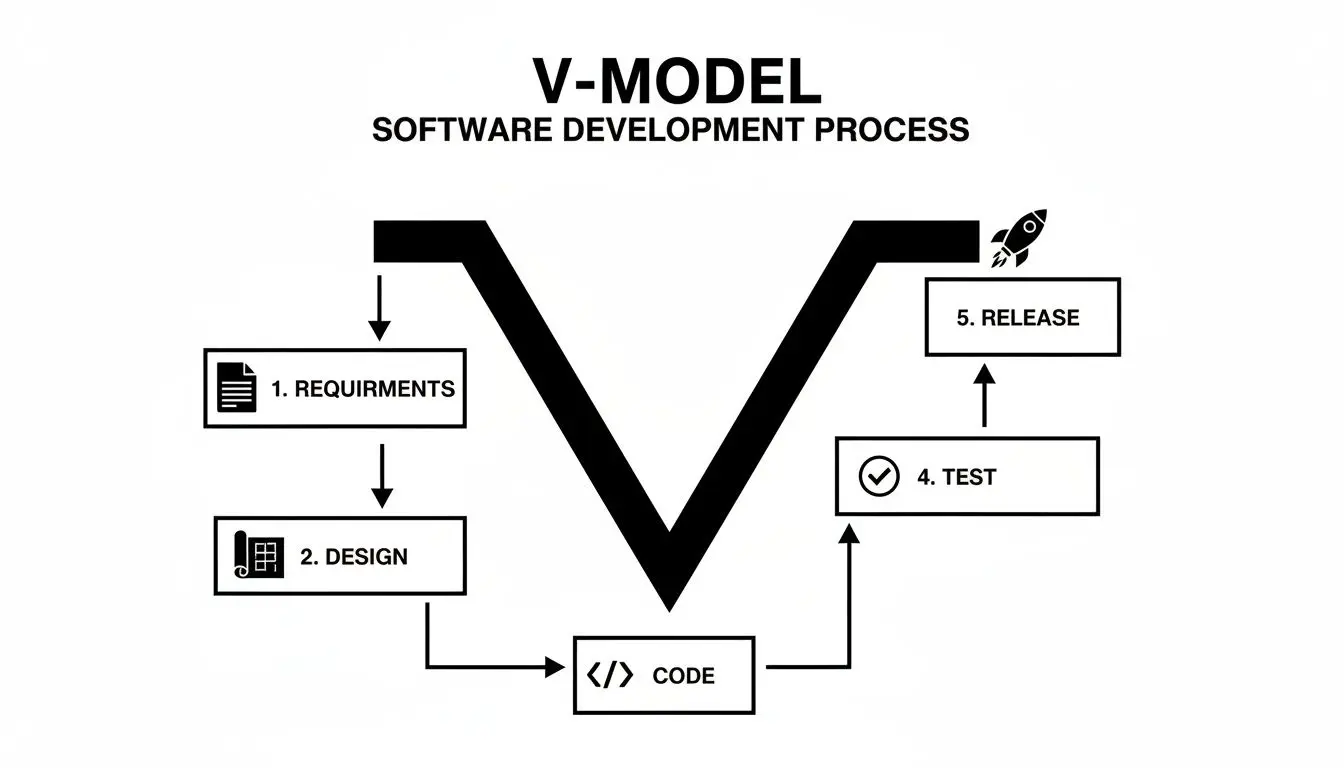
The key takeaway from this flow is its symmetry. Test planning starts with requirements analysis, not after code is written. This proactive approach is the source of the model’s primary benefits.
Superior Defect Detection
The most significant advantage of the software development v model is its ability to catch defects extremely early. By creating test cases during the design phases, flaws are often found in the documentation—on paper—long before code is written.
Fixing a requirement error is exponentially cheaper and faster than fixing a bug discovered in a live production environment. This “shift-left” approach to quality assurance dramatically reduces the cost and impact of errors. It ensures every requirement is not just implemented but is also testable and verified, minimizing late-stage surprises that derail budgets and timelines.
Enhanced Project Control and Traceability
The V-Model provides an exceptional level of project control. Its strict, sequential nature makes scope creep difficult to justify. Since requirements are locked down early, the team can focus on delivering what was agreed upon without the distraction of new feature requests.
This rigid structure also creates a clear and auditable trail. The key benefits include:
- Robust Traceability: Every feature can be traced from its test case back to its corresponding design element and the original business requirement. This is essential for accountability and for diagnosing issues.
- Compliance-Ready Documentation: For projects in heavily regulated industries like finance or healthcare, the V-Model naturally produces the thorough documentation required for audits against standards like GDPR or DORA.
- Predictable Outcomes: Because planning is so exhaustive, project managers can forecast timelines and budgets with higher confidence than with more flexible methodologies.
The V-Model’s strength lies in transforming quality assurance from a final gate into a continuous discipline. It forces a level of rigor that makes it the default choice for systems where reliability is not just a feature, but the entire foundation.
V-Model vs. Other Methodologies: A Strategic Choice
Selecting a development methodology is a strategic decision that shapes a project’s rhythm and risk profile. The choice should be pragmatic, based on project realities rather than industry trends. For a CTO or product leader, understanding the trade-offs between the V-Model, Waterfall, and Agile is fundamental to aligning engineering efforts with business goals.
V-Model vs. Waterfall: Predictability with Proactive Quality
The V-Model and Waterfall are both linear, sequential, and require significant upfront planning. Both have low tolerance for changes once the project is underway.
The key difference lies in their approach to quality assurance.
Waterfall consolidates testing into a single, monolithic phase at the end of the development cycle. This creates a high-risk “big bang” integration where bugs and design flaws surface simultaneously, often leading to chaotic and expensive rework.
The software development V-Model addresses this by integrating verification and validation throughout the lifecycle. Its defining feature is planning tests in parallel with design. This proactive approach catches design flaws on paper, long before code is written, which is a more effective way to build quality into the system from the start.
V-Model vs. Agile: Certainty vs. Flexibility
The comparison with Agile highlights a core strategic trade-off: predictability versus flexibility.
The V-Model is designed for certainty. It excels when requirements are stable, well-understood, and unlikely to change. This makes it an ideal choice for projects where reliability and compliance are non-negotiable—such as building a financial transaction processor or the control software for a medical device. The heavy upfront investment in planning provides a high degree of confidence in the final outcome, timeline, and budget.
The choice between the V-Model and Agile boils down to a key question: Are you building a bridge or exploring a new continent? The V-Model is your detailed blueprint for the bridge. Agile is your compass for exploration—it helps you adapt as you discover the terrain.
Agile, by contrast, is designed for uncertainty and adaptation. It is the appropriate choice when requirements are expected to evolve and rapid market feedback is critical for success. Developing a new user-facing feature for a SaaS product, where customer reactions will shape the final form, is a classic Agile use case. Its iterative cycles allow for constant course correction, a flexibility the V-Model cannot accommodate. Modern practices often blend these principles; for example, a CI/CD pipeline automates delivery to enable faster feedback loops even in structured environments.
Even on smaller projects, the V-Model’s rigorous traceability can offer an edge. Research has shown it can outperform Waterfall in reliability by 20-30% on projects under 50 developer-months. Its most significant benefit is a 40% reduction in risk due to early, module-by-module testing. This is a critical advantage for complex systems like AI integrations where robustness is paramount. You can read more about the detailed findings on V-Model performance and its impact.
Methodology Selection Framework
Choosing the right methodology is one of the most critical decisions a technology leader can make. The wrong choice leads to friction and delays, while the right one aligns the team for success. This table provides a framework for comparing these models based on key project factors.
| Factor | V-Model | Agile (e.g., Scrum) | Waterfall |
|---|---|---|---|
| Requirements | Fixed and well-defined | Evolving and dynamic | Fixed and fully defined upfront |
| Flexibility | Very low once started | Very high; built for change | Extremely low; changes are costly |
| Risk Management | Proactive; early test design | Continuous risk mitigation | Reactive; late-stage testing |
| Client Involvement | Low; mainly at start and end | High and continuous | Low; primarily during requirements |
| Best For | High-reliability, regulated systems (medical, finance) | User-facing products, R&D, uncertain markets | Simple, short projects with no ambiguity |
| Key Advantage | High quality and predictability | Adaptability and speed to market | Simplicity and strict control |
No single methodology is a universal solution. The V-Model provides unparalleled rigor for when you cannot afford to be wrong. Agile offers the speed and flexibility to navigate uncertainty. Even Waterfall has a place for the simplest projects. The key is to honestly assess your project’s constraints and choose the tool that best fits the job.
Knowing When to Avoid the V-Model
An effective guide must also provide honest limitations. While the V-Model offers exceptional quality control, its greatest strength—its rigid structure—is also its most significant weakness. As a CTO or technical leader, knowing when not to use this model is as critical as knowing when to apply it. Forcing the wrong project into this framework is a reliable path to failure.
The software development V-Model is the wrong choice for any project where requirements are ambiguous, incomplete, or likely to change. Its entire logic depends on a stable, fully understood set of requirements before design begins. If your project involves market exploration, relies on user feedback loops, or includes innovative features with many unknowns, the V-Model is the wrong tool.
The High Cost of Inflexibility
Attempting to change direction mid-project with the V-Model is not just difficult; it is prohibitively expensive and complex. A seemingly small change to a requirement triggers a domino effect, forcing a formal rework of every subsequent document: system design, architectural design, module design, and all associated test plans.
This cascade of rework nullifies the model’s primary benefit of predictability. What began as a clear path becomes a tangled mess of revised documents, version control challenges, and team confusion.
The V-Model demands that you know your exact destination before taking the first step. If the destination is uncertain, forcing a project into this rigid structure is a recipe for budget overruns and missed deadlines.
Practical Hurdles and Upfront Costs
Beyond its inflexibility, other practical issues can make the V-Model a non-starter, especially for fast-moving organizations or teams focused on rapid time-to-market.
Consider these significant hurdles:
- Heavy Upfront Investment: The model requires a massive initial investment in planning, analysis, and documentation. This can occupy key personnel for weeks or months before any code is written.
- Delayed Start to Coding: No code is written until the low-level module design is complete and signed off. For stakeholders expecting to see a working prototype, or for projects where speed is critical, this long delay can be a deal-breaker.
- Massive Documentation Overhead: The sheer volume of documentation required can be a significant burden. It takes considerable effort to create, review, and maintain, which is often impractical for smaller teams or in a culture that values lean processes.
The V-Model is a specialist tool for high-stakes projects with a high degree of certainty. Applying it to the wrong kind of problem is a critical—and costly—mistake.
Practical Steps for Implementing the V-Model
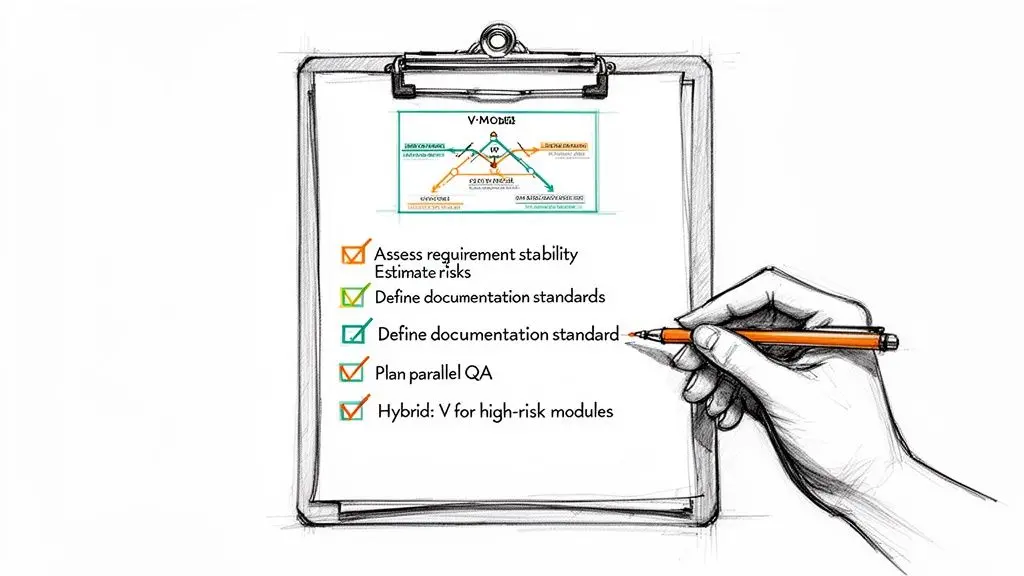
Transitioning from theory to practice requires clear, actionable steps. Before committing to the V-Model, ensure it is the right tool for the job by asking critical questions.
Is the V-Model Right for Your Project?
Use this checklist to make a pragmatic decision. The V-Model is a strong candidate only if you can confidently answer “yes” to most of these questions:
- Requirement Stability: Are the project requirements fully defined, unambiguous, and genuinely fixed?
- Risk Tolerance: Is this a mission-critical project where failure would have severe business, safety, or financial consequences?
- Regulatory Scrutiny: Is the project subject to strict regulations (like DORA in finance or standards in healthcare) that demand a full, auditable documentation trail?
- Contractual Obligations: Are you working under a fixed-scope, fixed-price contract that prioritizes predictability over flexibility?
If the answer to these is “no,” a more flexible, iterative approach is likely a better fit.
A successful rollout of the software development V model depends on securing total buy-in from all teams for its rigorous documentation and parallel testing activities. Roles must be sharply defined—a non-negotiable skill for any successful IT project manager.
The V-Model does not have to be an all-or-nothing commitment. It can be used as a specialized tool within a larger program. For example, apply it to build a high-risk security component or a core transaction engine inside a broader Agile project. It remains a powerful choice for specific engineering challenges where rigor is paramount.
Conclusion: Key Takeaways for Technical Leaders
The software development V-model is not a relic of a bygone era but a strategic asset for specific, high-stakes scenarios. For technical leaders, the decision to use it should be a pragmatic one, based on a clear understanding of its trade-offs.
- Embrace it for Certainty: Use the V-Model when requirements are stable, and the cost of failure is high. Its strength lies in building highly reliable, compliant, and predictable systems for regulated industries.
- Avoid it for Uncertainty: Steer clear of the V-Model for projects with evolving requirements, where market feedback is essential, or when speed-to-market is the primary driver. Its rigidity is a liability in these contexts.
- Understand the Trade-offs: The V-Model prioritizes predictability and quality over flexibility. This comes at the cost of significant upfront planning and a delayed start to coding.
- Think Hybrid: Consider applying the V-Model selectively to critical components within a larger, more flexible project structure. This allows you to benefit from its rigor where it matters most without constraining the entire project.
Ultimately, the V-Model is a powerful tool in a leader’s arsenal. Knowing when—and when not—to deploy it is a mark of mature engineering leadership.
At Devisia, we believe in choosing the right methodology for the job, balancing rigor with pragmatism to deliver meaningful, maintainable software. Discover how our product-first approach can turn your vision into a reliable digital product. Learn more at https://www.devisia.pro.