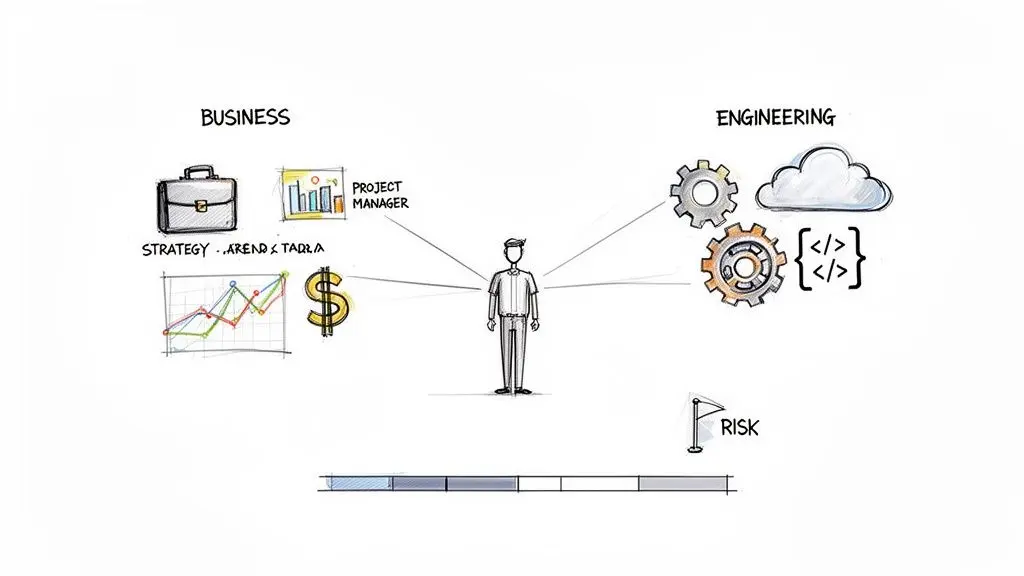
An IT project manager ensures complex software projects are delivered on schedule, within budget, and to specification. Their role extends beyond task tracking; they are the strategic bridge between business objectives and technical implementation, managing scope, risk, and communication to prevent project failure.
The Problem: Why Complex Technical Projects Fail
Most complex software initiatives do not fail due to poor code quality. They fail because of a breakdown in managing constraints: scope creep, unidentified risks, and poor communication are the typical failure points that even elite engineering teams cannot solve alone. This is the precise problem an effective IT project manager is hired to address.
They function as the central control point for any major software or AI initiative, responsible for translating an ambitious business vision into a concrete, executable plan. More than a scheduler, they provide the connective tissue between stakeholders, technical teams, and executive leadership, enforcing the operational discipline required for predictable delivery.
Beyond Gantt Charts: The Strategic Function
A common misconception is that the role is purely administrative—updating timelines and tracking tasks. While these activities are outputs, they result from a much deeper, strategic function. A skilled IT project manager institutes the structure necessary to deliver reliable systems, not just features.
Their primary value is in creating clarity and predictability through three core activities:
- De-risking technical initiatives: Identifying potential architectural, compliance, or resourcing vulnerabilities long before they escalate into crises.
- Enforcing strategic alignment: Ensuring engineering efforts remain directly tied to business goals, preventing costly and time-consuming deviations.
- Facilitating pragmatic trade-offs: Mediating decisions between scope, budget, and deadlines, ensuring stakeholders understand the consequences of each choice.
An effective IT project manager doesn’t just ask, “Is it done?” They ask, “Does this deliver the intended business value, is it secure, and is the system maintainable?” This shift in perspective separates tactical task management from strategic project leadership.
Ultimately, this individual owns the how and the when, freeing founders and CTOs to focus on the what and the why. Their presence introduces a layer of operational rigor essential for building complex systems where failure is not a viable option.
Core Responsibilities and Technical Acumen
An IT project manager operates on three pillars: scope and timeline, risk mitigation, and budget oversight. These are not administrative checkboxes but interconnected disciplines that require strategic thinking and technical literacy. The role translates high-level business goals into a clear, actionable plan that an engineering team can execute.
The process begins by defining what will be built and, just as critically, what will be excluded. The project manager establishes a precise scope, decomposes large initiatives into manageable work packages with firm deadlines, and acts as a gatekeeper against scope creep by forcing a discussion about the resource impact of every new request.
Proactive Risk and Compliance Management
Beyond scheduling, a proficient IT project manager is the project’s primary defense against failure. This requires identifying potential threats—technical, regulatory, or operational—before they materialize. In B2B systems, these risks are often highly technical and entangled with compliance mandates.
Consider a team deciding between a novel open-source AI model and a commercially licensed API. The open-source option may appear cheaper and more flexible, but it introduces risks related to security vulnerabilities, uncertain long-term support, and ambiguous licensing. The commercial API offers predictable costs and defined support but may be less customizable. The IT project manager frames this decision by evaluating the technical trade-offs against business and legal constraints.
A superficial analysis might favor the lowest initial cost. An experienced IT project manager understands that security and compliance are architectural choices, not features to be added later. They integrate requirements from regulations like GDPR, NIS2, and DORA into the project plan from day one.
Technical Literacy as a Prerequisite
Assessing risk at this level is impossible without genuine technical literacy. An effective IT project manager does not need to be a senior software engineer, but they must be fluent in the language of engineering to bridge the gap between the development team and business leadership.
Key areas of technical knowledge include:
- Architectural Patterns: Understanding the implications of architectural choices, such as microservices versus a monolith, on scalability, maintenance costs, and team structure.
- CI/CD Pipelines: Recognizing the role of continuous integration and delivery in reducing deployment risk and enabling faster feedback loops. Learn more about building a robust CI/CD pipeline in our detailed guide.
- Privacy by Design: Championing the principle that data protection must be integrated into the system’s core architecture, not treated as a post-launch remediation task.
This technical depth enables the IT project manager to conduct credible conversations with engineers, challenge assumptions, and accurately translate technical constraints for non-technical stakeholders. Without it, the role is reduced to task tracking, incapable of guiding a project through the complexities of modern software development. Their responsibility is to ensure the final product is not only delivered on time and on budget but is also secure, compliant, and maintainable.
Differentiating the IT Project Manager from Other Roles
Ambiguous role definitions create operational chaos. When responsibilities overlap, critical tasks are dropped, projects stall, and accountability erodes. This is particularly damaging in technology organizations where the distinct functions of the IT Project Manager, Product Manager, and Program Manager must operate in concert.
Clarity of purpose is not a luxury; it is a prerequisite for effective execution. Each role has a unique mission, and understanding these distinctions is fundamental to building a team that can deliver complex systems without internal friction. Attempting to merge these roles often results in an overburdened individual and critical functions being neglected.
Defining Core Locus of Control
The simplest way to differentiate these roles is by the primary question they are responsible for answering. While all contribute to a project’s success, their perspectives and priorities are distinct. The IT Project Manager is grounded in the reality of execution.
A practical framework is as follows:
- An IT Project Manager owns the ‘how’ and the ‘when’. Their domain is execution—managing resources, timelines, and budgets to deliver a specific, defined outcome.
- A Product Manager owns the ‘what’ and the ‘why’. Their focus is the product itself—defining its features based on market analysis and user needs to solve a specific problem.
- A Program Manager oversees ‘strategic alignment’. They manage a portfolio of interconnected projects to ensure they collectively achieve a larger business objective. You can explore this role further in our guide to the Program Management Officer.
This flowchart illustrates the primary domains an IT Project Manager commands within a single project.
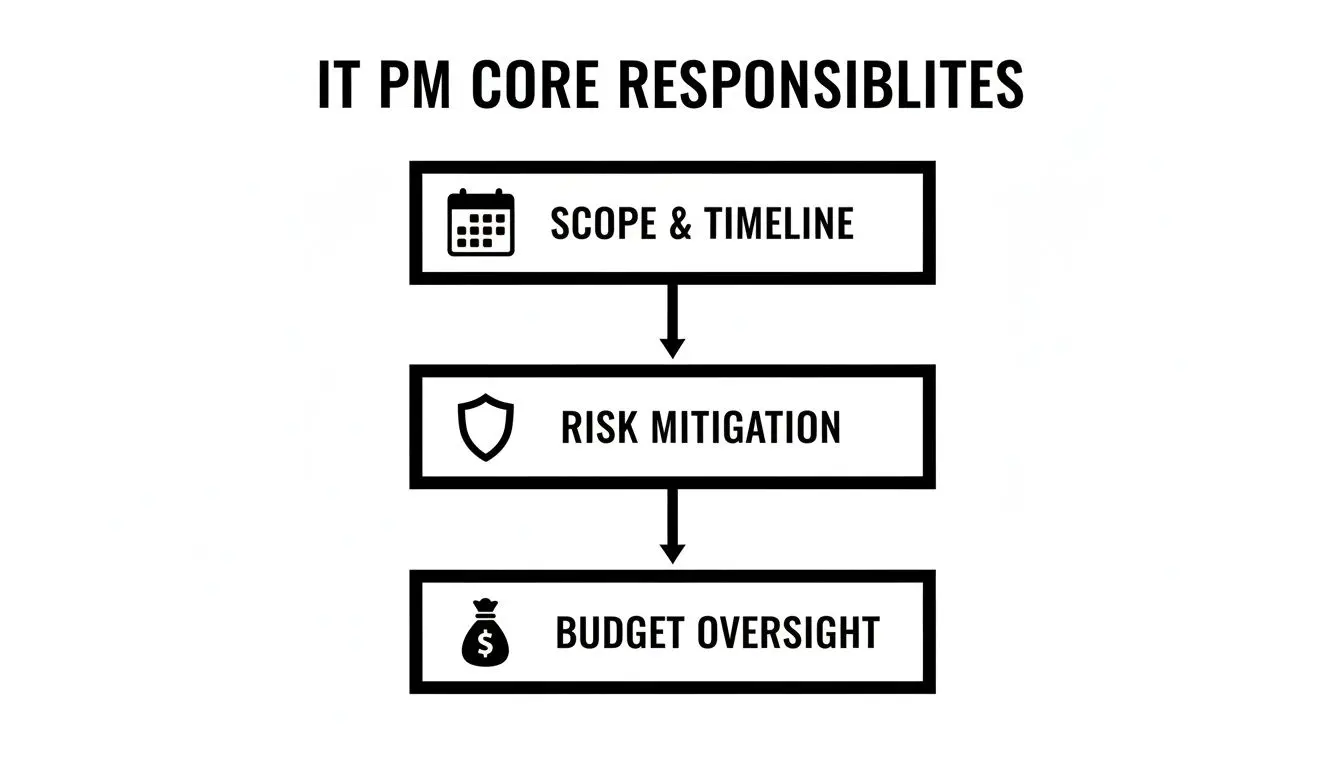
The hierarchy is clear: the IT Project Manager’s responsibilities—scope, timeline, risk, and budget—are the tactical mechanisms that drive successful project execution.
Role Comparison: A Side-by-Side Analysis
| Aspect | IT Project Manager | Product Manager | Program Manager |
|---|---|---|---|
| Primary Focus | Execution: How and when the project will be delivered. | Vision: What should be built and why. | Strategy: How multiple projects connect to achieve a business goal. |
| Key Responsibilities | Timeline management, budget tracking, resource allocation, risk mitigation, task coordination. | Market research, feature definition, user story creation, roadmap planning, backlog prioritization. | Cross-project coordination, stakeholder management, strategic alignment, resource optimization across projects. |
| Success Metrics | On-time delivery, on-budget completion, scope adherence, team productivity. | User adoption, customer satisfaction, revenue growth, market share, product ROI. | Overall business impact, successful delivery of the entire program, strategic objective attainment. |
This table clarifies the distinct operational lanes for each role, preventing the friction that arises from undefined responsibilities.
Practical Scenario: Launching a Regulated SaaS Platform
Imagine your company is building a new SaaS product for the financial services industry, subject to strict compliance requirements like DORA.
The Product Manager is responsible for market research, customer interviews, and defining the core features. They determine what the platform must do to be valuable and competitive.
The IT Project Manager takes that product vision and translates it into an executable plan. They determine how the development team will build it by mapping the timeline, assigning engineers, establishing sprint schedules, and managing the budget. They are also responsible for identifying and mitigating risks, such as ensuring the chosen cloud architecture complies with data residency rules stipulated by DORA.
If this SaaS launch is part of a broader corporate initiative to enter the fintech market, a Program Manager would oversee the entire effort. Their role is to coordinate the SaaS project with related initiatives—such as a new marketing campaign and a sales team compliance training program—to ensure all components are aligned and progress in unison.
By clearly separating the ‘what’ from the ‘how,’ organizations establish a healthy tension that drives better outcomes. The Product Manager advocates for the user and the market, while the IT Project Manager enforces the discipline of realistic execution.
Measuring the Impact of an IT Project Manager
How can you determine if your IT project manager is effective? Measuring success solely by adherence to deadlines is a common but flawed approach. An exclusive focus on speed can mask serious underlying problems, such as poor code quality, accumulating technical debt, or a final product that fails to meet business objectives.
The true measure of an IT project manager’s impact is not just speed but predictable delivery, system reliability, and strategic alignment. This discipline is increasingly critical. The U.S. Bureau of Labor Statistics projects that demand for project management specialists will grow by 6% between 2024 and 2034, signaling their rising importance. You can find more insights on these career trends from their official reports.
Key Performance Indicators (KPIs) for Evaluation
A comprehensive assessment requires a balanced set of Key Performance Indicators (KPIs) that track both execution efficiency and outcome quality. Optimizing for one at the expense of the other leads to systems that are delivered on time but are impossible to maintain.
First, core execution metrics provide a clear view of operational discipline:
- On-Time Delivery (OTD): The percentage of project milestones completed by their planned date. A straightforward measure of schedule adherence.
- Budget Variance: The difference between the planned budget and actual expenditure. A minimal variance indicates strong financial control.
- Scope Creep Percentage: The measure of deviation from the initial project scope. A low percentage signifies effective change control.
However, these metrics are incomplete without quality-focused indicators:
- Defect Escape Rate: The number of bugs that are discovered by users after a release. A low rate indicates a robust quality assurance process managed during development.
- Team Velocity: A measure of the amount of work a development team completes during a sprint. Stable or increasing velocity suggests effective workflow and dependency management.
- Stakeholder Satisfaction Scores: Regular, structured feedback from business and technical stakeholders to ensure alignment and address concerns proactively.
A project delivered on time and on budget that results in an insecure, unusable, or buggy product is a failure. An effective IT project manager balances the immediate pressure for delivery with the long-term imperative of building a robust and maintainable system.
Essential Project Artifacts
The impact of an IT project manager is also evident in the key documents they produce and maintain. These artifacts are not bureaucratic exercises; they are essential tools for creating alignment, managing risk, and ensuring transparent communication.
Key deliverables include:
- Project Charter: The formal document that authorizes the project, defines its high-level objectives, identifies key stakeholders, and establishes the project manager’s authority.
- Work Breakdown Structure (WBS): A hierarchical decomposition of the total scope of work to be carried out by the project team. It translates a large objective into an actionable plan of manageable tasks.
- Risk Register: A living document that identifies potential threats to the project, assesses their likelihood and impact, and outlines mitigation strategies. This is the central repository for proactive risk management.
When and How to Hire an IT Project Manager
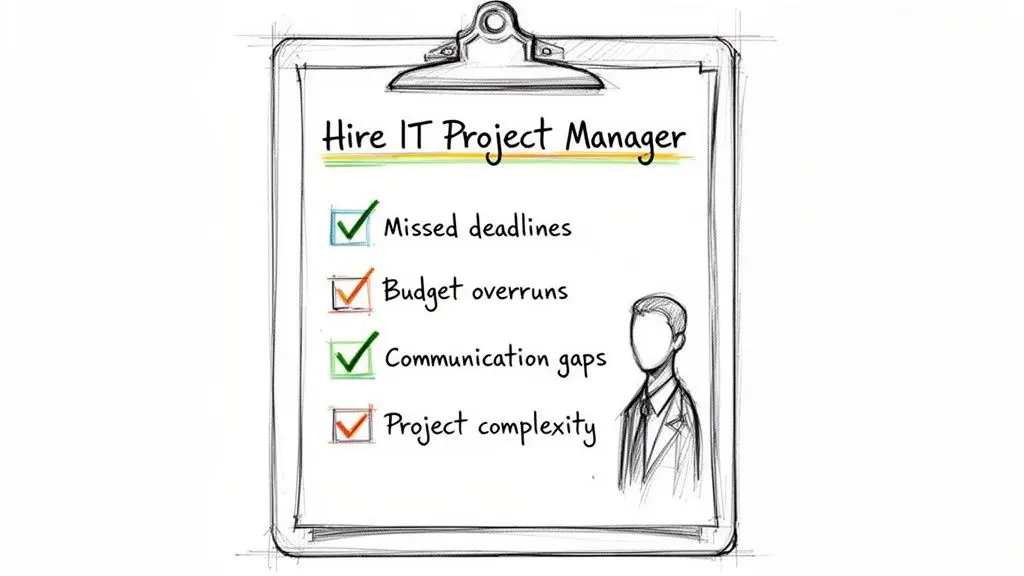
The need for an IT project manager becomes apparent when an organization repeatedly encounters the same operational failures. Recurring budget overruns, consistently missed deadlines, or a persistent communication gap between engineering and business stakeholders are clear signals that project complexity has outgrown the current organizational structure. The most telling indicator is when a founder or CTO can no longer manage project details without sacrificing their core strategic responsibilities.
Identifying the Right Candidate Profile
Once the decision to hire is made, it is critical to look beyond certifications. While credentials like PMP or Agile certifications indicate a baseline of knowledge, they do not guarantee effectiveness in a modern software development context. Proven experience and the right mindset are far more predictive of success.
A strong candidate should offer more than process management. Look for these attributes:
- A Product-Aware Mindset: An understanding that the objective is not merely shipping features but delivering tangible business value. The candidate should be able to connect technical tasks back to strategic goals.
- Experience with Modern Architecture: A solid grasp of concepts like microservices, CI/CD pipelines, and cloud infrastructure is necessary to lead credible discussions with the engineering team.
- Security and Compliance Acumen: The ability to speak knowledgeably about principles like privacy by design and demonstrate experience navigating regulatory frameworks such as GDPR or NIS2.
The right IT project manager is a strategic investment in predictable delivery. They introduce the discipline required to transform ambitious technical goals into reliable, maintainable systems.
Key Interview Questions to Ask
The interview process should be designed to evaluate practical experience, not just theoretical knowledge. Focus on how candidates have managed real-world challenges and navigated difficult trade-offs.
Consider asking scenario-based questions:
- Describe a project where you managed significant scope creep. How did you handle stakeholder expectations, and what was the outcome?
- Walk me through an instance where you identified a major technical risk the engineering team had initially overlooked. What was your mitigation plan?
- Explain your approach to balancing the pressure for rapid delivery with the need to maintain code quality and system security.
This role represents a significant investment. The median salary for an IT project manager in the US typically falls between $97,740 and $130,000 annually, with substantial variations based on location and company size. Top technology firms often offer compensation packages well above this range. You can explore more detailed salary data and regional variations for IT project managers to inform budgeting. A successful hire ensures this investment yields returns through smoother, more predictable project execution.
Conclusion: A Strategic Partner in Technical Execution
An IT project manager is more than a taskmaster; they are a strategic partner responsible for translating an ambitious vision into reliable software. Their discipline transforms abstract goals into predictable outcomes, ensuring that what you build is not only delivered on schedule and within budget but is also secure, maintainable, and aligned with core business objectives. In an ecosystem of complex SaaS platforms, AI systems, and stringent compliance mandates, this role is the foundation of successful execution.
Key Takeaways
- Problem-Solver, Not Just a Scheduler: An IT project manager’s primary function is to mitigate the risks—scope creep, budget overruns, and communication breakdown—that cause complex projects to fail.
- Technical Literacy is Non-Negotiable: To effectively manage risk and facilitate trade-offs, they must understand modern software architecture, security principles, and compliance frameworks.
- Clarity in Roles Prevents Chaos: Distinguishing the IT Project Manager (the ‘how’ and ‘when’) from the Product Manager (the ‘what’ and ‘why’) is critical for accountability and effective execution.
- Measure Impact Beyond Deadlines: Evaluate success using a balanced set of KPIs that include not only on-time and on-budget delivery but also quality metrics like defect escape rates and stakeholder satisfaction.
This alignment between strategic vision and tactical execution is critical for any technology leader, particularly a Chief Technology Officer responsible for a company’s technical vision and its implementation. A strong IT project manager provides the internal structure for success, ensuring your most critical technical initiatives deliver their intended value.
At Devisia, we build reliable digital products with a product mindset focused on clear decisions and long-term maintainability. Turn your business vision into a scalable and secure software system.