The title “Chief Technology Officer” is widely used, but its responsibilities are often misunderstood. A CTO’s role extends far beyond being the most senior software engineer.
A Chief Technology Officer (CTO) is the executive accountable for a company’s technology strategy and its execution. Their primary function is to ensure that all technical decisions—from architectural patterns to infrastructure choices—directly support and advance core business objectives. They serve as the critical link between technical implementation and business value.
Unpacking the Modern CTO Role
The modern CTO is a strategic partner, not merely a technical manager. The outdated stereotype of a developer isolated in a server room has been replaced by that of a business architect who leverages technology to create a competitive advantage.
The core mission is to define and execute a technology vision that is secure, scalable, and sustainable. This requires navigating a complex landscape of trade-offs, making critical decisions that directly impact the company’s financial performance and long-term market position.
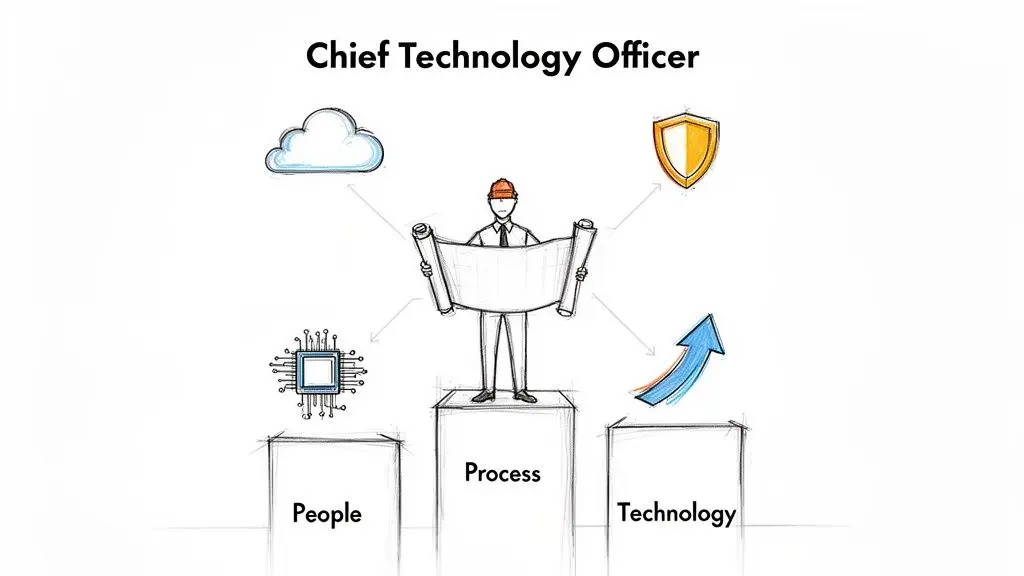
The Three Pillars of CTO Accountability
An effective CTO’s influence rests on three interconnected pillars. Mismanagement of any one pillar compromises the integrity of the entire system.
-
People: Accountability begins with people. The CTO is responsible for building, mentoring, and retaining high-performing engineering teams. This involves more than recruitment; it requires fostering a culture of technical ownership, engineering excellence, and continuous improvement.
-
Process: This defines how work is executed. The CTO establishes the engineering methodologies (e.g., CI/CD, Agile practices), defines architectural principles, and enforces the quality standards governing how software is designed, built, tested, and deployed.
-
Technology: This pillar covers the tools and platforms. The CTO oversees the entire technology stack—from programming languages and cloud infrastructure to third-party APIs—ensuring each component is robust, secure, and financially justifiable.
A common mistake is to treat these pillars as a simple checklist. An experienced CTO understands their deep interdependence. A talented team (people) is ineffective with chaotic workflows (process), and a well-defined process is useless with an inappropriate technology stack.
Ultimately, the CTO’s role is to convert technical investment into measurable business outcomes. Whether integrating AI systems responsibly, modernising a legacy platform, or ensuring compliance with regulations like GDPR or DORA, their strategic decisions determine if the company simply maintains operations or genuinely leads its industry.
Navigating Core CTO Responsibilities
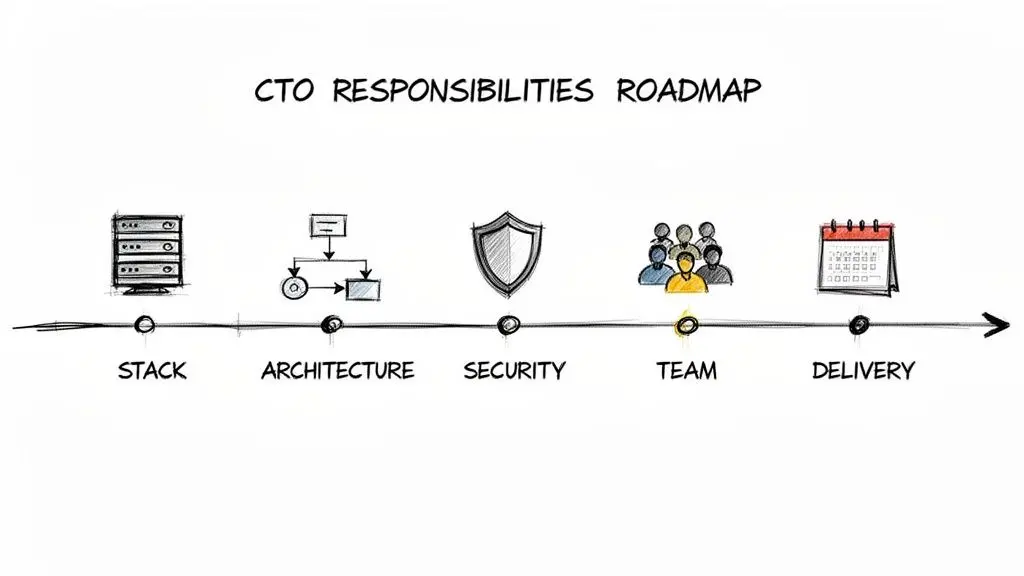
An effective Chief Technology Officer continuously balances a portfolio of critical functions, shifting between high-level strategic planning and detailed architectural oversight. These are not disparate tasks but interconnected responsibilities that power the company’s technical engine and align it with business goals.
The role’s breadth covers everything from foundational technology choices to engineering culture. This demands a leader capable of making pragmatic trade-offs, such as balancing short-term product velocity against the long-term maintainability and stability of the systems under their purview. Every significant decision impacts product quality, security posture, and the organization’s ability to adapt to market shifts.
Technology Strategy and Architecture
The core of the CTO role is defining the company’s technology vision. This involves selecting appropriate tools, frameworks, and infrastructure. This is not about adopting trends but about a rigorous analysis of business requirements, scalability needs, and total cost of ownership. Our guide on cloud computing vs on-premise solutions explores the trade-offs involved in such foundational decisions.
This strategy is operationalized through clear architectural principles that guide the development process. The CTO ensures that systems are designed for maintainability, security, and performance from inception. This proactive approach prevents the gradual accumulation of technical debt that eventually stifles innovation.
Team Leadership and Development
A CTO is fundamentally a leader of people. Their success is directly tied to their ability to build, mentor, and retain a world-class engineering team. This extends beyond recruitment to creating a culture of ownership, continuous learning, and psychological safety where engineers are empowered to experiment and take calculated risks.
They are also responsible for implementing and refining development methodologies—whether Agile, Scrum, or Kanban—that structure how work is accomplished. This framework brings predictability and quality control, transforming a group of individuals into a high-performing, cohesive unit.
Governance, Risk, and Compliance
In an environment of increasing regulatory scrutiny, the CTO serves as the ultimate steward of the company’s technical compliance and security. This is a non-negotiable responsibility that requires a proactive, not reactive, posture.
A naive approach treats security and privacy as features to be added post-launch. A mature CTO embeds these principles into the architecture from day one, understanding that trust is easier to maintain than to rebuild after a breach.
The CTO is accountable for implementing robust cybersecurity measures and ensuring adherence to regulatory frameworks like GDPR, NIS2, and DORA. This involves conducting regular risk assessments, managing data privacy protocols, and maintaining a well-defined incident response plan.
As AI adoption becomes widespread, this governance role expands. Forecasts from Forrester suggest that by 2026, the CTO’s role in governing AI strategy will become even more critical, as they will be tasked with remediating business-led AI projects that fail due to a lack of technical discipline.
Key CTO Responsibilities and Associated Deliverables
| Responsibility Area | Description | Key Deliverables |
|---|---|---|
| Technology Strategy | Defining the long-term vision, selecting technologies, and aligning tech choices with business goals to create a competitive advantage. | Technology Roadmap, Architectural Blueprints, R&D Proposals, Budget Forecasts |
| Team Leadership | Building, mentoring, and scaling a high-performing engineering team. Fostering a culture of innovation, ownership, and continuous improvement. | Hiring Plans, Team Structure Charts, Career Development Frameworks, Engineering Principles Document |
| Execution & Delivery | Overseeing the entire software development lifecycle to ensure high-quality products are delivered on time and within budget. | Product Delivery Schedules, Performance Dashboards (velocity, cycle time), Quality Assurance Reports |
| Governance & Security | Establishing and enforcing policies to manage risk, ensure compliance with regulations (GDPR, etc.), and protect company and customer data. | Security Policies, Compliance Audit Reports, Disaster Recovery Plan, Data Governance Framework |
This table illustrates that for every high-level strategy, there is a tangible deliverable. A CTO’s effectiveness is measured not by their vision alone, but by their ability to execute it consistently.
How the CTO Role Changes with Company Stage
While the title “Chief Technology Officer” is static, the role itself is highly dynamic. A CTO’s responsibilities shift dramatically based on a company’s size and maturity. The work of a CTO in a seed-stage startup bears little resemblance to that of their counterpart at a global enterprise.
Failing to recognize this evolution is a common pitfall that leads to misaligned hires, organizational friction, and strategic failure. Responsibilities must scale with the organization—what works for a team of ten will break at one hundred and become a significant liability at one thousand.
The Startup CTO
In a young startup, the CTO is typically the lead architect and a hands-on developer. Their focus is on speed and resourcefulness. The mission is to build a Minimum Viable Product (MVP) quickly enough to validate the business model before capital runs out.
A startup CTO’s priorities are tightly focused:
- Rapid Prototyping: They make pragmatic decisions on the tech stack to deliver a functional product to users. Perfection is sacrificed for progress.
- Hands-On Development: They are actively involved in writing code, fixing bugs, and managing deployments. The role is defined by direct contribution.
- Building the Foundation: They select an initial architecture (e.g., a simple monolith or serverless functions) that meets immediate needs without requiring a complete rewrite in the near future.
This stage is defined by constraints, trade-offs, and versatility. The objective is survival and achieving product-market fit, not engineering a flawless, infinitely scalable system.
The Enterprise CTO
In a large enterprise, the CTO operates at a different level of abstraction. The role pivots from direct implementation to high-level strategy, governance, and management of large-scale teams. They are no longer building a single product but steering a complex portfolio of technology investments.
This transition involves a significant shift in focus:
- Strategic Oversight: Instead of coding, they align the technology roadmap with multi-year business goals and manage multi-million dollar budgets.
- Team and Talent Management: Their primary function is to lead large, often globally distributed engineering departments. They focus on cultivating the next generation of technical leaders.
- System Governance: They are responsible for navigating complex legacy systems while planning the phased integration of new technologies like AI into a heavily regulated and compliant infrastructure.
The enterprise CTO must master stakeholder management, vendor negotiations, and ensuring all technology decisions meet stringent security and compliance mandates. The stakes are higher, and the pace of change is necessarily more deliberate.
A critical hiring mistake is misaligning a CTO’s experience with the company’s current stage. An enterprise CTO may over-engineer solutions and exhaust resources at a startup, while a startup CTO could be overwhelmed by the scale, bureaucracy, and regulatory complexity of a large corporation.
This distribution is reflected in market data. In the US IT sector, which employs over 26,345 CTOs, the top hiring industries are Technology (23%), Fortune 500 (14%), and Start-ups (12%). This highlights the role’s importance across the full spectrum of company maturity. You can explore more CTO job demographics at Zippia.com.
CTO vs CIO vs VP of Engineering
Technical leadership titles are often used interchangeably, creating organizational ambiguity and friction over ownership.
When roles overlap, projects stall, internal conflicts arise, and accountability becomes unclear. Defining sharp, distinct lines between these functions is essential for building a cohesive and effective leadership team.
The Chief Technology Officer, Chief Information Officer (CIO), and VP of Engineering each command a unique domain. While all operate within technology, their focus, metrics, and daily responsibilities are fundamentally different. Structuring these roles correctly is critical for scaling a company effectively.
Delineating Core Focus Areas
The simplest way to differentiate these roles is by their primary focus:
-
The Chief Technology Officer is externally and future-focused. They concentrate on how technology can create new products, enter new markets, and drive business growth. Their horizon is long-term, centered on emerging technologies, research and development, and strategic innovation.
-
The Chief Information Officer is internally focused. Their mission is to ensure the company’s internal IT and business operations are efficient, secure, and reliable. They manage systems that support the business, such as CRM platforms, corporate networks, and security protocols, to improve productivity and reduce operational risk.
-
The VP of Engineering is focused on execution and delivery. They translate the CTO’s technical vision and the product roadmap into functional software. Their domain is the present: managing engineering teams, overseeing development sprints, and ensuring high-quality code is shipped on schedule. Their role is tactical and grounded in the software development lifecycle. For a deeper look at how these roles fit into the bigger picture, you can explore the responsibilities of a Program Management Officer in our related article.
This diagram illustrates the evolution of a CTO’s responsibilities, shifting from hands-on work in a startup to strategic leadership in an enterprise.
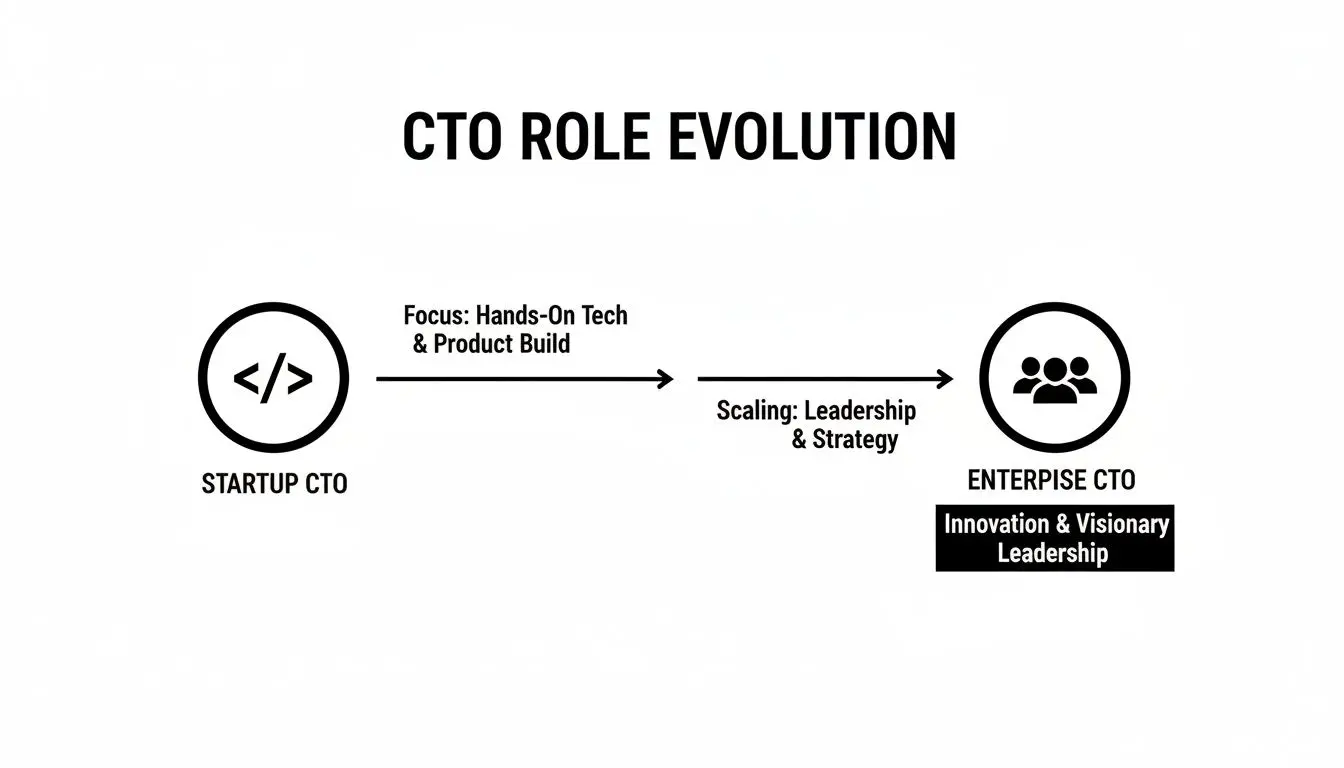
As the company grows, the role naturally transitions from direct coding and architecture toward team leadership and high-level strategic oversight.
A Clear Comparison of Tech Leadership Roles
To further clarify these distinctions, the following table breaks down their core functions, success metrics, and typical activities. A clear division of labor prevents duplicated effort and ensures all aspects of technology—from internal infrastructure to external product innovation—are expertly managed.
Comparison of Tech Leadership Roles CTO vs CIO vs VP Engineering
| Role | Primary Focus | Key Metrics | Typical Responsibilities |
|---|---|---|---|
| CTO | External Product & Innovation | Market adoption, Scalability, R&D breakthroughs, IP generation | Setting tech vision, Evaluating new technologies, Leading architecture, Prototyping |
| CIO | Internal Business Operations | System uptime, IT cost reduction, Employee productivity, Security compliance | Managing IT infrastructure, Overseeing ERP/CRM systems, Data security, Vendor management |
| VP Eng. | Internal Team & Delivery | Team velocity, Code quality, Cycle time, On-time delivery, Bug rates | Managing engineers, Project planning, Code reviews, Overseeing sprints, Process improvement |
Understanding these distinctions is not merely an academic exercise. It is a foundational requirement for building a technology organization that can innovate, operate efficiently, and deliver consistently.
Identifying a High-Impact CTO
Hiring a Chief Technology Officer is one of the most consequential decisions a company can make. The right hire accelerates growth and builds a resilient technical foundation. The wrong one leads to costly rewrites, team attrition, and strategic failure.
It is essential to look beyond the resume. A high-impact CTO demonstrates a specific combination of technical depth, business acumen, and leadership. The indicators of success are often subtle but are strong predictors of performance.
Signals of a Strong Candidate
A strong candidate’s history reveals a pattern of pragmatic, well-reasoned decisions. They do not merely follow trends; they analyze trade-offs with rigor.
- Product-First Mindset: They understand that technology exists to solve a customer problem. They ask “why” before discussing “how,” ensuring engineering effort is tied directly to user value.
- Architectural Pragmatism: Their track record shows systems built appropriately for the company’s stage. They avoid both premature optimization and short-sighted hacks that create significant technical debt.
- Clear Communication: An effective CTO can explain a complex technical concept, such as a microservices architecture, to non-technical stakeholders without resorting to jargon. This is critical for aligning the entire business with the technology strategy. Our guide on a code of conduct for engineering and AI teams can help foster this clarity.
Red Flags to Watch For
Conversely, certain behaviors should be considered immediate red flags. These often indicate a leader who prioritizes personal preferences over sound business and engineering principles.
A common red flag is the “magpie CTO”—a leader constantly distracted by new technologies. They pursue hype over stability, often advocating for a trendy framework without a clear business case, risking the company’s future on an unproven foundation.
Other warning signs include:
- Disregard for Maintainability: They prioritize shipping features at any cost, with little consideration for the engineers who will have to maintain the codebase in the future.
- Poor Team Leadership: A history of high attrition among their best engineers is a major concern. Investigate whether they actively mentor junior developers or if their teams have a revolving door.
- Inability to Articulate Trade-Offs: Every technical decision involves pros and cons. A candidate who presents a solution as perfect, with no downsides, is either too inexperienced to see the compromises or is not being transparent.
This level of strategic and technical leadership is why the Chief Technology Officer role is projected to be the highest-paid in the IT sector by 2026, with an average salary reaching $266,122. This reflects the immense value of CTOs who can successfully navigate complex challenges like AI integration and cloud migration. You can find more insights in the 2026 IT workforce planning guide.
Building Strategic Technology Partnerships
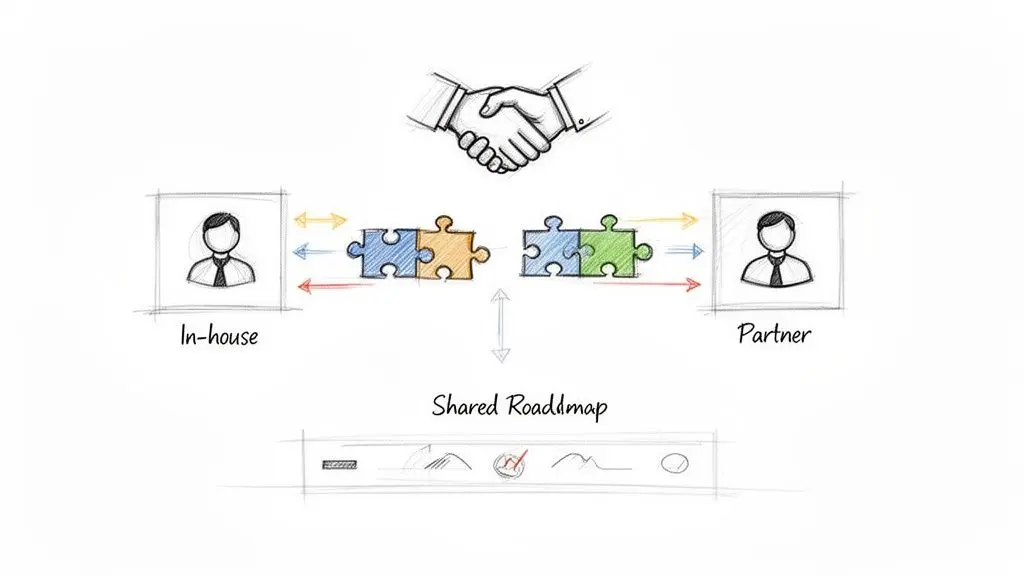
A modern Chief Technology Officer understands that attempting to build everything in-house is a strategic error. The objective is not to delegate tasks but to build partnerships that function as a seamless extension of the core team.
This approach shifts the dynamic from a simple transactional exchange to a valuable collaboration. A true partner contributes specialized expertise, whether to accelerate development, integrate complex AI systems, or modernize legacy platforms without compromising on quality or security. This allows the internal team to focus on core competencies while leveraging external talent for specific, high-impact initiatives.
Selecting the Right Partner
Choosing a partner requires more than a checklist of technical skills; it demands a deep alignment of philosophy and process. Selecting a partner based on the lowest price is a common mistake that often leads to architectural compromises and significant long-term maintenance costs.
Key criteria for vetting potential partners include:
- Technical Philosophy: Do they prioritize clean, maintainable architecture over expedient but brittle solutions? Their approach to technical debt and code quality must align with yours.
- Process Alignment: How do they manage communication, feedback, and delivery? Look for a clear commitment to incremental progress, well-defined scopes, and full transparency.
- Security Posture: In an interconnected ecosystem, your partner’s security practices become your own. The software supply chain is a major vulnerability. A potential partner must demonstrate a serious and proactive commitment to security.
The best partnerships are built on shared principles. The right partner operates with a product mindset, making decisions that serve the long-term health of the software, not just the immediate sprint goal.
Managing a Successful Collaboration
Once a partner is selected, the mechanics of the collaboration determine its success. Establishing clear rules of engagement from the outset prevents friction and ensures alignment.
A successful collaboration is built on these pillars:
- Defined Communication Channels: Establish a rhythm of regular, structured check-ins and dedicated channels for asynchronous communication to ensure information flows efficiently.
- Precise Scopes of Work: Vague requirements lead to scope creep and budget overruns. Define deliverables, acceptance criteria, and timelines with absolute clarity before work begins.
- Integrated Feedback Loops: The partner should not operate in a silo. They must be integrated into your existing feedback and review processes to ensure their work is continuously validated against your business needs and technical standards.
Frequently Asked Questions About the CTO Role
For founders and business leaders, understanding the specifics of the Chief Technology Officer role is critical. Here are straightforward answers to common questions about a CTO’s function and what to expect.
These points clarify when to hire a CTO, what their expertise should encompass, and how the role is adapting to major technological shifts like artificial intelligence.
Does Every Startup Need a CTO From Day One?
Not necessarily. In the earliest stages, a skilled senior engineer (often a ‘founding engineer’) can typically manage the initial product development. This hands-on role is focused on speed and delivering a minimum viable product.
A formal CTO becomes critical when the company needs to scale the team, make long-term architectural decisions, and align the technology roadmap with fundraising and significant business growth. The role transitions from primarily coding to strategic leadership.
Should a CTO Be an Expert in Every Technology?
No. This is both impossible and impractical. A strong CTO has deep expertise in a few relevant domains but, more importantly, possesses a broad knowledge base and the ability to evaluate new technologies objectively.
Their true value lies in understanding technical trade-offs, leading engineering teams, and making sound architectural decisions—not in mastering every programming language. They provide direction, not encyclopedic knowledge.
What Is the Biggest Mistake Companies Make When Hiring a CTO?
One of the most common and costly errors is mismatching the CTO’s background with the company’s current stage. Hiring an enterprise-level CTO for an early-stage startup often results in over-engineering, slow processes, and unnecessary complexity.
Conversely, a startup CTO may lack the experience to navigate the scale, compliance requirements, and stakeholder management of a large organization. Aligning the candidate’s experience with your company’s immediate needs is crucial for a successful hire.
How Does a CTO’s Role Change With the Rise of AI?
AI transforms the CTO’s role from a technology manager to a strategic innovator. The modern CTO must evaluate and integrate AI platforms while ensuring robust data governance and privacy for machine learning models.
They are also responsible for managing the costs of AI infrastructure and guiding the business on how to use AI to achieve a sustainable competitive advantage. This evolution places the CTO at the center of the company’s AI strategy and its responsible implementation.
At Devisia, we partner with CTOs to turn their vision into reliable digital products and AI-enabled systems. We provide the pragmatic architectural guidance and end-to-end delivery needed to build meaningful, maintainable software. Learn more at https://www.devisia.pro.