Service-Oriented Architecture (SOA) is an architectural approach for building distributed systems where business functions are encapsulated as a collection of interoperable, reusable services. This soa service oriented model allows disparate applications to communicate and share capabilities, enabling organizations to break free from rigid, monolithic systems and build more flexible, integrated IT landscapes.
The Problem: Monolithic Rigidity and Integration Failure
Many established organizations find their growth constrained by monolithic software architectures. These large, tightly-coupled applications are often slow to update, expensive to maintain, and difficult to scale. A seemingly minor change in one part of the system can trigger unforeseen failures elsewhere, leading to prolonged development cycles and significant business risk.
This architectural inflexibility becomes a critical liability when business needs change. Integrating a new partner system, launching a mobile application, or adapting to new regulations like DORA or NIS2 can become a monumental engineering effort. The root cause is tight coupling, where components are so deeply intertwined that they cannot evolve independently.
The Solution: Decoupling Through Services
Service-Oriented Architecture directly addresses this problem by treating business capabilities as distinct, discoverable services rather than as tangled code within a single application. For example, instead of each application implementing its own customer lookup logic, developers can call a standardized, pre-existing “Customer Lookup” service.
This strategic decoupling allows different parts of the IT landscape to evolve at different paces. A legacy inventory system, for instance, can be wrapped in a service interface, making its data accessible to a modern e-commerce platform without requiring a high-risk, all-or-nothing rewrite.
At its core, SOA is an architectural philosophy that prioritizes business agility through integration. It organizes complex enterprise systems into a collection of manageable, reusable components that align directly with business processes.
This model provides a clear, pragmatic path for modernization and interoperability.
Foundational Principles of SOA
To achieve this flexibility, a soa service oriented design relies on several core principles. These rules ensure that services remain independent yet can interoperate reliably, creating a coherent and manageable system across the enterprise.
Three of the most critical principles are:
- Loose Coupling: Services should have minimal dependencies on each other. A change to the internal implementation of one service (e.g., upgrading its database) must not force changes in the applications or other services that consume it. This is the key to independent evolution.
- Service Contracts: Each service publishes a formal, standardized contract, typically using technologies like WSDL (Web Services Description Language). This contract defines the service’s operations, the data formats it requires, and the responses it provides. It acts as a stable, predictable agreement for all consumers.
- Reusability: Services are designed to be reused across multiple applications and business processes. A single “Payment Processing” service can be consumed by the company’s public website, mobile app, and internal accounting system, ensuring functional consistency and reducing redundant development effort.
Core Components of a Service-Oriented Architecture
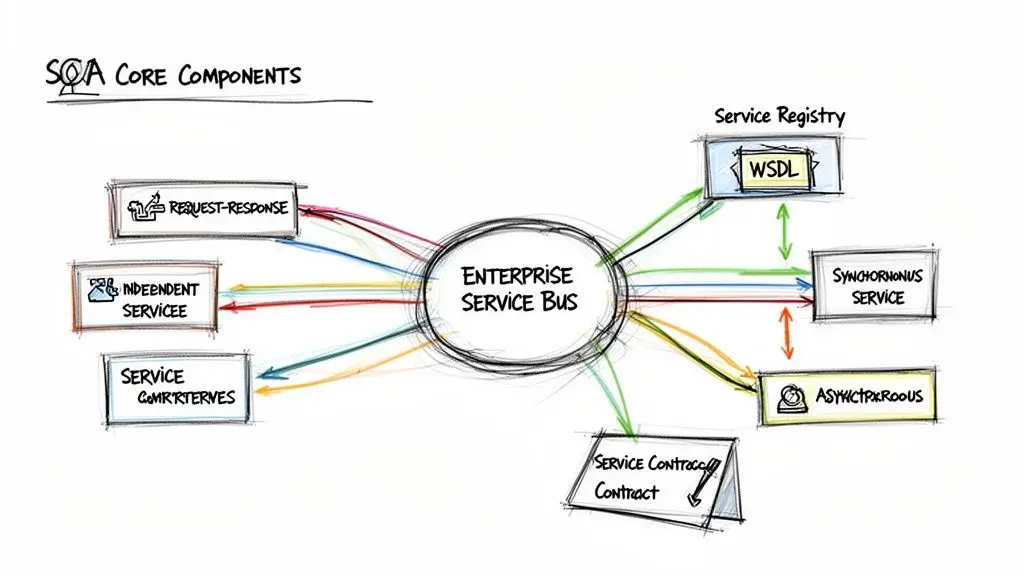
To understand how a soa service oriented architecture enables integration, it is essential to examine its core components. These elements work together to create a manageable, interconnected system where services can communicate reliably and be discovered by applications across the organization.
Each component has a specific function, forming a coherent architectural pattern. This structure has become foundational for building large-scale, integrated systems. In the technology sector, these principles are applied daily in the construction of custom SaaS platforms and complex integrations. The model’s significance is reflected in market data, with the U.S. alone constituting 36% of the global SOA market share, a figure driven by cloud adoption and the persistent need for enterprise-level system integration.
The Enterprise Service Bus (ESB): Centralized Integration Hub
At the center of many traditional SOA implementations is the Enterprise Service Bus (ESB). It acts as a central messaging backbone, mediating and routing communication between disparate services. An ESB is more than a simple message queue; it provides critical integration functions that decouple services from one another.
Instead of services communicating directly in a complex web of point-to-point connections, they connect to the ESB. The ESB handles protocol translation, data format transformation, and message routing. However, this centralized model presents a significant trade-off. Without proper governance, the ESB can become a single point of failure and a performance bottleneck, effectively becoming a new monolith that undermines the flexibility SOA aims to provide. For more on mitigating these risks, see our guide on effective IT system integration.
Service Contracts: The Rules of Engagement
For services to interact reliably, they require a clear, formal agreement on communication protocols and data structures. This is the role of the service contract. Typically defined using standards like WSDL (Web Services Description Language) and exchanged via protocols like SOAP, the contract specifies exactly what a service does.
A service contract is the unambiguous API definition for a service. It defines the operations the service offers, the data formats it expects as input, and the structure of the data it will return as output.
This formal agreement allows a service consumer (e.g., a web application) to interact with a service provider (e.g., a “Payment Processing” service) without needing any knowledge of its internal implementation. This stability is essential for maintaining loose coupling.
Service Registry: The Enterprise Directory
In an environment with dozens or hundreds of services, applications need a mechanism to locate the correct service. The service registry functions as a discoverable directory—a “phone book”—for all available services within the enterprise.
When a new service is deployed, it is published to the registry. When an application needs a specific capability, it queries the registry to find the location and contract details for the required service. This dynamic discovery mechanism prevents developers from hard-coding service endpoints into applications, adding a critical layer of flexibility.
Communication Styles: Synchronous vs. Asynchronous
Services within an SOA can communicate using different styles, and selecting the appropriate one is crucial for performance and system resilience.
- Synchronous (Request-Response): The consumer sends a request and blocks, waiting for an immediate response. This pattern is suitable for real-time interactions where an instant answer is required, such as validating user credentials.
- Asynchronous (Event-Driven): The consumer sends a message or event and continues its processing without waiting for a direct reply. This pattern is better suited for long-running processes or for decoupling systems, such as submitting an order that triggers a complex, multi-step fulfillment workflow.
SOA vs. Microservices: Choosing the Right Architectural Tool
For technology leaders, the discussion of Service-Oriented Architecture versus microservices is not about determining a “winner.” It is about selecting the appropriate architecture for a specific business context and set of technical constraints. Both are valid approaches to decomposing monolithic systems, but they solve different problems at different scales.
Microservices can be viewed as an evolution of the core principles behind a soa service oriented approach, but with a strong emphasis on developer autonomy and rapid, independent deployment. This distinction is crucial; it frames the choice not as “old vs. new,” but as enterprise integration versus agile application development.
Scope and Granularity
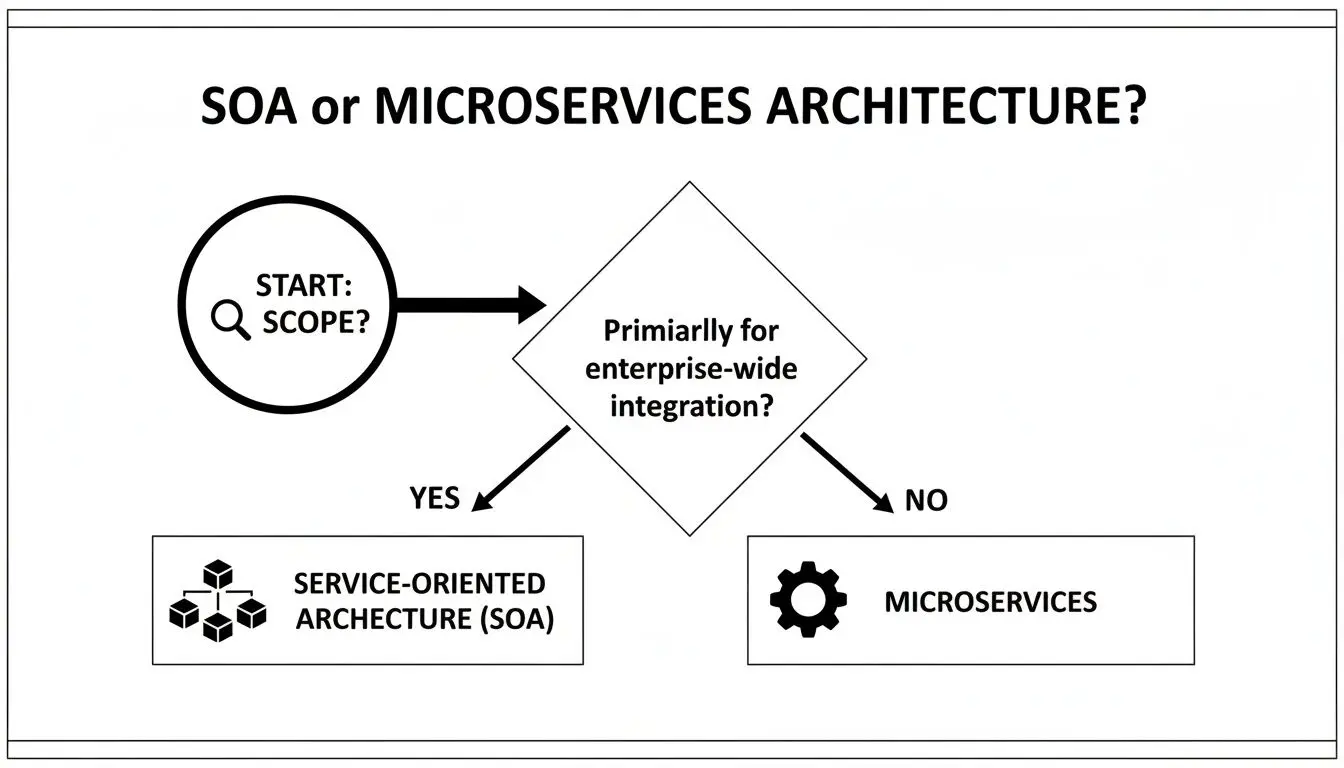
The most significant differentiator is scope. SOA is fundamentally an enterprise-wide integration strategy. Its primary purpose is to integrate and expose business capabilities across an entire organization, often connecting large, heterogeneous systems. Services in SOA are typically coarse-grained, representing broad business functions like “Manage Customer Accounts” or “Process Insurance Claim.”
Microservices, in contrast, operate at the application scope. A single application is constructed as a suite of small, fine-grained services, each focused on a narrow business capability. For instance, an e-commerce application might have separate microservices for its shopping cart, product reviews, and payment gateway. Their design objective is to make one application scalable and maintainable, not to integrate an entire enterprise.
Communication and Data Management
Communication patterns also highlight their different philosophies. A traditional SOA often relies on a centralized Enterprise Service Bus (ESB), or “smart pipe,” which handles routing, transformation, and orchestration. Services are “dumb endpoints” that plug into this intelligent middleware.
Microservices invert this model, following a pattern of “smart endpoints and dumb pipes.” Each microservice contains its own business logic and communicates with others over simple, lightweight protocols like REST APIs. There is no central bus orchestrating interactions. This decentralization increases operational complexity but eliminates the risk of the ESB becoming a single point of failure or a development bottleneck.
This philosophy extends to data management:
- SOA: Services often share databases or rely on a canonical enterprise data model to ensure consistency.
- Microservices: Each service owns and manages its own database. This database-per-service pattern ensures true decoupling but introduces the challenge of maintaining data consistency across a distributed system.
The choice between a centralized ESB and decentralized endpoints is a direct trade-off. SOA provides enterprise-wide governance and visibility at the cost of potential bottlenecks. Microservices provide team autonomy at the cost of increased distributed system complexity.
Architectural Comparison: SOA vs. Microservices
| Dimension | SOA (Service-Oriented Architecture) | Microservices |
|---|---|---|
| Scope | Enterprise-wide integration | Single application scope |
| Service Granularity | Coarse-grained (broad business functions) | Fine-grained (narrow, specific tasks) |
| Communication | Centralized ESB (smart pipes, dumb endpoints) | Decentralized APIs (dumb pipes, smart endpoints) |
| Data Management | Shared databases and enterprise data models | Database-per-service, decentralized data |
| Governance | Top-down, centralized, and formal | Decentralized, team-based responsibility |
| Deployment | Often monolithic or coordinated releases | Independent, automated deployments per service |
| Optimal Use Case | Complex enterprise integration, regulated industries | Agile product development, scalable web applications |
The right choice depends on the problem being solved. Are you orchestrating a complex enterprise landscape or building a nimble, scalable product? Answering this question is the first step toward selecting the right architecture.
Benefits, Trade-offs, and Documented Risks
Adopting a Service-Oriented Architecture (SOA) is a strategic decision with significant trade-offs. Technical leaders must look beyond the hype and evaluate the real-world impacts on development velocity, operational stability, and long-term total cost of ownership.
The primary business benefit of SOA is strategic reusability. When a core business function—such as order management—is encapsulated into a well-defined service, it can be consumed by any authorized application. A web portal, a mobile app, and a partner integration can all leverage the same service. This not only reduces redundant development but also simplifies maintenance. A change to the order processing logic needs to be implemented in only one place to be reflected across all channels.
Pioneering adopters like Merrill Lynch demonstrated this by exposing 420 applications as web services, resulting in a tenfold performance increase and drastically shorter development cycles for new products. This illustrates the power of SOA in high-volume, complex operations. For further reading, see this analysis of the service-oriented architecture market.
The Business Value of Reuse and Consistency
The advantages extend beyond code reuse:
- Improved Business Agility: With decoupled systems, the business can adapt more quickly. A new regulatory requirement for customer verification can be implemented by updating a single ‘Customer Identity’ service rather than patching dozens of siloed applications.
- A Pragmatic Path to Modernization: SOA provides a methodology for modernizing legacy systems without a high-risk “big bang” rewrite. Old mainframes or ERP systems can be wrapped with service interfaces, making their data and logic accessible to modern applications.
- Enhanced Interoperability: By enforcing standard contracts and protocols, SOA enables disparate systems from different vendors or built with different technologies to communicate effectively, breaking down information silos.
The Documented Risks and Governance Overhead
However, a naive implementation of SOA can introduce significant complexity. Failures often occur when organizations underestimate the operational and organizational maturity required.
A common failure pattern is treating SOA as a purely technical project. Without strong governance and a clear vision for service ownership, an SOA initiative is likely to create more problems than it solves, leading to a brittle and unmanageable system.
Frequently cited risks include:
- The ESB as a Monolithic Bottleneck: The Enterprise Service Bus, intended to facilitate communication, can become a single point of failure and a performance chokepoint. When it becomes overloaded with complex business logic, it turns into a new monolith, defeating the goal of agility.
- Performance Overhead: Early SOA implementations often used heavy protocols like SOAP and XML. The overhead of parsing these verbose message formats can introduce significant latency, which is unacceptable in high-throughput systems.
- Governance Complexity: Managing an enterprise-wide service catalog is a substantial undertaking. It requires clear policies for versioning, security, ownership, and lifecycle management. Without this discipline, the result is a chaotic landscape of undocumented, redundant, and conflicting services.
Successful SOA adoption requires a pragmatic, incremental strategy that avoids over-engineering and delivers tangible business value at each step.
Implementing and Governing an SOA Strategy
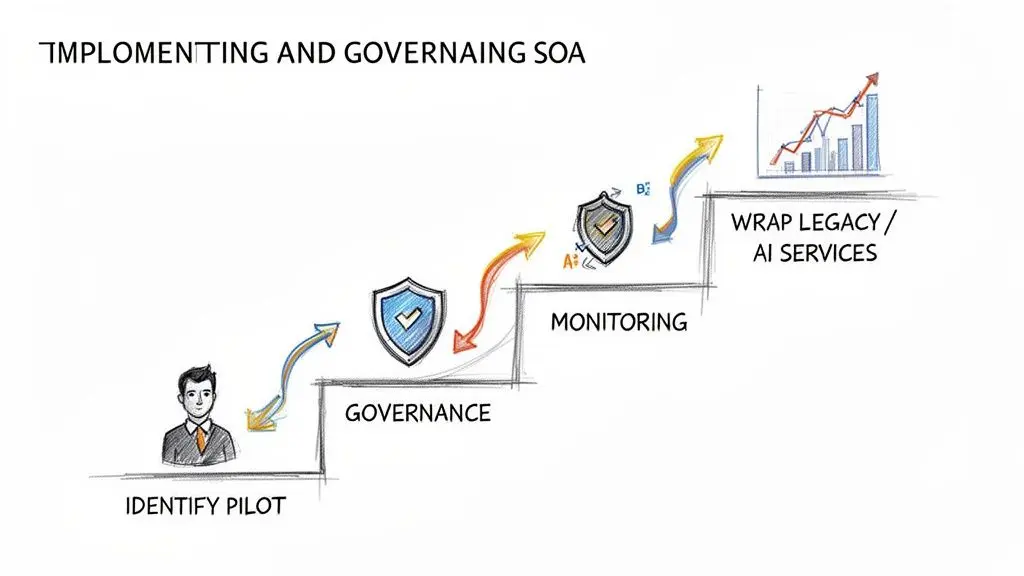
Transitioning from architectural theory to a functioning system is where many SOA initiatives falter. Adopting a soa service oriented model is a strategic shift that demands strong governance and a pragmatic roadmap. The “big bang” rollout is a common and costly mistake. A more effective strategy delivers value incrementally.
Begin with a high-value, well-understood business area for a pilot project. Identify a single, critical capability—like “Customer Profile Management” or “Inventory Lookup”—that is frequently used and would benefit significantly from becoming a reusable service. This approach minimizes risk, demonstrates tangible ROI quickly, and builds momentum for broader adoption.
Establishing a Robust Governance Framework
A successful SOA is built on a foundation of robust governance. Without clear rules, the service landscape will degrade into a chaotic collection of redundant and insecure endpoints. This is not about creating bureaucracy; it is about ensuring that services remain reliable, secure, and aligned with business needs.
The pillars of a practical governance model include:
- Service Ownership: Every service must have a designated owner—a team or individual responsible for its entire lifecycle, from development and deployment to maintenance and eventual retirement. This prevents services from becoming “orphaned” code.
- Versioning Strategy: Services evolve. A strict versioning policy (e.g., semantic versioning) is essential to manage updates without breaking dependent applications. This enables non-disruptive updates and provides clear deprecation schedules for older versions.
- Security Policies: Centralized security standards are non-negotiable. This includes defining authentication and authorization mechanisms (e.g., OAuth 2.0), setting data encryption standards, and enforcing access control policies consistently across all services.
Governance is the discipline that transforms a collection of services into a coherent, secure, and valuable enterprise asset. It prevents architectural decay and ensures long-term maintainability.
Monitoring and Observability in a Distributed System
In a distributed architecture, comprehensive monitoring is essential for reliability and performance. A failure in one service can cascade and impact others, so rapid fault detection and diagnosis are critical.
A monitoring strategy should define and track key metrics for every service:
- Service Health: Basic uptime and availability.
- Performance: Latency (request duration) and throughput (requests per second) to identify bottlenecks.
- Reliability: Error rates and failure patterns to proactively address underlying issues.
These metrics should feed into centralized dashboards and alerting systems, providing operations teams with a unified view of the ecosystem’s health.
Modernizing Legacy Systems and Integrating AI
For many enterprises, SOA provides a structured approach to modernizing legacy systems. A common pattern is to “wrap” a monolith’s core functions with a service interface. This unlocks valuable data and logic for modern applications without the risk and expense of a full rewrite. When considering infrastructure, our analysis of cloud computing vs on-premise solutions offers additional context.
This same principle applies to integrating modern capabilities like AI models. Instead of embedding a model directly into one application, it can be exposed as a governed, secure, and cost-managed service. For example, an “AI Fraud Detection” service can be called by multiple systems, ensuring consistent rule application and allowing the model to be updated independently.
The growth of SOA is closely tied to the rise of cloud computing. The SOA market, valued at USD 1.98 billion in 2025, is projected to reach USD 2.25 billion by 2026, reflecting a 14.03% CAGR driven by the demand for agile IT. More details are available in the service-oriented architecture market growth report.
The Bottom Line for Technical Leaders
The key takeaway for a CTO or engineering leader is that Service-Oriented Architecture is not obsolete. It remains a powerful and relevant strategy for managing enterprise-wide complexity. When implemented with deliberate governance, SOA excels at creating reusable, consistent business capabilities that can be shared across multiple systems, improving agility and reducing redundant development.
The trade-off is clear: you gain integration efficiency and reusability at the cost of potential performance overhead and the operational discipline required for governance. Without that rigor, an SOA can create new bottlenecks.
It is also critical to view SOA and microservices as distinct architectural tools for different problems. SOA is engineered for enterprise-wide integration; microservices are optimized for the rapid, independent evolution of a single application.
Ultimately, successful architecture is about making pragmatic choices that align with long-term business goals. This means prioritizing maintainability and incremental value over blindly adopting the latest trend. The correct decision is the one that equips your organization to adapt and scale effectively. For more on this, it is worth exploring the evolving role of the Chief Technology Officer in guiding these strategic decisions.
Common Questions About SOA
When discussing enterprise architecture, several key questions arise, particularly for leaders connecting technology decisions to business outcomes. Here are common inquiries about a soa service oriented strategy.
Is SOA Still Relevant Today?
Yes. While newer patterns like microservices are popular for application development, SOA remains a powerful strategy for enterprise-wide integration. Its core strength lies in creating a governed, reusable set of services that expose business capabilities from diverse systems, including legacy platforms. For many organizations, SOA offers a pragmatic path to modernization without the risk of a “big bang” rewrite. It is a strategy of evolution, not revolution.
What Is the Biggest Challenge in Adopting SOA?
The primary challenge is organizational, not technical. A successful SOA implementation requires a robust governance framework and a cultural shift toward shared service ownership. Without clear policies for versioning, security, and lifecycle management, the service landscape can degrade into chaos. Many initiatives fail because they are treated as pure technology projects, underestimating the need for cross-team collaboration and central oversight. This is how the Enterprise Service Bus (ESB) often becomes a monolithic bottleneck, defeating the architecture’s purpose.
Can Small Businesses Benefit From SOA?
Yes, particularly as cloud platforms make sophisticated architectures more accessible. For a small or mid-size business, a soa service oriented approach can be a cost-effective way to integrate disparate systems and modernize without a large upfront investment. It allows them to build a scalable foundation that can adapt as the business grows. SMEs are increasingly using SOA to gain a competitive edge through more agile and interoperable systems. More insights on this trend can be found in the growing SOA market report.
Adopting SOA is not about replacing everything at once. It is about strategically building a flexible digital backbone that supports long-term business goals, enabling faster adaptation to market changes and new opportunities.
A phased approach, beginning with a single high-value pilot service, is the most prudent path for any organization to realize the benefits of this proven architectural style.
At Devisia, we specialize in designing and building pragmatic, maintainable software architectures that deliver measurable business value. Whether you’re modernizing a legacy system or building a new AI-enabled platform, we provide a clear path from vision to a reliable digital product. Learn more at https://www.devisia.pro