For a long time, IT outsourcing was seen as little more than a cost-cutting play. That view is dangerously outdated. Today, for any serious technical leader, it’s a strategic answer to the immense pressures of building and scaling a modern business.
Why Smart Outsourcing Is a Strategic Necessity
When founders, CTOs, and IT managers hear the word “outsourcing,” they often picture handing off menial tasks to save a few quid. This misses the point entirely. The truth is, building a tech-driven company has become incredibly complex.
The problem isn’t just about budget anymore. It’s a mix of critical challenges that can grind a company’s growth to a halt and blunt its competitive edge.
The Core Problems Driving Modern ITO
Businesses are fighting a few persistent battles that in-house teams alone often struggle to win:
- The Specialised Talent Shortage: Finding, hiring, and keeping experts in niche domains like AI systems, cybersecurity, or modern cloud architecture is a constant struggle. The competition for top-tier talent is brutal, and the hiring cycle can feel endless.
- Intense Pressure for Rapid Innovation: Technology moves fast. Integrating new tools, like large language models (LLMs) or advanced data analytics, demands a speed and depth of expertise that can easily overwhelm an already-busy internal team.
- The Need for Lean Operations: Every organisation has to focus its energy on its core mission. Pulling your best engineers away from product development to manage infrastructure or patch up legacy systems is a strategic own goal. It prevents them from creating real business value.
A naive approach treats outsourcing as a simple transaction—hiring temporary hands for a single project. This almost always leads to fragmented systems, technical debt, and a vendor relationship that needs constant, hands-on management.
Reframing Outsourcing as a Strategic Solution
A well-structured ITO IT outsourcing engagement tackles these problems head-on. It’s a shift from a cost-first mindset to a value-first one. You’re not just buying hours; you’re building a partnership to hit specific strategic goals. It’s about tapping into a global talent pool—a foundational strategy for the world’s most successful companies.
In fact, the adoption rate among major corporations is striking. An overwhelming 92% of the world’s largest 2,000 companies already outsource their IT services. This isn’t a trend; it’s a bedrock strategy for navigating digital complexity. You can read more about the global IT outsourcing landscape to see just how widespread it is.
Ultimately, successful outsourcing is about gaining a strategic ally. It’s about finding a partner that brings a product mindset and technical discipline, helping you accelerate your roadmap while your core team focuses on the mission-critical work. This is how you make high-stakes technical decisions and win in a competitive market.
Choosing the Right IT Outsourcing Model
Picking the right IT outsourcing (ITO) model isn’t just a procurement decision; it’s a strategic one. To get it right, you have to move past the textbook definitions and understand the practical trade-offs.
The decision really comes down to two layers: where your partner is located, and how you structure the work itself.
This decision tree gives you a quick way to gut-check if ITO is even the right move based on your core needs for talent and speed.
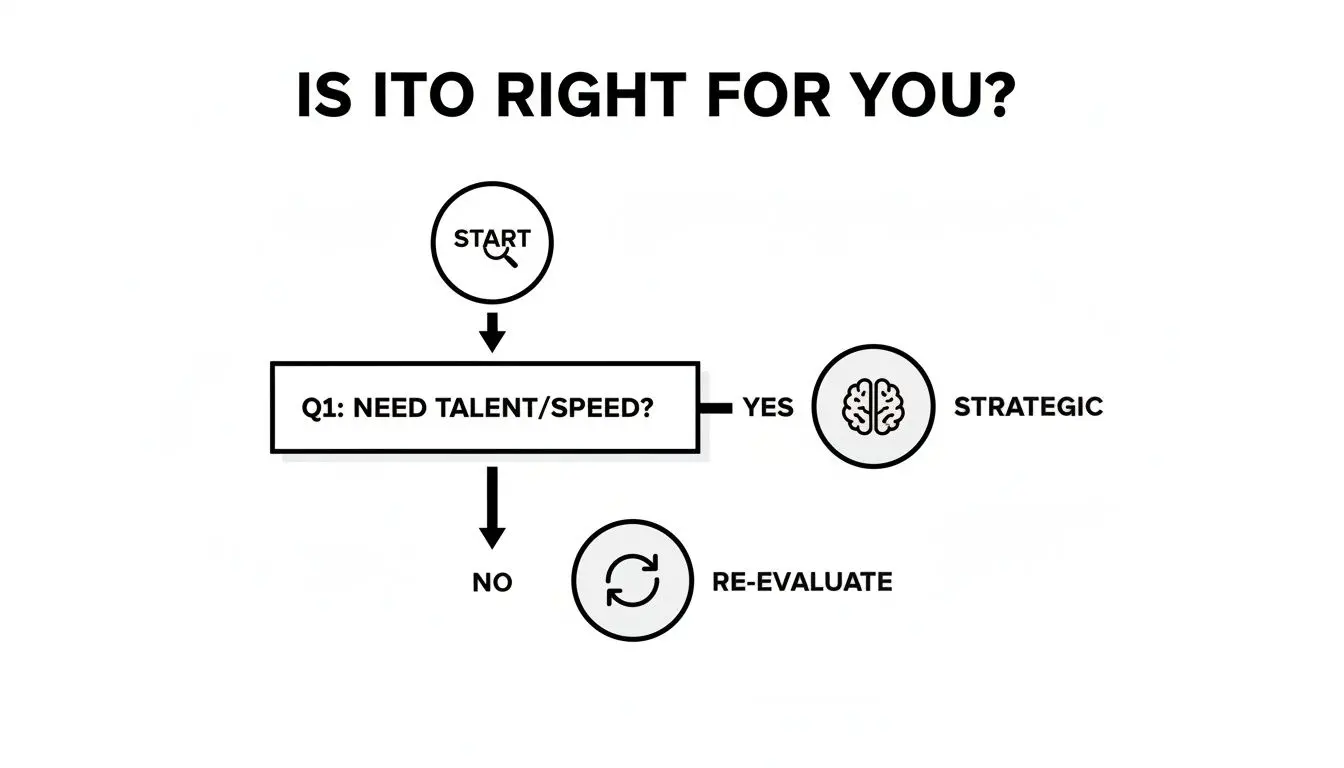
As the flowchart shows, when your primary driver is finding specialised talent or just shipping faster, ITO stops being a cost-cutting tactic and becomes a real strategic enabler.
Geographic Models: Onshore, Nearshore, and Offshore
The first piece of the puzzle is geography. This directly shapes your costs, communication cadence, and how well you can collaborate. Each path has its own set of trade-offs.
- Onshore: This means partnering with a firm in your own country. You get maximum time-zone overlap and no cultural friction, but it’s almost always the most expensive option. It makes sense for projects that demand constant in-person meetings or involve sensitive data under strict domestic laws.
- Nearshore: Here, you engage a partner in a neighbouring country or one with just a few hours’ time difference—think a UK company working with a team in Eastern Europe. Nearshoring is often the sweet spot, balancing significant cost savings with good communication, as working hours still overlap and a quick flight is manageable.
- Offshore: This involves working with a provider in a distant country, often on the other side of the world. A US company partnering with a team in Asia is a classic example. Offshore offers the biggest cost advantages, but it demands rock-solid processes for asynchronous work. Without them, cultural gaps and the lack of real-time collaboration can quickly derail a project.
Core Engagement Structures
Once you’ve sorted out the “where,” you need to decide on the “how.” The engagement model dictates your level of control, cost structure, and the very nature of your relationship with the partner.
The most common mistake is forcing a project into the wrong engagement model—for example, using staff augmentation for a complex product build that requires deep, shared ownership. This mismatch inevitably leads to misaligned expectations, scope creep, and a failed engagement.
This isn’t just a contractual detail; it defines how an external team plugs into your organisation. For a deeper dive into the broader outsourcing world, you might find this guide useful: The Ultimate Guide To Outsourcing Software Development.
Here are the three primary structures for ITO IT outsourcing you’ll encounter:
Comparing IT Outsourcing Engagement Models
Choosing between these models means understanding what you’re optimising for—control, cost, flexibility, or long-term partnership. The table below breaks down the core differences to help you align the model with your strategic goals.
| Model | Best For | Control Level | Cost Structure | Typical Use Case |
|---|---|---|---|---|
| Staff Augmentation | Filling specific skill gaps or short-term needs | High (direct management) | Time & Materials (per hour/day) | Adding a specific frontend developer to an existing project team. |
| Project-Based | Projects with a fixed, well-defined scope | Low (vendor manages delivery) | Fixed Price | Building a standard marketing website or a small, self-contained app. |
| Dedicated Team | Long-term projects, new product development | Medium (collaborative management) | Monthly Retainer (per team) | Building and evolving a core software product or MVP from scratch. |
Each model serves a different purpose. The key is to avoid the one-size-fits-all thinking and match the model to the job at hand. Let’s look closer at each one.
1. Staff Augmentation This is the most tactical approach. You are essentially “renting” developers to fill specific skill gaps on your team. These engineers report directly to your managers and work right alongside your own people.
It’s perfect for short-term needs, like hitting a deadline on a project with a clear backlog, or when you need niche expertise without the long-term overhead of a full-time hire. The risk? These individuals often feel more like contractors than team members, which can limit their connection to your product’s long-term vision.
2. Project-Based Model This model is built for projects with a clearly defined scope, timeline, and budget. You hand the requirements to your partner, and they take full responsibility for managing the process and delivering the finished product.
It can work well for self-contained tasks, like a new website or a specific application module. The downside is its rigidity. This model is a poor fit for innovative products where you expect requirements to evolve as you learn more about your market and users.
3. Dedicated Team With a dedicated team, your partner provides a full, cross-functional team that works exclusively on your project for the long haul. This team becomes an extension of your own organisation, deeply integrated into your product strategy and roadmap.
This is the ideal model for building a new product from the ground up, modernising a core system, or driving continuous innovation. It fosters a sense of shared ownership and true partnership, making it a powerful strategic choice. This approach has more in common with opening a new remote office than it does with traditional outsourcing. It’s a long-term architectural decision, much like choosing a cloud provider—a topic we cover in our guide on the trade-offs between on-premises and cloud infrastructure.
Balancing the Benefits and Inherent Risks
IT outsourcing is often framed as a simple trade-off between cost and control. This is a dangerously incomplete picture. A successful partnership isn’t about finding the cheapest vendor; it’s about navigating the very real opportunities and risks that come with building systems with an external team.
The upsides go far beyond the balance sheet. A strategic outsourcing partner gives you access to a global talent pool, bringing in specialised skills—like AI/ML engineering or advanced cybersecurity—that are difficult and expensive to find, let alone hire.
This access directly accelerates your roadmap. Instead of a months-long search for a single engineer, you can have an entire team running in weeks. Your core team is freed from maintenance and operational drag, letting them focus on the strategic work that actually grows the business.
The Strategic Advantages of Well-Managed ITO
When done right, outsourcing is a lever for growth, not just an operational fix. The real advantages are strategic.
- Accelerated Time-to-Market: Assemble teams with the exact skills you need to build, test, and launch products faster than you ever could on your own.
- Access to Specialised Skills: Tap into experts in modern digital architecture, AI systems, or niche compliance frameworks like DORA without the overhead of a permanent hire.
- Greater Strategic Focus: Let your core product and engineering teams concentrate on innovation, leaving the operational complexities to a dedicated partner.
This isn’t a niche strategy anymore. Statistics show that 76% of IT work is now delivered via external or third-party models. It’s a clear sign of how deeply outsourcing is woven into modern tech. You can explore more insights on outsourcing statistics to see just how widespread this has become.
The Pitfalls of a Naive Approach
But for every success story, there are cautionary tales. A naive approach, driven only by finding the lowest price, is a recipe for long-term failure. The risks are subtle, and they can cripple a business if ignored.
The most dangerous risk isn’t a single event but a gradual erosion of quality and control. A poor vendor choice can lead to brittle, poorly architected systems that become a technical and financial burden for years to come.
These dangers rarely appear overnight. They creep in, manifesting as small frustrations before escalating into major problems.
- Vendor Lock-In and IP Risk: A partner who builds opaque systems or fails to guarantee a clean IP hand-off in the contract can hold your operations hostage. If you don’t have full control of your source code, you’ve lost your autonomy.
- Communication Silos and Cultural Mismatch: Poor communication and deep cultural divides lead to misunderstandings, blown timelines, and a final product that completely misses the point.
- Hidden Costs and Scope Creep: That initial low price is often a mirage. Unplanned infrastructure costs, third-party tool licenses, and endless scope changes can inflate the final bill far beyond what you budgeted for.
- Erosion of Institutional Knowledge: If you over-rely on an external team without a solid knowledge transfer process, you’ll eventually have an internal team that no longer understands its own systems. This creates enormous long-term risk.
Ultimately, these risks all point to one thing: the need for a transparent partner. Success depends on finding a firm that sees risk mitigation not as a checkbox, but as a core part of its architecture and governance.
Building a Framework for Governance and Security
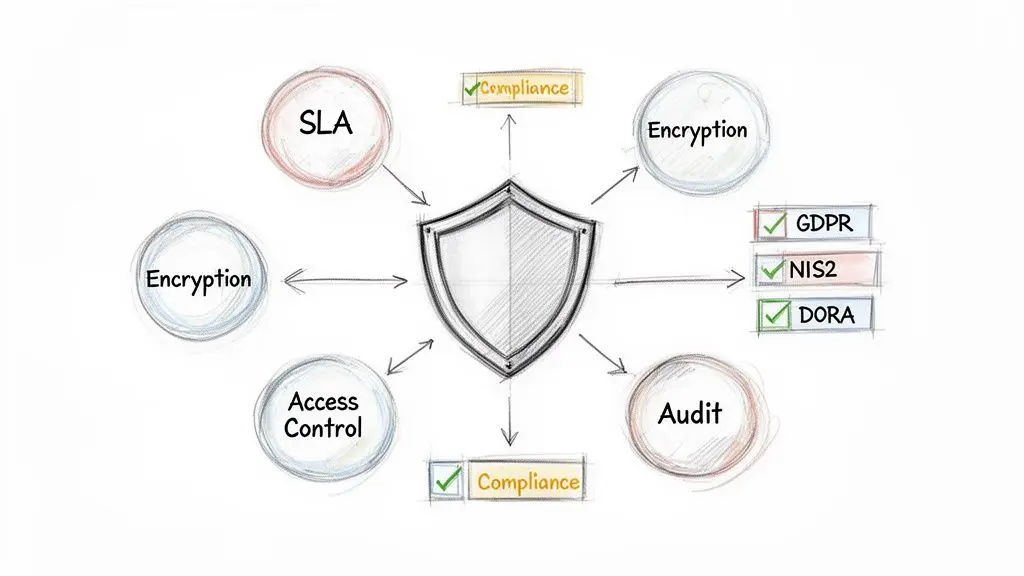
Outsourcing without strong governance isn’t a strategy; it’s an invitation to failure. A successful ITO IT outsourcing partnership hinges on a framework that bakes accountability and security into the engagement from day one. This isn’t about bolting on controls later. It’s about building a system where transparency and responsibility are part of the architecture.
Bringing in an external team adds complexity around data, compliance, and performance. A handshake agreement is naive and exposes your business to huge risks, from data breaches to total project derailment. A real governance framework is your first and best line of defence.
Drafting Meaningful Service Level Agreements
The Service Level Agreement (SLA) is the backbone of your governance. Vague SLAs are useless. They must contain specific, measurable metrics that actually matter to your business. This document is where you turn expectations into contractual promises.
A strong SLA must clearly define:
- System Availability and Uptime: Specify the exact uptime percentage (e.g., 99.9%) and the penalties for missing it.
- Response and Resolution Times: Don’t treat all issues the same. A critical bug might demand a one-hour response and four-hour fix, while a minor issue can wait 24 hours.
- Performance Metrics: Include real-world benchmarks like page load times or API latency under specific traffic loads.
- Security Incident Response: Outline the exact playbook for a security breach—who gets notified, how quickly, and what steps are mandatory.
A partner who pushes back on detailed, metric-driven SLAs is a red flag. Real partners welcome accountability. It’s how they prove their value and build trust.
Implementing ‘Privacy by Design’ from Day One
Privacy isn’t a feature you add at the end of a project. It’s an architectural mindset, and it’s non-negotiable when you work with an outsourcing partner. It means building systems where data protection is the default setting.
This requires a very deliberate approach:
- Data Minimisation: The partner should only access the absolute minimum data required to do their job. Anonymise or pseudonymise everything you can.
- End-to-End Encryption: All data must be encrypted, period. That means in transit (using protocols like TLS 1.3) and at rest (using standards like AES-256). This covers databases, backups, and all communication.
- Strict Access Controls: Enforce the principle of least privilege. An engineer should only have access to the code and data relevant to their specific task. Audit these rights regularly and revoke them instantly when a role changes.
These patterns aren’t just good ideas; they are fundamental to mitigating risk and building a system on a foundation of security.
Ensuring Regulatory and Security Compliance
Your compliance duties don’t vanish when you outsource. You are still the data controller and ultimately responsible for following the law. Your partner is a data processor, and it’s your job to ensure they meet the same standards you do.
Key compliance areas to lock down include:
- GDPR: If you handle data from EU residents, your partner must prove they are fully GDPR compliant. This includes having clear processes for data subject access requests (DSARs) and the right to be forgotten.
- NIS2 and DORA: For companies in critical EU sectors or the financial industry, these regulations demand strict cybersecurity and resilience. Your partner must have demonstrable processes for incident reporting, risk management, and third-party security.
- Regular Audits: Governance without verification is just hope. Schedule regular performance and security audits—run by your team or a trusted third party—to confirm the partner is sticking to the rules.
Navigating these requirements is essential for any leader. For a deeper look, you might find our guide on governance, risk, and compliance software helpful. By establishing clear rules and shared accountability, you move the relationship from a simple contract to a true strategic partnership.
Your Checklist for Selecting a Strategic Partner
Choosing a partner is the single most important decision you’ll make in any ITO IT outsourcing engagement. This isn’t about finding a vendor. It’s about finding an ally who will own the outcome right alongside you.
A shallow evaluation focused on the lowest price is a straight path to technical debt, frustration, and failed projects. To get it right, you have to go deeper and look for tangible proof of competence, professionalism, and cultural fit. This checklist is designed to help you do just that.
Technical Acumen and Architectural Philosophy
A provider’s technical philosophy is far more revealing than the list of frameworks on their website. You’re looking for a team that thinks architecturally, prioritising a system’s long-term health over short-term fixes.
Have them walk you through how they approach system design.
- Ask for Architectural Diagrams: Request anonymised examples from past work. Do they show a clean, logical structure? Or are they a tangled mess that’s hard to follow?
- Evaluate Their Code Quality Standards: Don’t settle for “we write clean code.” Ask to see actual code samples. Look for consistent formatting, clear comments, and a solid grasp of established design patterns.
- Discuss Their Stance on Simplicity: A great partner actively fights unnecessary complexity. They should be able to justify every technology choice and explain the trade-offs they considered.
Process Maturity and Development Lifecycle
A mature process is what separates a professional engineering firm from a loose collective of freelancers. It’s the operational backbone that delivers predictability, quality, and clear communication.
A partner with immature processes relies on individual heroics to get work done. This is never sustainable and always leads to burnout, missed deadlines, and wildly inconsistent quality. Look for a team that runs on a repeatable, well-defined system.
Dig into their development lifecycle:
- How do they handle requirements? You want to see a structured discovery process, not just a vague promise to build whatever you ask for.
- What does their feedback loop actually look like? Do they hold regular demos? How do they gather and integrate feedback? The loop needs to be tight and consistent.
- How do they manage knowledge transfer? A strategic partner plans for documentation from day one. They work to prevent knowledge silos and ensure your team can take ownership down the line. Protecting this knowledge is also a legal matter. For more on this, see our article on why you need a comprehensive confidentiality agreement template.
Security Posture and Compliance Track Record
When you outsource, you’re granting a partner access to your systems and, often, sensitive data. Their security posture is not a feature; it’s a fundamental requirement.
You need to verify their commitment to security with concrete evidence, not just promises.
- Request Security Certifications: Ask if they hold certifications like ISO 27001 or have been through SOC 2 audits. While not a silver bullet, these signal a formal commitment to security best practices.
- Review Their Compliance Experience: Ask for specific examples of how they’ve helped clients meet regulations like GDPR, NIS2, or DORA. They should be able to talk fluently about data residency, encryption, and incident response. As you formalise your governance, it’s also vital to know how to choose IT audit companies to independently verify a partner’s security claims.
Ultimately, your goal is to find a team that sees themselves as a long-term custodian of your product’s success—not just a group of contractors paid to write code.
Your Guide to a Smooth Transition and Onboarding
Signing the contract is just the beginning. A successful partnership really starts with the handover—and a sloppy transition can kill momentum before it even begins.
The goal isn’t just to hand over tasks. It’s to integrate your new ITO IT outsourcing partner so they function as a seamless extension of your own team, ready to contribute meaningfully from day one.
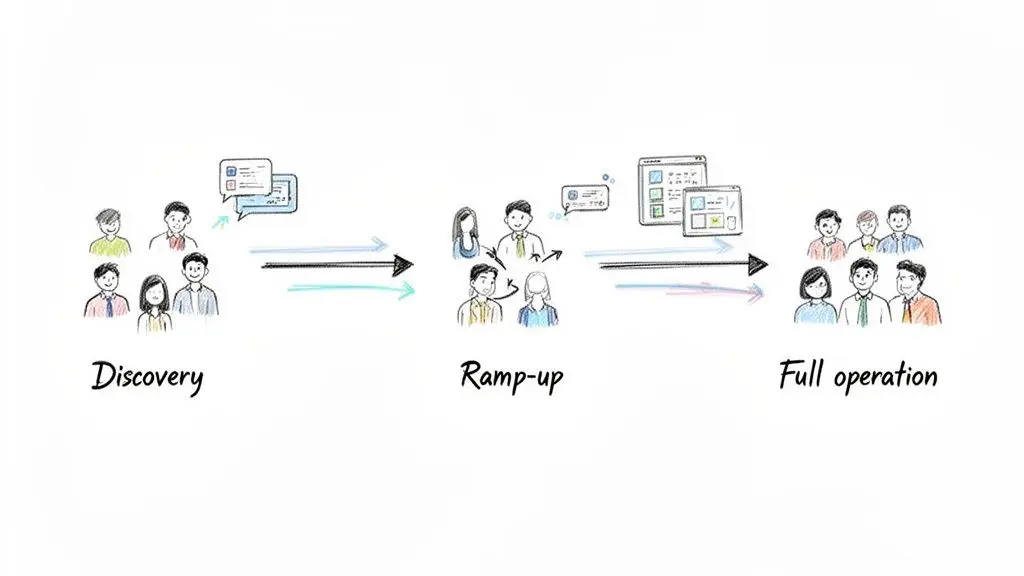
This doesn’t happen by accident. A methodical, phased approach—moving from initial discovery to full operation—is what separates a fast start from weeks of frustrating friction.
A Phased Playbook for Integration
A chaotic “all-at-once” handover is a recipe for failure. It overwhelms everyone and guarantees that critical knowledge gets lost. A structured, phased approach is non-negotiable.
Here’s a simple three-part structure that works:
-
Initial Discovery and Knowledge Transfer: This is the foundation. Your partner should lead deep-dive sessions to absorb not just the technical docs, but the unwritten rules, the business context, and the why behind your product.
-
Tooling and Environment Setup: True integration happens in shared digital spaces. This means providing controlled access to code repositories like Git, project boards like Jira, and communication channels like Slack. Roles and permissions must be crystal clear to maintain security and avoid confusion.
-
Ramp-Up and Initial Sprints: The new team shouldn’t be thrown into the deep end. They should start with smaller, well-defined tasks to get familiar with the codebase and your development rhythm. This controlled ramp-up builds confidence and lets you course-correct early.
The single biggest onboarding mistake is assuming technical documentation is enough. True knowledge transfer is about sharing context—the product vision, past architectural trade-offs, and customer pain points. A partner who doesn’t ask for this isn’t thinking deeply enough.
Defining Roles and Building One Team
For an outsourced team to truly deliver, they need to feel like part of the core mission. This takes more than a project brief; it demands clear roles, defined responsibilities, and a deliberate effort to create a single, unified culture.
That means explicitly defining who owns what.
- Who is the Product Owner? There must be a single source of truth for requirements and priorities. No ambiguity.
- Who is the technical lead? A designated lead on both sides ensures architectural decisions are coherent and don’t drift apart.
- What are the communication protocols? Establish daily stand-ups, weekly demos, and clear channels for ad-hoc questions. This is how you prevent silos before they form.
When you invest in a methodical transition and clear roles, you move beyond a simple vendor relationship. You create a cohesive unit focused on a shared goal, whether it’s getting a new product to market or modernising a critical system. That upfront effort pays for itself many times over in speed, quality, and a more resilient partnership.
Frequently Asked Questions About IT Outsourcing
Even with a solid plan, a few key questions always come up when technical leaders are weighing an ITO IT outsourcing partnership. Here are some direct answers to the most common concerns we hear.
How Do I Protect My Intellectual Property When Outsourcing?
Protecting your IP isn’t just a checkbox; it’s a foundational part of the partnership. It’s a mix of clear legal agreements, smart technical controls, and choosing a partner who respects what you’ve built.
- The Legal Layer: Your Master Services Agreement (MSA) and Non-Disclosure Agreement (NDA) are your starting point. These documents need to be crystal clear: all intellectual property created for you, during the engagement, belongs to you. No ambiguity, no exceptions.
- The Technical Layer: You must always retain ultimate control of your infrastructure and source code. Your partner needs access, but it should be role-based and restricted—never full administrative keys to the kingdom.
- The Human Layer: Work with a partner who brings this up first. A trustworthy firm will be proactive about their internal security, have a proven track record, and walk you through their process for safeguarding your assets.
A partner who gets cagey about IP ownership or tries to water down the language in a contract is showing you who they are. True partners get it: your IP is your business, and their job is to protect it as fiercely as you do.
What Are the Most Common Hidden Costs in Outsourcing?
The hidden costs that sting the most rarely come from technology. They come from poorly defined scope and weak project management.
We see it all the time: uncontrolled “scope creep” turns predictable costs into a runaway train of hourly bills. Then there are the surprise costs for third-party licenses or infrastructure you thought were included.
But the biggest hidden cost? The time your own senior people waste managing a disorganized or underperforming vendor. That’s a drag on your entire roadmap. The only way to avoid this is to insist on a partner who demands a thorough discovery phase, offers transparent, all-inclusive pricing, and locks down the scope before a single line of code is written.
Is It Better to Choose a Large Firm or a Specialized Partner?
This comes down to what you truly need. Are you looking for scale or for a genuine partner?
Large outsourcing firms offer a massive global footprint and can throw a lot of bodies at a problem. But that scale often comes with bureaucracy, rigid processes, and the risk of your project being handed to a junior team.
A smaller, specialized partner, on the other hand, usually gives you direct access to their senior talent. You get a more focused, agile engagement and a team that’s invested in your product’s success, not just in closing out a ticket. For companies that need high-quality custom software and a pragmatic, product-first mindset, a specialized firm almost always delivers more value.
Ultimately, the right choice isn’t about headcount. Judge a potential partner on their relevant experience, their architectural philosophy, and whether they feel like an extension of your own team.
Ready to move beyond theory and build a digital product you can rely on? Devisia specialises in turning business vision into scalable, maintainable software and AI-enabled systems. We act as a long-term technical partner, providing the product mindset and engineering discipline you need to succeed.