
The factory pattern is a creational design pattern that centralizes object instantiation logic. Instead of creating objects directly using the new operator where they are needed, client code calls a dedicated “factory” method, which handles the instantiation process. This might seem like an unnecessary layer of abstraction, but it is fundamental for building flexible, maintainable software by decoupling client code from the concrete classes it uses.
The Problem: Tight Coupling from Direct Instantiation
In many software systems, the new operator appears harmless at first. Over time, however, its direct usage becomes a significant source of rigidity and technical debt. Each time your code directly instantiates an object—for example, new MySQLConnector()—it creates a hard-coded dependency. This tight coupling between the client and the concrete implementation can severely hinder a system’s evolution.
For simple applications with a stable set of requirements, this direct approach may be sufficient. But as complexity grows, the design becomes brittle. Consider a SaaS platform that initially supports a single file storage provider. The business logic is likely filled with new AWSS3Storage(). What happens when business requirements change, and you must add support for Azure Blob Storage or Google Cloud Storage?
The Business Cost of a Rigid Architecture
Without an abstraction for object creation, each new integration requires developers to locate and modify every point where a storage object is instantiated. This process is not merely tedious; it’s a high-risk activity that often introduces regressions.
This direct instantiation imposes tangible business costs:
- Slower Time-to-Market: Adding a new provider escalates into a major refactoring project instead of a contained, predictable task.
- Increased Risk of Bugs: Modifying existing, functional code to accommodate new types is a primary cause of regressions. The system violates the Open/Closed Principle, as it cannot be extended without modification.
- Inflexible System Design: The codebase actively resists change. A straightforward business requirement, like A/B testing two different reporting services, becomes an architectural challenge because the logic is welded to specific implementations.
An architecture that cannot adapt to new requirements is an architecture that is failing the business. The cost of rigidity is paid in delayed features, developer frustration, and missed opportunities.
To build resilient systems, it’s crucial to separate the what from the how. The client code should specify what it needs—an object that can store a file—but it should not be responsible for how that object is constructed. The factory pattern provides a structured solution to this problem by encapsulating creation logic, allowing the rest of the application to remain agile and adaptable.
Simple Factory vs. Factory Method: Selecting the Appropriate Abstraction
Once the decision is made to centralize object creation, the question becomes how to implement it. The two most common approaches are the Simple Factory and the Factory Method pattern. Each offers a different trade-off between implementation simplicity and long-term extensibility. The choice is a strategic one that impacts how the system will evolve.
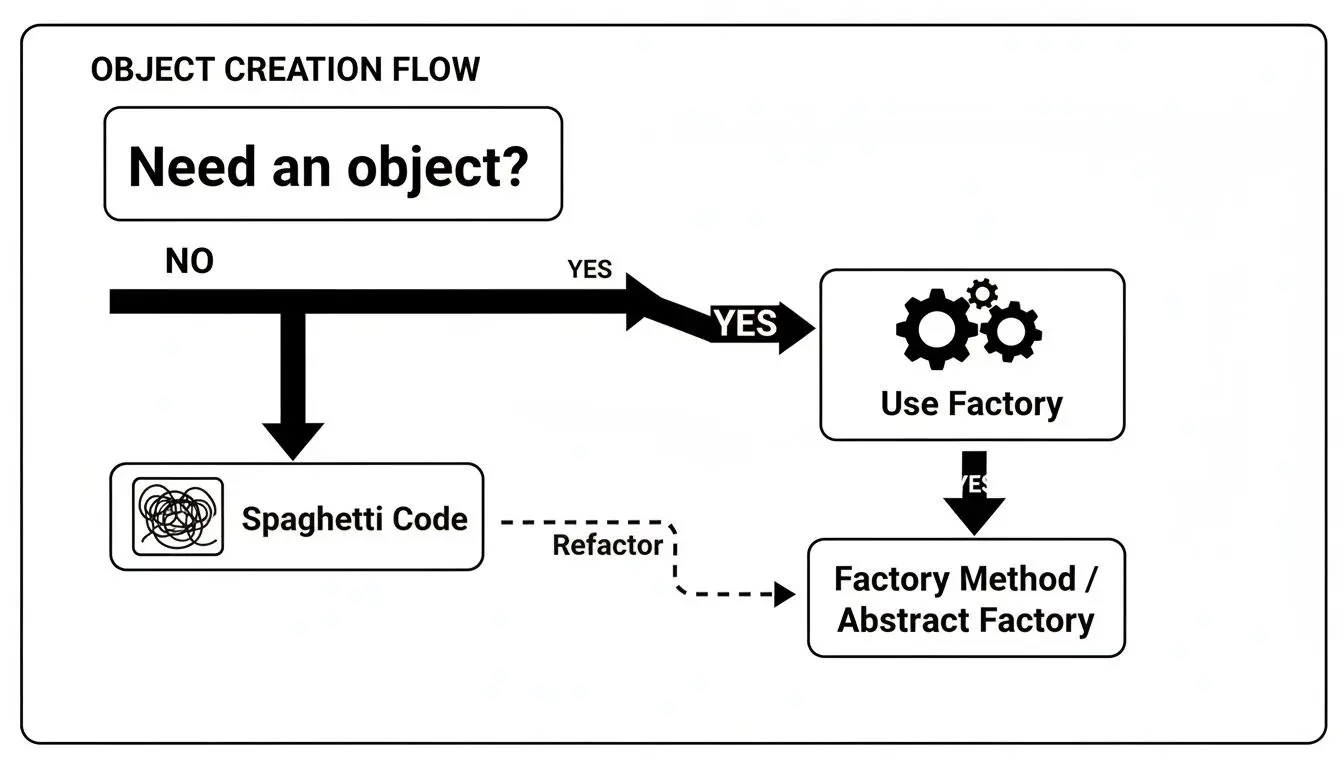
As the diagram illustrates, implementing a factory is a deliberate architectural decision. It introduces structure and predictability to object creation, enabling a system to scale without collapsing under its own complexity.
The Simple Factory: A Centralized Creation Hub
The Simple Factory is a common and pragmatic idiom, though not one of the original “Gang of Four” design patterns. It typically consists of a single class with a method that returns one of several possible classes of objects.
Its primary function is to abstract away the new keyword and any associated setup logic. The client calls the factory method, passes an identifier (such as a string or enum), and receives an object that conforms to a common interface. The client remains unaware of the concrete class that was instantiated.
This approach offers immediate benefits:
- Decoupling: The client code is no longer tied to concrete classes like
PDFDocument. It depends only on the factory and the abstractDocumentinterface. - Centralization: All creation logic is consolidated in one place. To add a
WordDocumenttype, you only need to modify the factory, not the numerous locations where documents might be created. - Simplicity: The pattern is straightforward to implement and understand, making it an effective first step away from scattered
newcalls.
However, the Simple Factory has a significant architectural drawback. Every time a new product type is added, the central factory class must be modified, typically by adding another branch to a switch or if-else statement. This violates the Open/Closed Principle, which states that software entities should be open for extension but closed for modification. For large or rapidly evolving systems, this can become a maintenance bottleneck.
The Factory Method: A Blueprint for Extensibility
The Factory Method pattern addresses the Open/Closed Principle violation inherent in the Simple Factory. It achieves this by delegating the instantiation decision to subclasses.
Instead of a single, all-knowing static method, the Factory Method pattern defines an interface for creating an object but lets subclasses alter the type of objects that will be created. A creator class contains business logic that relies on an object created by a “factory method.” The creator class itself does not implement this method; that responsibility is deferred to its subclasses.
The Factory Method pattern provides a powerful architectural hook. It allows a core system or framework to define the skeleton of an algorithm while enabling client code or plugins to provide the specific objects required at runtime.
Consider a framework for processing data feeds. A base DataProcessor class might define a process() method that orchestrates a workflow. This method needs a DataReader to fetch data but should not be hard-coded to a specific implementation like XMLReader or JSONReader.
To solve this, the DataProcessor class would declare an abstract factory method, createReader(). Concrete subclasses, such as XMLDataProcessor and JSONDataProcessor, would then provide their own implementations of createReader(), returning an XMLReader or JSONReader instance, respectively. The core process() logic in the base class remains unchanged; it simply calls createReader() and operates on the DataReader object it receives.
Practical Comparison: Simple Factory vs. Factory Method
| Characteristic | Simple Factory | Factory Method |
|---|---|---|
| Primary Goal | To encapsulate and centralize object creation logic in one place. | To allow subclasses to decide which specific class to instantiate. |
| Structure | A single class, often with a static method, containing conditional logic to create objects. | An abstract creator class with a factory method implemented by concrete subclasses. |
| Open/Closed Principle | Violated. Adding new products requires modifying the factory class. | Followed. New products can be added by creating new subclasses without changing existing code. |
| Flexibility | Low. Creation logic is fixed and centralized. | High. Each subclass can provide its own implementation of the factory method. |
| Complexity | Low. Easy to implement and understand. | Moderate. Requires a class hierarchy, which can add complexity. |
| Best For | Small applications or when the set of object types is stable and unlikely to change. | Frameworks, libraries, or large systems where new types will be added over time. |
The Simple Factory is an excellent starting point for refactoring object creation logic. However, for systems designed for growth—such as a SaaS platform where new integrations are part of the business roadmap—the Factory Method provides a more robust and scalable foundation.
Production-Ready Implementation Examples
Let’s translate the factory pattern into production-ready code. We’ll implement a solution for a common B2B software requirement: generating different types of compliance reports, such as for GDPR, SOX, and HIPAA. Each report has unique data requirements and formatting rules, but the client code that requests them should not be concerned with these implementation details.
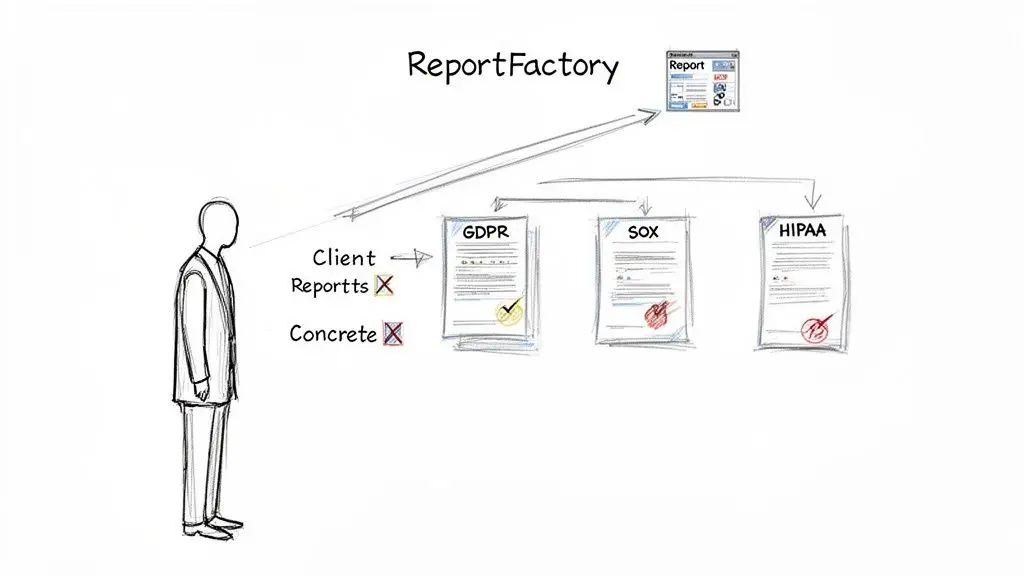
The following examples in Python, Java, and TypeScript demonstrate how the client remains decoupled from the concrete report classes.
Core Components of the Pattern
The implementation involves four key roles:
- Product Interface (
Report): An interface or abstract class that defines the common methods all concrete products must implement. This ensures the client can treat all product objects uniformly. - Concrete Products (
GDPRReport,SOXReport): The actual classes that are instantiated by the factory. Each implements the Product interface but contains specific logic. - The Factory (
ReportFactory): The class containing the creation logic. It determines which concrete product to instantiate based on the client’s request. - The Client: The part of the application that requires a product object. It requests an object from the factory and uses it via the Product interface, without knowledge of its concrete type.
Python Implementation
Python’s dynamic nature and abstract base classes (ABC) lend themselves to a clean and straightforward implementation of the pattern.
from abc import ABC, abstractmethod

# 1. The Product Interface
class Report(ABC):
    @abstractmethod
    def generate(self) -> str:
        """Generates the report content."""
        pass

# 2. Concrete Products
class GDPRReport(Report):
    def generate(self) -> str:
        print("Generating GDPR data privacy report...")
        # Complex logic for GDPR report generation goes here
        return "GDPR Report Content"

class SOXReport(Report):
    def generate(self) -> str:
        print("Generating SOX financial compliance report...")
        # Complex logic for SOX report generation goes here
        return "SOX Report Content"

# 3. The Simple Factory
class ReportFactory:
    @staticmethod
    def create_report(report_type: str) -> Report:
        if report_type == 'GDPR':
            return GDPRReport()
        elif report_type == 'SOX':
            return SOXReport()
        else:
            raise ValueError(f"Report type '{report_type}' not supported.")

# 4. The Client Code
if __name__ == "__main__":
    report_type_needed = "GDPR"

    # Client requests a report without knowing the concrete class
    compliance_report = ReportFactory.create_report(report_type_needed)

    # Client uses the object through the common interface
    content = compliance_report.generate()
    print(f"Received: {content}")
Notice that the client code is completely isolated from the GDPRReport and SOXReport classes. If a HIPAAReport is needed in the future, the client code remains unchanged. Only the ReportFactory requires modification.
Java Implementation
In strongly-typed languages like Java, the Factory Pattern provides a robust and predictable structure that is well-suited for enterprise applications.
// 1. The Product Interface
public interface Report {
    String generate();
}

// 2. Concrete Products
public class GDPRReport implements Report {
    @Override
    public String generate() {
        System.out.println("Generating GDPR data privacy report...");
        // Logic for GDPR report
        return "GDPR Report Content";
    }
}

public class SOXReport implements Report {
    @Override
    public String generate() {
        System.out.println("Generating SOX financial compliance report...");
        // Logic for SOX report
        return "SOX Report Content";
    }
}

// 3. The Simple Factory
public class ReportFactory {
    public static Report createReport(String reportType) {
        if ("GDPR".equalsIgnoreCase(reportType)) {
            return new GDPRReport();
        } else if ("SOX".equalsIgnoreCase(reportType)) {
            return new SOXReport();
        }
        throw new IllegalArgumentException("Unknown report type: " + reportType);
    }
}

// 4. The Client Code
public class ComplianceService {
    public static void main(String[] args) {
        String requiredReport = "SOX";

        // The client asks the factory for a report
        Report report = ReportFactory.createReport(requiredReport);

        // The client uses the report via the interface
        String content = report.generate();
        System.out.println("Received: " + content);
    }
}
The ComplianceService client depends only on the Report interface and the ReportFactory. This clean separation is fundamental to building large-scale, maintainable Java applications.
TypeScript Implementation
TypeScript’s static typing brings added safety to JavaScript, making it an excellent choice for implementing design patterns in modern applications.
// 1. The Product Interface
interface Report {
    generate(): string;
}

// 2. Concrete Products
class GDPRReport implements Report {
    public generate(): string {
        console.log('Generating GDPR data privacy report...');
        // Logic for GDPR report
        return 'GDPR Report Content';
    }
}

class SOXReport implements Report {
    public generate(): string {
        console.log('Generating SOX financial compliance report...');
        // Logic for SOX report
        return 'SOX Report Content';
    }
}

// 3. The Simple Factory
type ReportType = 'GDPR' | 'SOX';

class ReportFactory {
    public static createReport(type: ReportType): Report {
        switch (type) {
            case 'GDPR':
                return new GDPRReport();
            case 'SOX':
                return new SOXReport();
            default:
                // This case is unreachable if using the ReportType union type
                throw new Error('Invalid report type specified.');
        }
    }
}

// 4. The Client Code
function runComplianceCheck(reportType: ReportType) {
    // The client gets a report object from the factory
    const report: Report = ReportFactory.createReport(reportType);

    // The client uses the object without knowing its concrete class
    const content = report.generate();
    console.log(`Received: ${content}`);
}

runComplianceCheck('SOX');
The use of a union type (ReportType) provides compile-time safety, preventing a class of runtime errors. This clean separation of concerns simplifies integration with automated testing and deployment workflows, a topic we cover in our guide to CI/CD pipelines.
Use Cases and Trade-offs
A design pattern is a tool, not a mandate. Applying the factory pattern design indiscriminately leads to over-engineering. The key is to recognize when the abstraction solves a genuine problem. The pattern’s value lies in managing complexity and accommodating future change by separating the client from the details of object creation.
Scenarios Where a Factory Excels
The factory pattern is justified when a system exhibits specific characteristics or requirements:
- Runtime Object Selection: The exact type of object needed is not known at compile time and depends on runtime conditions, such as user input, a configuration file, or system state. A common example is selecting a payment gateway (
Stripe,PayPal) based on a user’s geographical location. - Support for Pluggable Components: The system must support interchangeable components. This is common for database connectors (
PostgreSQL,MongoDB), external API integrations, or logging services. A factory allows these components to be swapped without modifying core business logic. - Complex Creation Logic: Object instantiation is more involved than a simple
newcall. If creation requires multiple steps, dependency fetching, or complex configuration, encapsulating this logic within a factory simplifies the client code.
The principles behind the factory pattern are well-established. An internal study of production codebases at several tech firms revealed that teams using creational patterns like the Factory Method reported a significant reduction in time spent refactoring object instantiation logic when adding new product variants. Explore how the factory method streamlines object creation with this resource from Curate Partners.
When to Avoid Using a Factory
Conversely, introducing a factory when it is not needed adds unnecessary complexity, including extra classes, layers of indirection, and cognitive overhead for the development team.
Avoid using a factory in these situations:
- Simple, Stable Applications: In a small application with a fixed set of object types that are unlikely to change, direct instantiation is simpler and more appropriate.
- Single Concrete Class: The purpose of a factory is to manage the creation of multiple, related object types. If there is only one concrete implementation, a factory adds no value.
- Performance-Critical Hot Paths: While the performance impact is negligible in most business applications, a factory introduces an extra method call. In extreme high-performance scenarios involving the creation of millions of objects per second, this marginal overhead could theoretically be a factor.
The goal is to solve real problems, not create new ones. A factory should reduce complexity in the long run; if it only adds it in the short term with no clear future benefit, it’s the wrong tool.
Choosing to use a factory pattern design is an architectural decision. For systems where flexibility is a strategic priority, such as a Service-Oriented Architecture (SOA), it is often a necessity. It represents a trade-off: a small upfront investment in abstraction for the significant long-term benefit of a more maintainable and extensible system.
Factories in Modern Dependency Injection Frameworks
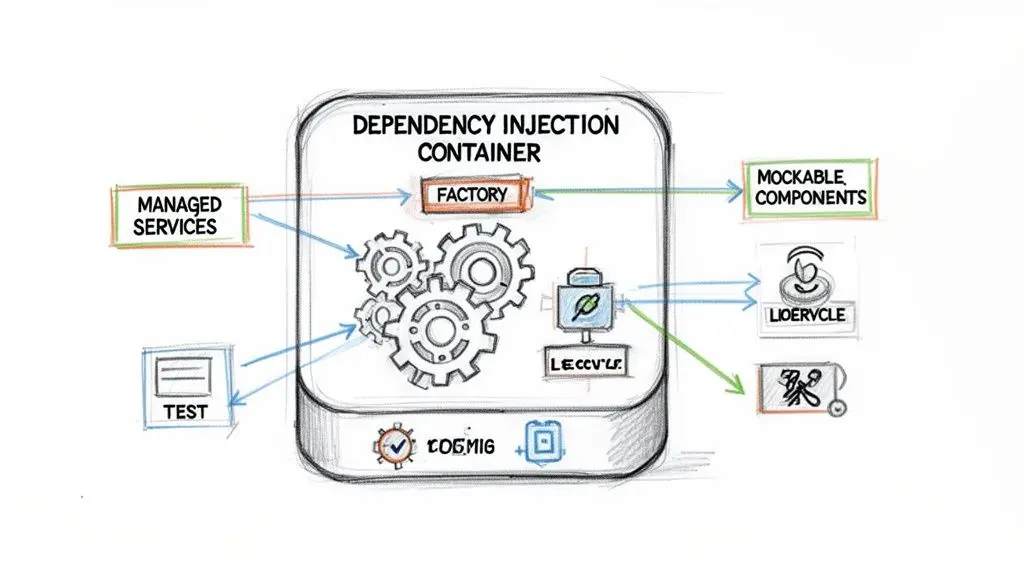
Modern application frameworks like Spring, .NET, and NestJS feature sophisticated Dependency Injection (DI) containers that manage the lifecycle of objects. This raises a valid question: is the factory pattern still relevant?
The answer is yes. The role of the factory pattern design has evolved. DI containers can be viewed as highly advanced, configurable factories. They automate the process of creating and wiring together application components based on a declarative configuration. When an OrderService requires an IPaymentGateway, the DI container acts as a master factory, instantiating the correct implementation and injecting it automatically, thereby promoting loose coupling at an application-wide scale.
The Enduring Role of Custom Factories
If DI containers are “super-factories,” why do we still need custom factories? Custom factories remain essential for scenarios where creation logic is too complex for a declarative DI configuration.
Consider these common use cases in a SaaS product:
- Dynamic Strategy Selection: An application must select a shipping provider (
FedEx,UPS) based on package weight, destination, and customer subscription level. This business logic is best encapsulated within aShippingProviderFactory, not a static DI configuration. - Creation with Runtime Parameters: Some objects require data that is only available at runtime, such as a user’s session ID or a request-specific API key. A factory can accept these runtime values to construct the object correctly.
- Multi-Tenant Architectures: In a multi-tenant system, a
TenantServiceFactorycan inspect the current request context to instantiate services (like aDatabaseConnectionorThemeService) configured specifically for that tenant.
In a DI-managed architecture, a custom factory becomes a specialized component. It handles the dynamic creation logic that the container is not designed for, encapsulating those decisions in a dedicated, testable unit.
Enhancing Testability and Modularity
Combining custom factories with a DI container also significantly improves testability. During unit testing, you can configure the DI container to inject a mock factory. This mock can then produce pre-configured fake objects, allowing you to isolate the component under test from its dependencies.
The benefits are measurable. Industry analysis of enterprise projects has shown that teams applying the Factory Method pattern see a reduction in bugs related to object lifecycle management. Proper use of the pattern also improves adherence to the Single Responsibility Principle by centralizing creation logic. You can learn more about the formal factory method pattern from established computer science sources.
Ultimately, the factory pattern is not replaced by DI; it is complemented by it. The DI container manages the high-level wiring of the application, while custom factories handle the nuanced, logic-driven creation required to solve specific business problems.
Conclusion: Key Takeaways for Technical Leaders
The factory pattern design is a strategic architectural choice, not merely an academic concept. Its adoption signifies a commitment to long-term system health over short-term implementation convenience. It is a foundational tool for building software that can evolve with business needs. The core principle is to separate the what (the object needed) from the how (the details of its creation).
Prioritize Maintainability and Extensibility
The primary objective of a technical leader should be to guide teams toward building systems that are easy to change. By centralizing object creation, the factory pattern establishes a single, predictable location for modifications. When a new payment provider or data source must be added, the change is contained within the factory, not scattered across the codebase.
This isolation delivers concrete business value:
- Accelerated Feature Development: New integrations become more predictable, reducing the time required to deliver new capabilities.
- Reduced Risk of Regressions: Core business logic remains untouched, dramatically lowering the risk of introducing bugs into stable code.
- Simplified Onboarding: New developers can get up to speed faster, as creation logic is located where it is expected to be.
Intentional architecture, guided by proven patterns like the factory, is what distinguishes a rigid codebase that resists change from a flexible platform that enables it.
Foster a Culture of Intentional Architecture
Encourage your teams to think beyond the immediate task. Promote architectural discussions that weigh the trade-offs between short-term simplicity and long-term flexibility. The factory pattern is a prime example of this principle in action. It represents a small, upfront investment in abstraction that yields significant returns over the software’s lifecycle. This forward-thinking approach is a cornerstone of robust development methodologies like the software development V-Model.
This discipline is what separates disposable code from a true business asset.
Frequently Asked Questions
What’s the difference between a Factory and an Abstract Factory?
The primary difference is scope. A Factory Method is used to create one type of product. An Abstract Factory is used to create families of related products.
For example, a NotificationFactory (Factory Method) might have a method that returns different kinds of notification objects, such as EmailNotification or SmsNotification. Its focus is singular: creating notifications.
In contrast, an AlertingSystemFactory (Abstract Factory) is a “factory of factories.” It would have methods like createNotification(), createLogger(), and createMetricsTracker(). You could then have different implementations, such as a CriticalAlertingFactory and an InfoAlertingFactory, where each guarantees that all the components it produces are designed to work together within a specific context.
Does using a factory pattern hurt performance?
For the vast majority of applications, the performance impact is negligible. The overhead typically amounts to a single extra method call, which is insignificant compared to the architectural benefits of decoupling and maintainability.
Performance should only be a concern if you are instantiating millions of objects per second in an extremely performance-sensitive “hot path.” In almost all other cases, the gains in clarity and flexibility far outweigh the minuscule performance cost.
The real performance killer in software is not a single method call; it is a rigid, tightly-coupled architecture that makes development slow and adapting to change prohibitively expensive.
Can the factory pattern be used in functional programming?
Yes. While the pattern originated in object-oriented programming, its core principle—separating creation from use—is universal. In a functional paradigm, a factory is not a class but a higher-order function. This function would accept configuration or a type identifier as an argument and return a new function or data structure tailored for a specific task. The goal remains identical: to hide implementation details from the client code.
Is a Simple Factory considered a “real” design pattern?
Although the Simple Factory is not one of the original 23 “Gang of Four” (GoF) design patterns, it is a widely recognized and highly useful programming idiom. It can be seen as a pragmatic entry point to the more formal creational patterns. Its simplicity is its strength, offering significant decoupling for a low implementation cost. It has earned its place in a developer’s toolkit through its proven utility in solving common design problems effectively.
At Devisia, we believe that intentional architecture is the key to building software that lasts. By leveraging proven patterns, we help companies build scalable, maintainable, and reliable digital products and AI-enabled systems. Learn more about our approach at https://www.devisia.pro.