The term “digital transformation” is overused, often obscuring its practical meaning. For retailers, it’s not a marketing buzzword but a necessary architectural shift: moving from a business that uses digital tools to a digital-native operation. This requires a fundamental re-architecture of operations, supply chains, and customer engagement models, all built upon a coherent data strategy and modern software principles.
This guide provides a pragmatic, engineering-focused roadmap for founders, CTOs, and technical leaders navigating this process. We will examine the architectural trade-offs, implementation patterns, and governance considerations required to build a resilient, scalable retail ecosystem.
Understanding the Core Problem: Architectural Fragmentation
The primary driver for retail transformation is often a critical systems-level failure: essential business functions operate in isolated silos. E-commerce platforms, physical point-of-sale (POS) systems, inventory management, and customer relationship management (CRM) tools do not communicate effectively, resulting in a fragmented and inefficient operational landscape.
This is not an abstract technical debt issue; it creates tangible business liabilities. A customer sees an item in stock online, only to find the shelf empty in-store. A marketing campaign promotes a product a customer has just returned. These are not isolated errors but symptoms of a brittle, fractured architecture—a patchwork of monolithic applications and bolt-on solutions that were never designed to interoperate.
The Problem of Disconnected Systems
The root cause is typically a legacy technology stack composed of monolithic, single-purpose applications. A system for POS, another for the warehouse, and a separate one for an early e-commerce site. As new channels like mobile apps and social commerce emerged, more standalone solutions were added, creating a complex and fragile ecosystem.
This “add-another-app” approach creates severe operational risks:
- Data Silos: Customer profiles, product information, and inventory levels are trapped in disparate systems. A single, accurate view of the business is computationally expensive or impossible to achieve.
- Operational Inefficiency: Teams are forced into manual data reconciliation and complex report generation to move information between systems. This workflow is slow, error-prone, and resource-intensive.
- Degraded Customer Experience: Without a single source of truth for customer and inventory data, delivering a consistent, personalized journey across channels is operationally infeasible.
The Solution: An Integrated, Data-Driven Architecture
The solution is to transition from a collection of isolated applications to an integrated, data-driven architecture. The objective is to build a cohesive system where every channel and function can exchange data in real-time. This creates a unified commerce platform where data flows to where it is needed, enabling automated workflows and data-informed decisions.
A successful retail transformation is not a high-risk “rip and replace” project. It is an incremental process of building a robust architectural foundation—typically using APIs and a central data platform—that allows for modular modernization while delivering measurable business value at each stage.
By dismantling data silos, organizations can implement high-value capabilities. Predictive analytics can be used for accurate demand forecasting, and unified customer profiles can enable true one-to-one personalization. This architectural shift resolves operational friction and unlocks business outcomes, such as optimized inventory, higher customer lifetime value, and a scalable platform prepared for future demands.
Building a Phased and Practical Transformation Roadmap
Attempting a “big bang” digital transformation is a common failure pattern. The complexity, cost, and operational disruption of a complete overhaul are prohibitive for most organizations. A more pragmatic approach is a phased roadmap that delivers value in manageable increments, mitigates risk, and builds organizational momentum. This methodology allows for modular modernization, with the ROI of each phase justifying the investment in the next.
The transformation journey moves from fragmented legacy systems to a coherent, data-driven operation. It typically unfolds across four logical stages, demonstrating the progression from disconnected technology to an integrated data platform that drives business outcomes.
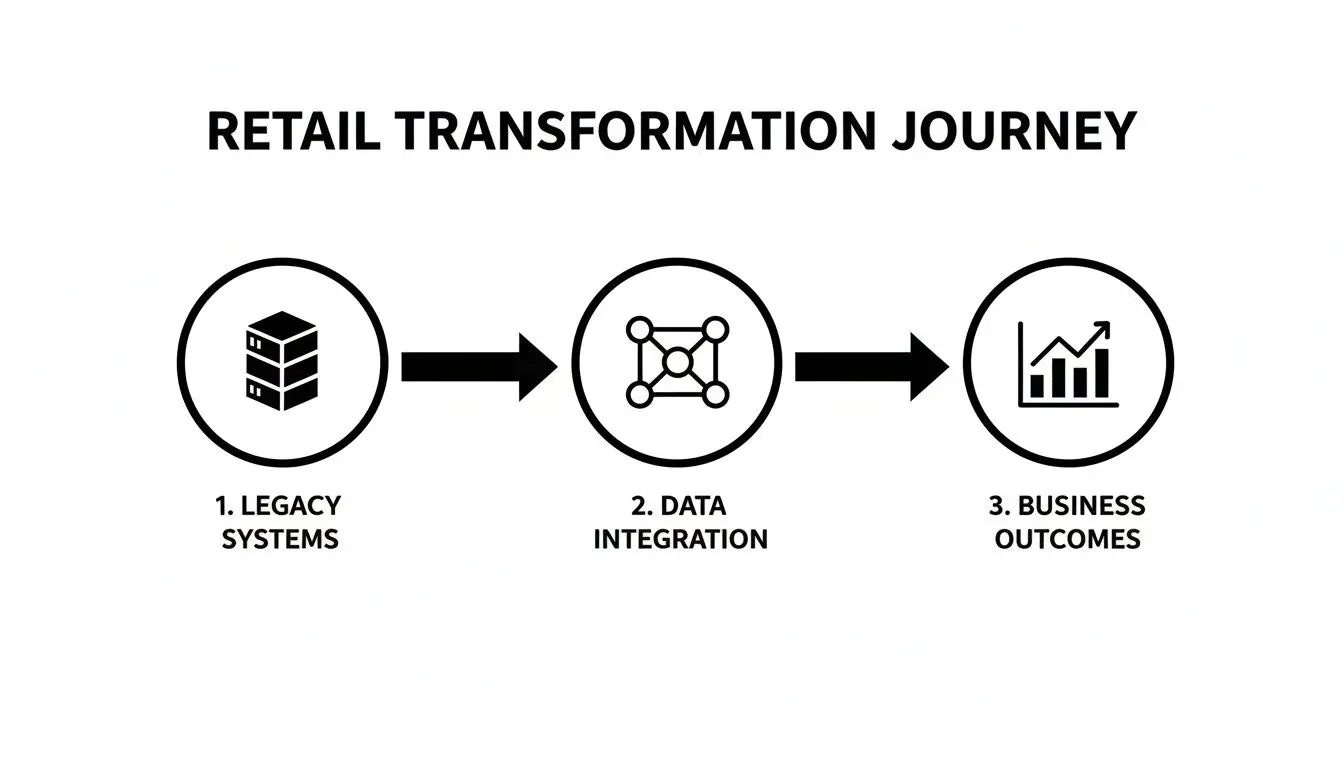
As the diagram illustrates, achieving tangible business impact is contingent on first resolving foundational data silos. This intermediate step is crucial and frequently overlooked.
Stage 1: Foundational Modernization
This initial phase focuses on replacing rigid, legacy infrastructure with a flexible, scalable foundation. The core problem is that legacy systems lack interoperability and cannot support modern customer experiences. The solution is to establish a modern architectural backbone.
Key initiatives include migrating core systems to the cloud and adopting an API-first architecture. This does not necessitate an immediate “rip and replace.” A common starting point is to wrap legacy systems with modern APIs, creating an abstraction layer that enables communication between old and new technologies. This is the first concrete step toward dismantling technical silos.
Stage 2: Data Unification
With a modern foundation in place, the next challenge is data fragmentation. Customer, product, and inventory data are often scattered across numerous systems, making a single source of truth impossible. This stage is dedicated to consolidating this data.
The primary goal is to implement a central data platform, such as a Customer Data Platform (CDP) or a data warehouse. This platform ingests, cleanses, and unifies data from all sources—e-commerce sites, POS systems, loyalty programs, and marketing tools. Success in this stage is measured not by system uptime, but by the quality, consistency, and accessibility of the data.
A phased roadmap transforms a high-risk, monolithic project into a series of manageable, value-driven initiatives. Each stage builds upon the last, ensuring that technical investments are directly tied to measurable business capabilities.
Stage 3: Intelligent Automation
With unified and accessible data, organizations can begin implementing intelligent automation. The problem at this stage is no longer a lack of data, but the inability to act on it at scale. Manual processes for inventory management, pricing, and marketing are inefficient and cannot keep pace with market dynamics.
This is where AI and machine learning are applied. The objective is to deploy targeted AI models for high-impact use cases.
- Demand Forecasting: Utilize predictive models to analyze historical sales data and market trends, reducing both overstock and stockouts.
- Dynamic Pricing: Automate price adjustments based on real-time demand, competitor pricing, and inventory levels.
- Marketing Automation: Leverage the CDP to trigger personalized marketing campaigns based on customer behavior, not demographic segments.
Success is measured by improvements in operational KPIs, such as inventory turnover, gross margin, and campaign conversion rates.
Stage 4: Experience Innovation
With a modern architecture, unified data, and intelligent automation in place, the foundation is set for creating innovative customer experiences. The previous stages focused on back-end systems and operational efficiency. This stage leverages that foundation to deliver front-end differentiation.
The goal is to build seamless, personalized journeys across all channels. This could involve developing augmented reality features for virtual try-ons, implementing a hyper-personalized loyalty program, or creating new digital experiences within physical stores. Because the foundational engineering work is complete, innovation can occur more rapidly and with lower risk. Progress is measured by customer-centric metrics like Net Promoter Score (NPS), customer lifetime value (CLV), and engagement rates.
Architecting for Future Agility and Scale
The technology architecture is the engine of a retail transformation. A poorly designed architecture results in a rigid system that accumulates technical debt, hinders innovation, and increases operational costs. The objective is to build a foundation that evolves with the business, not one that constrains it.
The primary obstacle is often a traditional monolithic architecture, where all components—storefront, checkout, inventory—are tightly coupled within a single application. While seemingly simpler to build initially, this design becomes a significant liability. A minor change in one component requires re-testing and re-deploying the entire system, making updates slow, risky, and expensive. This inflexibility is a direct impediment to modern retail operations.
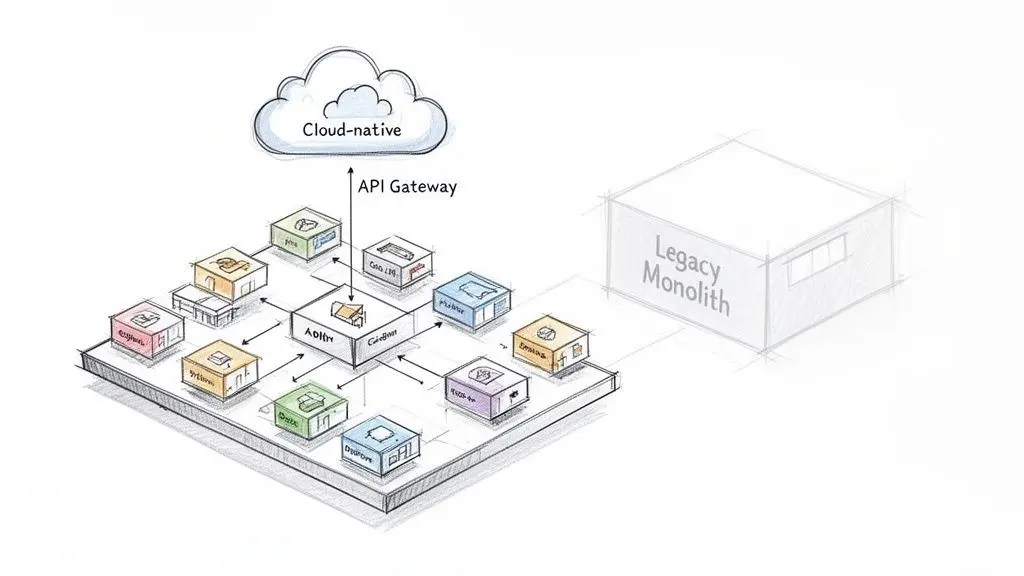
The solution is not a larger monolith but a transition to a modular, decoupled architecture. Modern approaches like microservices and MACH are specifically designed for the flexibility and scale required by the retail environment.
From Monoliths To Microservices And MACH
A microservices architecture represents a paradigm shift in system design. It decomposes a large application into a collection of smaller, independent services. Each service encapsulates a specific business function—such as payments, authentication, or product search—and can be developed, deployed, and scaled autonomously. This modularity allows different teams to work on separate services concurrently, significantly accelerating development cycles.
Building on this principle, MACH architecture provides a specific blueprint for modern digital experience platforms.
- Microservices: Individual pieces of business functionality are independently developed, deployed, and managed.
- API-first: All functionality is exposed via an Application Programming Interface (API), simplifying communication between services and channels.
- Cloud-native: The system is designed to run on cloud infrastructure, providing elasticity, resilience, and scalability. For more on this, see our comparison of cloud computing vs on-premise solutions.
- Headless: The front-end presentation layer (the “head”) is decoupled from the back-end logic, enabling the creation of unique customer experiences for any channel—web, mobile, kiosk, or IoT—powered by the same back-end services.
This approach is the antithesis of the all-in-one monolith, delivering a system engineered for adaptability.
Comparing Architectural Approaches for Retail Transformation
| Attribute | Monolithic Architecture | Microservices Architecture | MACH Architecture |
|---|---|---|---|
| Development Speed | Slow. Changes require full system redeployment. | Fast. Teams work on services in parallel. | Very fast. API-first design accelerates integration. |
| Scalability | Difficult. Must scale the entire application. | Granular. Scale individual services as needed. | Natively scalable via cloud infrastructure. |
| Flexibility | Low. Tightly coupled components. | High. Services are independent and replaceable. | Extremely high. Headless and API-first. |
| Technology Stack | Single, unified stack. | Polyglot. Use the best tool for each service. | Polyglot and best-of-breed component choice. |
| Resilience | Low. A failure in one part can crash the whole system. | High. Failures are isolated to a single service. | Very high. Cloud-native resilience patterns. |
| Cost | High initial simplicity, but maintenance costs grow over time. | Higher initial complexity, but lower long-term cost. | Composable model optimises long-term TCO. |
While monoliths may seem simpler at the outset, microservices and MACH architectures are designed for the long-term requirements of continuous evolution and scale.
Essential Components For A Flexible Retail Architecture
A practical MACH-based system involves several key components. A headless commerce platform provides core back-end functionality—product catalogs, cart, checkout—through APIs, without imposing a front-end presentation layer. This allows development teams to build custom user experiences that align with the brand, free from the constraints of traditional e-commerce templates.
An API gateway serves as the single entry point for all system requests, routing them to the appropriate back-end microservice. It also handles cross-cutting concerns like security, authentication, rate limiting, and monitoring, simplifying the overall architecture and providing a central point of control.
Adopting a modern architecture isn’t just a technical upgrade; it’s a strategic business decision. It directly enables faster time-to-market for new features, reduces the risk associated with deployments, and provides the scalability needed to handle peak demand without over-provisioning resources.
Integrating New Tech With Legacy Systems
For established retailers, a complete “rip and replace” of legacy systems is often too risky and costly. A more pragmatic approach is gradual modernization using established architectural patterns. The Strangler Fig Pattern is a proven method for this.
Instead of decommissioning the monolith at once, new microservices are built around it. The API gateway routes specific requests to the new services while allowing the legacy system to handle the remaining functions. Over time, more functionality is “strangled” from the monolith and replaced by modern services until the old system can be safely retired. This pattern de-risks the migration process and allows for continuous delivery of business value throughout the transformation.
Driving Real-World Results with AI in Retail
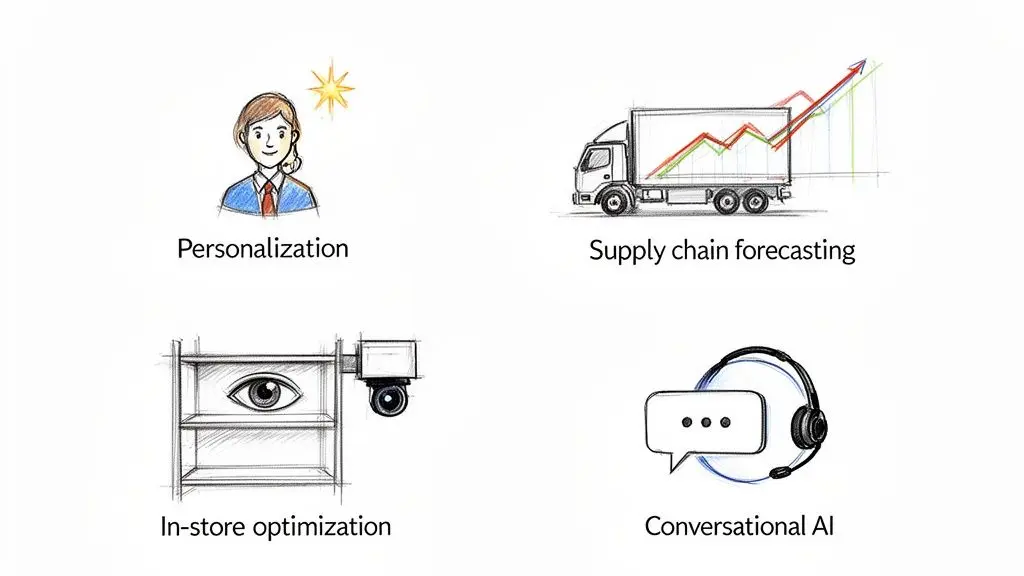
While a modern architecture and unified data are foundational, the business impact of a digital transformation retail strategy is often realized through Artificial Intelligence. This is not about speculative technology adoption but about applying specific AI models to solve high-value problems that are intractable with traditional software. Success requires focusing on practical use cases, ensuring data quality, and choosing integration patterns that complement the existing architecture.
Hyper-Personalisation with Recommendation Engines
The most common application of AI in retail is hyper-personalization, which aims to present the right product to the right customer at the right time. The problem it solves is relevance at scale; a human merchandiser cannot curate a unique experience for millions of individual users.
Recommendation engines use machine learning to analyze large datasets of customer behavior—past purchases, viewed items, abandoned carts—to predict future intent.
- Required Data: Clean, structured data from a Customer Data Platform (CDP) is a prerequisite. This includes user IDs, product interaction logs, and transaction histories.
- Integration Pattern: These models are typically integrated via an API. The front-end application sends a user ID, and the recommendation service returns a list of product IDs to display.
- Key Consideration: Avoid “black box” implementations. The system should provide some level of explainability for its recommendations to aid in debugging, model tuning, and building customer trust.
Supply Chain and Inventory Automation
Predictive models are highly effective for supply chain optimization. The core challenge is balancing the cost of holding excess inventory against the risk of stockouts and lost sales. AI-driven demand forecasting analyzes historical sales, seasonality, and external factors to predict future demand with greater accuracy than traditional methods. These insights can then automate purchase orders and inventory distribution, ensuring optimal stock levels across all locations.
According to market research, the rapid growth of the retail digital transformation market is fueled by the adoption of cloud computing and AI. Cloud platforms, comprising 36.72% of the market, enable scalable SaaS solutions for inventory management and customer experiences, which is particularly beneficial for small and medium-sized businesses.
In-Store Optimisation with Computer Vision
For retailers with physical locations, computer vision can bring digital intelligence into the brick-and-mortar environment. Cameras coupled with AI models can analyze video feeds in real time to address operational challenges like out-of-stock items and inefficient store layouts.
A critical implementation detail for in-store AI is edge computing. Processing video data locally on-device or on a small in-store server minimises latency and significantly reduces the costs and privacy risks associated with sending raw video streams to the cloud.
Common use cases include:
- Shelf Monitoring: Automatically detecting out-of-stock or misplaced products and alerting staff.
- Foot Traffic Analysis: Generating heat maps of customer movement to identify bottlenecks and optimize product placement, without tracking individuals.
This transforms passive video surveillance into an active source of operational intelligence.
Better Customer Service with Conversational AI
Large Language Models (LLMs) have created new opportunities for automating customer service. The problem is well-known: human agents are expensive and not available 24/7, while traditional chatbots are often rigid and frustrating.
LLM-powered conversational AI can understand natural language, retrieve order information via APIs, and handle a wide range of common inquiries, from order status to return policies. A robust implementation requires more than just an LLM; it needs guardrails to prevent hallucinations, tool-use capabilities to interact with other systems (e.g., an order database), and a clear escalation path to a human agent. These components are essential for building a genuinely useful system. For a deeper look at data-driven systems, see our guide to custom business analytics software.
Embedding Governance Risk and Compliance from Day One
A successful digital transformation must be secure and compliant by design. As retailers collect more customer data and rely on complex, interconnected cloud systems, the risk landscape expands significantly. Treating governance, risk, and compliance (GRC) as an afterthought is a recipe for data breaches, regulatory fines, and a loss of customer trust.
The problem is that traditional GRC models, such as manual audits and checklists, cannot keep pace with agile development and cloud-native infrastructure. The solution is a shift from a reactive to a proactive posture, embedding security and privacy into the system architecture and development lifecycle from the outset.
Adopting Privacy by Design Principles
Privacy by Design is an architectural philosophy, not a feature. It mandates that privacy is the default state, not an add-on. For any retailer handling sensitive customer data, this is a non-negotiable principle. It requires engineering systems to minimize data collection and protect it throughout its lifecycle.
Learn more about this methodology in our guide to Privacy by Design for modern software.
Implementation requires concrete engineering practices:
- Data Minimisation: Collect only the data absolutely necessary for a specific, legitimate purpose. If a customer’s exact date of birth is not required for a loyalty program, do not collect it.
- Purpose Limitation: Ensure data collected for one purpose (e.g., order processing) is not used for another (e.g., marketing) without explicit consent. This must be enforced at the architectural level through access controls.
- Pseudonymisation and Anonymisation: Where feasible, decouple personally identifiable information (PII) from behavioral data. Use techniques like tokenization to protect sensitive payment information.
Treating compliance as a final-stage check before deployment is a critical mistake. It leads to expensive architectural rework, security vulnerabilities, and systems that are inherently non-compliant. Governance must be an automated, continuous part of the development workflow.
Robust Data Governance for Customer Information
Customer data is both a valuable asset and a significant liability. A robust data governance strategy provides a framework for managing this data securely and ethically. It defines who can access what data, under what conditions, and for how long.
Key components of a retail data governance model include:
- Data Classification: Categorize all data based on its sensitivity (e.g., public, internal, confidential, PII). This classification should automatically trigger corresponding security controls.
- Access Control Policies: Implement Role-Based Access Control (RBAC) to ensure that employees and systems can only access the data required for their designated function.
- Data Retention Schedules: Automate the deletion of data that is no longer required for business or legal purposes. This reduces the attack surface and helps ensure compliance with regulations like GDPR.
Security and Compliance for Cloud-Native Systems
Modern, cloud-native architectures introduce new security challenges. The attack surface is no longer a single application but a distributed network of microservices, APIs, and third-party SaaS tools. Adhering to directives like NIS2 requires a comprehensive security posture covering this entire ecosystem. Practical steps include conducting regular risk assessments that map data flows, identify potential threats (such as insecure APIs or misconfigured cloud storage), and define clear mitigation strategies. This is a continuous process, not a one-time activity.
Key Principles for Leading a Successful Transformation
Digital transformation in retail is not a single project but a continuous process of architectural and cultural evolution. For business and technical leaders, success depends on adhering to a few core principles that deliver lasting value.
Prioritise a Phased Roadmap
Avoid the high-risk gamble of a “big bang” launch. An incremental, phased roadmap is the more pragmatic approach. Breaking the transformation into manageable stages de-risks the process, allows for continuous value delivery, and provides opportunities for teams to learn and adapt. Early wins from this approach are crucial for securing the organizational buy-in needed for subsequent phases.
Build on a Flexible Architecture
Future adaptability is determined by the architectural choices made today. A flexible, API-first foundation is non-negotiable. Frameworks like MACH (Microservices, API-first, Cloud-native, Headless) are critical for this. A MACH architecture mitigates vendor lock-in, allows for the integration of best-of-breed solutions, and enables scaling of individual system components without a complete overhaul. This is the foundation for all future innovation.
Focus on High-Impact AI Use Cases
Do not implement AI for its own sake. Target specific, high-value use cases with clear, measurable outcomes. Identify real operational pain points and apply targeted solutions.
- Supply Chain: Use predictive models for demand forecasting to reduce overstock and waste.
- Customer Experience: Deploy recommendation engines to directly increase average order value.
- Operations: Leverage computer vision to monitor shelf availability in real-time, preventing lost sales.
Every AI initiative must be tied to a defined key performance indicator (KPI) to track its direct impact on the business.
A successful transformation builds governance, privacy, and security into its DNA from day one. It’s an architectural choice, not a last-minute compliance checkbox. This proactive stance is what protects customer trust and prevents incredibly costly rework down the line.
Frequently Asked Questions
This section addresses practical questions from technical and business leaders undertaking a digital transformation retail initiative.
How Can Smaller Retailers Start Without A Massive Budget?
Focus on incremental progress and quick wins that generate a tangible return on investment, which can then be reinvested. Start by modernizing a single, high-impact area. For example, implementing a cloud-based Point of Sale (POS) system with open APIs creates a foundational, accessible data source. From there, you can connect a SaaS e-commerce platform via those APIs to enable a basic omnichannel experience. The key is to prioritize smart integrations over building everything from scratch.
What Is The Biggest Technical Risk?
The most significant technical risk is poor data integration. It is the silent killer of transformation projects. Legacy systems, third-party tools, and new cloud applications all generate data in different formats and store it in isolated silos. Without a coherent data strategy and a robust integration layer, such as a well-designed API gateway, creating a unified view of the customer is impossible. Many teams fall into the trap of building brittle, point-to-point integrations, which creates a complex web of dependencies and accrues massive technical debt. This is not just a technical problem; it directly undermines business goals by making personalization impossible and leading to inaccurate inventory data.
A common failure pattern is underestimating the complexity of integrating disparate data sources. A successful transformation prioritises a central data strategy to ensure consistency and reliability across the entire ecosystem.
How Should We Measure The ROI?
Tie metrics directly to specific initiatives. Use a mix of technical, operational, and business metrics for each phase of the roadmap.
For example:
- New e-commerce platform: Track granular metrics like conversion rates and average order value, not just top-line sales.
- Supply chain automation: Measure improvements in inventory turnover, carrying costs, and stockout rates.
- Customer service AI: Monitor first-contact resolution rates and customer satisfaction (CSAT) scores.
Crucially, connect these operational KPIs to higher-level business goals such as customer lifetime value (CLV), operational cost reduction, and overall revenue growth. You must be able to draw a clear, data-backed line from a technical investment to a measurable business outcome.
At Devisia, we specialize in building reliable, maintainable software systems that drive measurable business value. Whether you’re modernizing a legacy platform or integrating AI with robust governance, we provide a pragmatic, end-to-end development partnership. Find out how we can help you build your vision at https://www.devisia.pro.