
A consent management platform (CMP) is the software system responsible for requesting, recording, and enforcing user consent for data processing. It is the critical architectural layer that mediates between your digital product’s data operations and the legal requirements of regulations like GDPR and CCPA, ensuring user choices are respected and auditable.
Why a CMP Is Now an Architectural Necessity
The problem facing modern software teams is no longer just about compliance; it’s about managing mounting technical debt and operational risk. The era of treating privacy as a legal footnote addressed by a simple cookie banner is over. A consent management platform has transitioned from a superficial compliance tool to a core component of any robust digital architecture.
Ignoring this shift creates significant technical debt. Reactive, bolt-on privacy fixes lead to brittle, inconsistent systems that are difficult to maintain and audit. Every new feature or third-party script requires another ad-hoc patch, increasing the risk of non-compliance and security vulnerabilities. This approach is not sustainable.
The Driving Forces Behind Modern Consent Management
Several factors compel a more systematic approach to user consent:
- Regulatory Complexity: The global privacy landscape is a fragmented web of rules. GDPR in Europe, CCPA/CPRA in California, and similar laws worldwide have different definitions of consent and user rights. A robust CMP is essential to manage these jurisdictional nuances programmatically, not through manual, error-prone processes.
- The End of Third-Party Cookies: The phase-out of third-party cookies by major browsers fundamentally alters digital advertising and analytics. This forces a shift toward first-party data strategies where trust and explicit consent are paramount. A CMP provides the foundation for ethically collecting and leveraging this valuable data.
- User Expectations and Trust: Users are increasingly aware of their data privacy. A confusing, intrusive, or deceptive consent experience can instantly destroy trust and damage brand reputation. A well-designed CMP respects user choice and signals that your organization takes privacy seriously.
A consent management platform is fundamentally an architectural choice to build a system of trust. It reframes the conversation from a legal burden to a foundational agreement between you and your users, creating a reliable basis for ethical personalization and long-term system integrity.
The Technical Debt of Naive Implementations
A superficial approach, such as a simple “accept all” banner that doesn’t actually block data processing, is a significant risk. It creates a false sense of security while exposing the organization to regulatory fines and data breaches.
For example, without a proper enforcement mechanism, analytics or advertising scripts might fire before a user gives consent. This immediately violates regulations and shatters user trust. The risk of this “consent bypass” is a critical implementation detail often overlooked.
The consequences extend to AI systems. AI-powered features depend on high-quality, ethically sourced data. If your consent framework is flawed, the data feeding your machine learning models is tainted from the start. This can lead to biased outputs, inaccurate predictions, and significant legal and reputational damage. Treating the CMP as a strategic part of your architecture ensures that data flowing into all systems—including critical AI pipelines—is compliant and trustworthy from the moment of collection.
Deconstructing a Modern Consent Management Platform
To understand what a Consent Management Platform does from an engineering perspective, we must look beyond marketing claims. A modern CMP is not a monolithic application; it’s a system of coordinated components, each with a specific function.
Think of it as the architectural blueprint for handling consent. It is responsible for translating a user’s click on a banner into an enforceable decision across your entire technology stack. This process relies on key components working in concert.
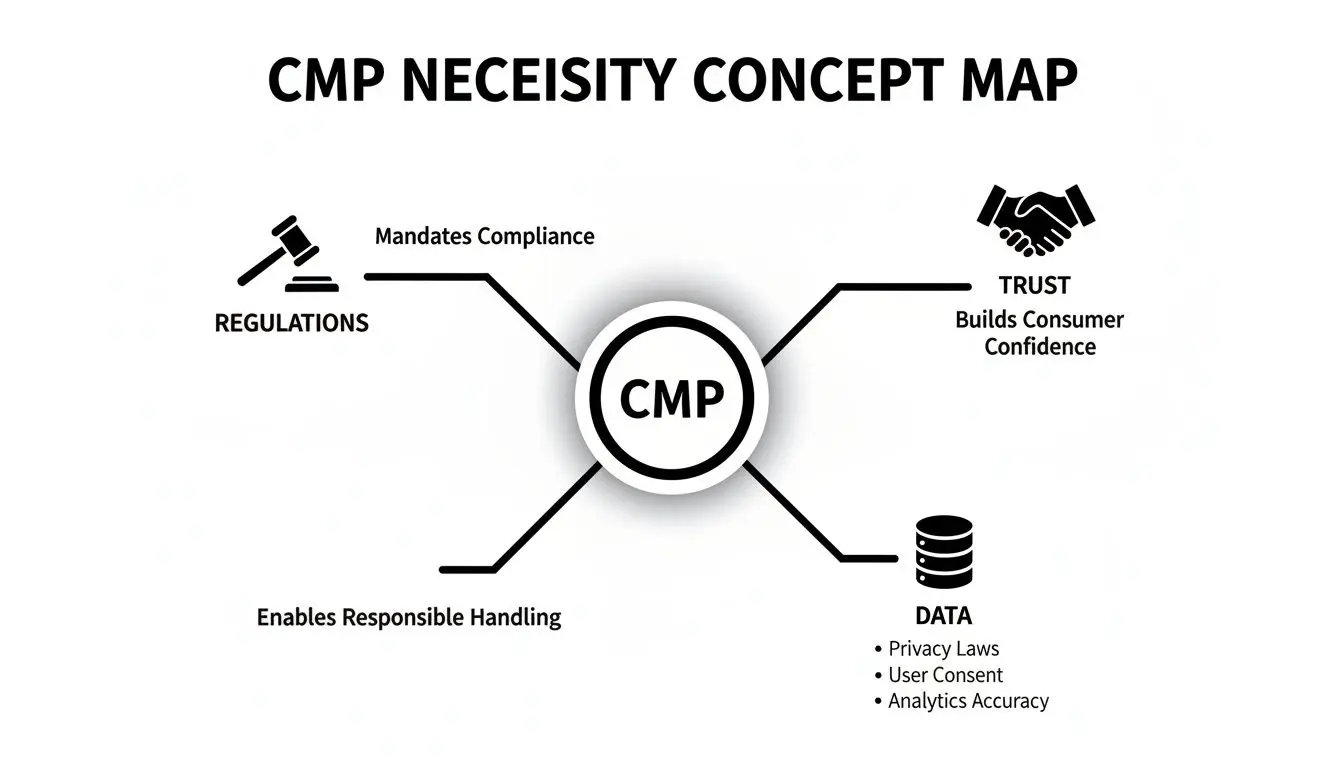
This illustrates that a CMP is not just a technical fix. It’s a strategic piece of infrastructure that connects compliance obligations with customer relationships and data strategy.
The Core Architectural Components
Any robust CMP is built on three pillars, each managing a distinct stage of the consent lifecycle:
- Consent Capture UI: This is the user-facing component—the banner, pop-up, or preference center. Its function is to clearly present data processing purposes and capture a user’s choice. From an engineering standpoint, this UI must be performant, customizable to the brand, and fully accessible. A slow or clunky UI will degrade Core Web Vitals and harm SEO.
- Consent Database: This is the auditable source of truth. Every consent action—granted, denied, or withdrawn—is logged with a timestamp against a unique user identifier. The data model must support versioning to track changes in privacy policies and prove what a user agreed to at a specific point in time. This is non-negotiable for demonstrating compliance during an audit.
- Enforcement Engine: This is where consent is operationalized. The engine’s job is to translate a user’s stored preference into an action: blocking or allowing specific scripts, trackers, or API calls in real-time. This is arguably the most critical component for preventing non-compliant data processing and must integrate deeply with your application and third-party services.
These three components form the backbone of any CMP, ensuring a user’s choice is not just recorded but actively enforced.
Architectural Patterns and Data Models
Implementing these components involves key architectural decisions. A common pattern is a centralized service that holds all consent data and exposes an API for other services to query. This promotes simplicity and a single source of truth.
However, for applications requiring extremely low latency, a decentralized or hybrid model may be more suitable. In this pattern, consent signals are cached closer to the user—at the edge or on the client-side—to enable faster enforcement decisions.
The data model itself must be flexible. It needs to link a persistent user identifier to granular consent strings (e.g., analytics:granted, marketing:denied), timestamps, the exact policy version shown to the user, and the jurisdiction where consent was given. This level of detail is what regulators expect to see.
For a closer look at the different consent mechanisms, you can explore the nuances of opt-in vs opt-out in our detailed guide.
Market data underscores the strategic importance of this architecture. North America, holding a dominant 36.20% revenue share of the CMP market, shows surging demand for robust privacy solutions. The global market, valued at USD 1.07 billion in 2026, is projected to grow at a CAGR of 17.05%, reaching an estimated USD 2.34 billion by 2031. This is not a niche tool; it’s a fundamental part of the modern technology stack.
Building vs. Buying Your Consent Management Platform
For any technical leader, the “build vs. buy” decision is a familiar trade-off analysis. When applied to a consent management platform, this choice carries significant weight, balancing immediate compliance needs against long-term architectural control and total cost of ownership.
There is no universal answer. The right path depends on your organization’s resources, technical complexity, and the centrality of data governance to your core strategy. This requires a pragmatic assessment of the trade-offs, considering not just the initial implementation but the perpetual maintenance required for privacy compliance.
The Case for Buying an Off-the-Shelf CMP
For most small to midsize organizations, buying a third-party CMP is the most pragmatic path. These solutions offer speed and pre-packaged compliance features, which is critical when engineering resources are focused on the core product.
The primary advantages include:
- Rapid Implementation: A commercial CMP can often be deployed in days, typically via a tag manager integration, enabling a compliant banner to go live quickly.
- Built-in Compliance: Vendors invest heavily in keeping their platforms aligned with GDPR, CCPA, and emerging regulations. This offloads the significant burden of legal research and continuous development from your team.
- Lower Upfront Cost: The initial investment is far less than funding a dedicated internal build. Subscription pricing makes costs predictable and manageable.
However, this convenience comes with constraints. You are tied to the vendor’s roadmap, you may introduce performance overhead, and customization options might not align with your brand’s user experience. Vendor lock-in is a real risk, making future migration complex and costly.
The Rationale for Building a Custom CMP
Building a bespoke consent management platform is a significant engineering commitment, typically undertaken by larger enterprises or companies where data flows are highly complex or central to the business model. This approach offers complete control and flexibility.
A custom-built CMP is an architectural commitment to privacy as a core system capability, not just a feature. It allows for perfect integration with your proprietary data stacks, from CRMs to AI-driven personalisation engines, ensuring consent signals propagate flawlessly across your entire ecosystem.
With a custom build, you can design a consent experience that is a natural extension of your brand and UI. You can also avoid the performance degradation associated with some third-party scripts; commercial CMPs can add significant latency, negatively impacting Core Web Vitals and user experience.
The costs, however, are substantial. Building requires dedicated engineering, legal, and product resources. More importantly, it saddles your team with the perpetual responsibility of monitoring global privacy laws and updating the platform accordingly. This is not a one-time project; it is an ongoing operational cost.
The market’s explosive growth highlights this complexity. The European CMP sector is projected to expand from USD 724.85 million in 2024 to over USD 4 billion by 2032 — a clear indicator of the investment required to build and maintain these systems correctly. Discover more insights on the CMP software market.
Decision Matrix: Off-the-Shelf vs. Custom-Built CMP
Making the right choice requires an honest assessment of your organization’s context. The table below frames the key trade-offs.
| Consideration | Off-the-Shelf CMP (Buy) | Custom-Built CMP (Build) |
|---|---|---|
| Time to Market | Fast. Deployment can take days or weeks. | Slow. Development can take many months, sometimes years. |
| Technical Resources | Low. Requires integration skills, not a full development team. | High. Needs a dedicated team of engineers, product managers, and legal experts. |
| Customisation | Limited. Usually restricted to UI styling and basic logic. | Total Control. Fully bespoke UI, logic, and integrations are possible. |
| Long-Term Cost | Predictable subscription fees, but costs scale with usage. | High initial build cost plus significant ongoing maintenance and legal monitoring. |
| Regulatory Risk | Mitigated. The vendor is responsible for keeping the platform compliant. | Internalised. Your team carries the full burden of tracking and implementing legal changes. |
Ultimately, this is a strategic decision. If your organization has standard data practices and needs to achieve compliance quickly while keeping your team focused on core product development, buying is the logical choice. However, if you operate at a scale where data is a core business differentiator and you have the resources to own your privacy infrastructure, building a custom solution can provide a long-term competitive advantage.
Practical CMP Integration and Implementation Patterns
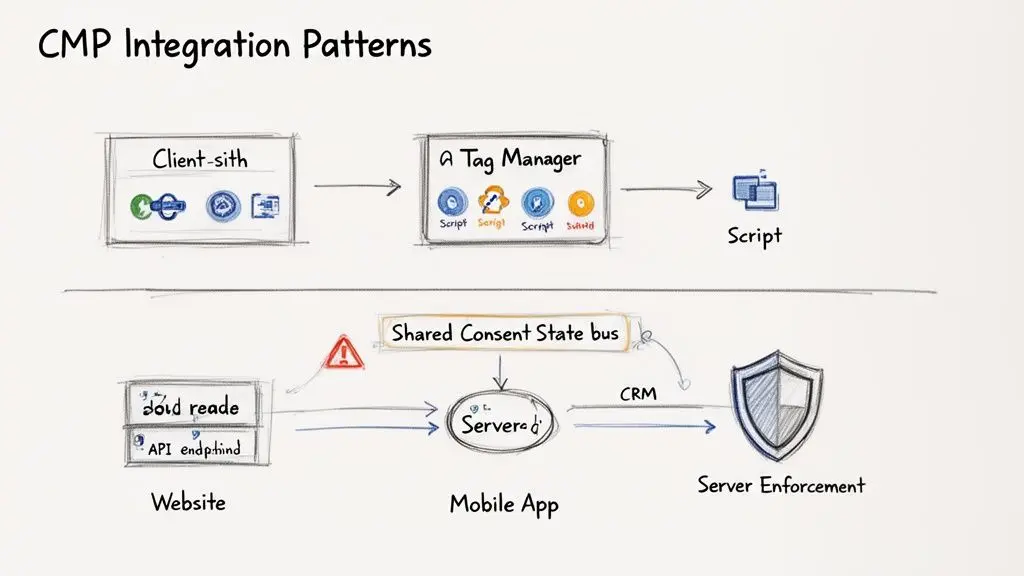
Integrating a consent management platform is where architectural theory meets the reality of a complex technology stack. A successful integration goes far beyond dropping a script onto a webpage; it demands careful planning to ensure consent signals are not just captured, but consistently enforced across all systems.
Missteps here lead to silent compliance failures and corrupted data. This section covers specific, actionable integration patterns for both client-side and server-side architectures.
Client-Side Integration Using Tag Managers
For many organizations, the most direct path is a client-side integration, often orchestrated through a tag management system (TMS) like Google Tag Manager. This pattern is popular for its speed, allowing teams to manage consent without deep code modifications.
The principle is straightforward: the CMP script must load first, blocking all other marketing and analytics scripts from firing. Once the user makes their choice, the CMP fires an event (e.g., consent_given) containing the consent status. The TMS listens for this event and uses it as a trigger to conditionally fire other tags.
This approach offers clear benefits:
- Rapid Deployment: It’s the fastest way to implement a compliant banner and begin blocking unauthorized trackers.
- Centralized Control: The TMS provides a single interface to manage which scripts fire based on specific consent categories (e.g., ‘analytics’, ‘marketing’).
- Flexibility: Non-technical team members can often manage tags and triggers, freeing up developer time.
However, this pattern is not without risks. Its primary weakness is its reliance on the user’s browser, which can be manipulated. A technically savvy user could potentially bypass the CMP’s blocking mechanism, leading to non-compliant data collection. Performance is another critical factor; a poorly optimized CMP can slow down your site, negatively impacting Core Web Vitals.
Server-Side Integration for Robust Enforcement
For truly robust and spoof-proof enforcement, a server-side integration is the superior architectural pattern. This approach moves consent decision logic from the user’s browser to your own backend infrastructure. Instead of relying on client-side triggers, your servers make the final determination on what data to process or forward.
A typical server-side workflow operates as follows:
- The client-side CMP captures the user’s consent and stores it, typically in a first-party cookie or by sending it to a consent API endpoint.
- When the application makes a request to your backend (e.g., an API call), it includes the user’s consent token.
- Your server validates this consent state before processing the request or forwarding data to a third-party service like a CRM or marketing automation platform.
This pattern architecturally guarantees that no data processing occurs without verified consent, creating a defensible audit trail. It is the only reliable method for enforcing consent for processes that occur outside the user’s browser.
Propagating Consent Across Systems
The true test of a consent management architecture is its ability to maintain a unified privacy profile for each user across all touchpoints—website, mobile app, CRM, and support tools.
A common solution is a centralized user profile service that acts as the single source of truth for consent. When a user updates their preferences on any platform, the change is pushed to this central service. Other systems then query this service via API to retrieve the latest consent status before acting.
This architecture prevents “consent drift”—where a user opts out on your website but continues to receive marketing emails because the CRM’s record is out of sync. For a deeper dive on how consent interacts with analytics, refer to our guide on Google Consent Mode v2. By treating consent as a core attribute of the user profile, you build a far more resilient and compliant data architecture.
Measuring and Monitoring Your Consent Framework
Deploying a consent management platform is the starting point, not the finish line. Treating your CMP as a ‘set-it-and-forget-it’ tool is a common and costly mistake. A consent framework is not just a legal checkbox; it’s a dynamic system that directly impacts user experience, data quality, and business metrics.
Effective monitoring means looking beyond “does the banner appear?”. It requires understanding how users interact with the consent interface and how it performs technically. A slow or confusing consent flow erodes trust and can actively harm your business, while a well-optimized one becomes a strategic asset.
Key Metrics for a Healthy Consent Framework
To determine if your consent implementation is effective, you must track specific, actionable metrics. These numbers provide a clear picture of compliance, user experience, and technical performance.
Key metrics to monitor include:
- Opt-in Rates by Region and Category: Track the percentage of users consenting, but segment the data. Break it down by country and consent purpose (e.g., analytics vs. marketing). A low opt-in rate in a specific region could indicate issues with banner wording, design, or legal interpretation.
- Preference Center Interactions: Measure how many users go beyond the initial banner to manage their preferences granularly. High engagement here suggests users trust you enough to want fine-grained control. Low engagement may mean your preference center is hard to find or use.
- Consent Banner Latency: The performance of your CMP script directly impacts site speed and user experience. A slow banner frustrates users and can damage Core Web Vitals. We have observed commercial CMPs adding over 200 milliseconds to Interaction to Next Paint (INP), while a highly optimized solution can keep that impact under 10 milliseconds.
Introducing Consent Analytics for Optimisation
The purpose of collecting this data—which we term consent analytics—is not to find new ways to exploit user information. It is to understand user behavior in order to refine the consent experience itself. This, in turn, improves the quality of the first-party data you are authorized to collect.
Consent analytics transforms a compliance task into a strategic advantage. By understanding how and why users consent, you can build trust, improve data quality, and de-risk your entire data operation.
For example, A/B testing might reveal that a simpler explanation of your data practices increases opt-in rates by 15%. You haven’t just satisfied a legal requirement; you have directly improved the data pipeline for your analytics and personalization engines. This approach connects robust privacy practices directly to measurable business value, demonstrating that a well-managed consent platform is a cornerstone of a modern, data-driven organization.
A Practical Example: Integrating a CMP with an AI Engine
To illustrate how these architectural principles are applied, consider a mid-sized SaaS company aiming to upgrade from a basic cookie banner to a system that integrates with a new AI-powered personalization engine—a common, high-stakes scenario.
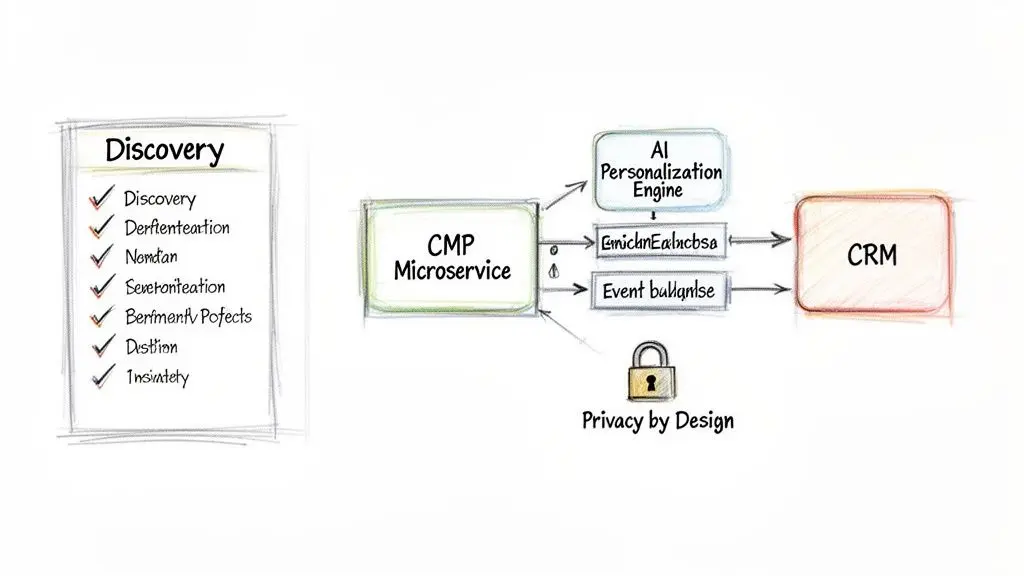
The first step is a discovery phase to map all data flows. This involves working with product, engineering, and legal teams to document:
- Data Entry Points: Where is user data collected (e.g., website forms, mobile app interactions, third-party scripts)?
- Processing Services: Which systems touch this data (e.g., CRM, analytics platform, the new AI engine)?
- Jurisdictional Footprint: Where are users located, determining which regulations (GDPR, CCPA) apply?
This audit uncovers hidden dependencies and flawed assumptions before they become costly engineering problems.
Based on this discovery, a recommended architectural pattern is a dedicated consent microservice. This decouples consent logic from the main application, making it easier to maintain, scale, and audit.
The architecture would be:
- A lightweight, performant UI captures user choices and sends them to the consent service’s API.
- The service validates and stores the consent record in a dedicated, auditable database with versioning and timestamps.
- Other systems, like the AI personalization engine, must query the consent service’s API to verify permission before processing any personal data.
This pattern establishes a single, definitive source of truth for consent. It architecturally decouples privacy logic from business logic, creating a critical gateway that prevents non-compliant data use, even if a developer makes a mistake elsewhere.
This event-driven model also keeps the system synchronized. When a user updates their preferences, the consent service can publish an event. Downstream systems can subscribe to these events and update their records automatically, preventing consent drift. For a deeper dive into these principles, explore our perspective on data protection and privacy.
Common Questions About Consent Management Platforms
Technical and product leaders often encounter the same practical challenges when implementing a consent management platform. Here are answers to common questions based on our experience building these systems.
How Does a CMP Affect Website Performance?
A CMP can significantly impact site performance, especially the Interaction to Next Paint (INP) metric. A slow-loading CMP script blocks the main browser thread, delaying user interactions and creating a frustrating experience.
Performance impact varies widely. Some platforms can add over 200 milliseconds of latency, pushing a site into the “needs improvement” category for Core Web Vitals. In contrast, a well-optimized CMP loading its banner in an isolated iframe can keep this impact under 10 milliseconds. When evaluating a vendor, demand performance data and conduct your own tests.
Can We Collect Any Analytics Data Without Consent?
Yes, but only in very specific and narrow circumstances, often dependent on jurisdiction. Emerging frameworks may allow for first-party analytics collection without prior consent, but the rules are strict:
- First-Party Only: The data must be processed exclusively for your own internal statistical analysis or site optimization.
- No Third-Party Sharing: The data cannot be shared with or sold to third parties, especially for advertising purposes.
- Clear Opt-Out: Users must be provided a simple and obvious way to opt out of this limited data collection.
This typically rules out tools like Google Analytics, as its model involves using data for Google’s own product improvements and is tied to its advertising ecosystem. To leverage this exemption, you would likely need a dedicated, truly first-party analytics solution.
How Do I Handle Consent for Users Without Accounts?
For anonymous visitors, consent is almost always managed with a first-party cookie. The CMP writes the user’s choices (e.g., analytics:granted, marketing:denied) into this cookie, which is then read on subsequent visits.
The key architectural challenge is to connect that anonymous consent to a user profile if they later sign up or log in. A well-designed system merges the anonymous consent record with the new user ID, ensuring their preferences persist seamlessly across their entire journey.
This requires a carefully designed identity resolution process on your backend but is essential for creating a consistent and respectful privacy experience, avoiding the need to repeatedly ask for consent.
At Devisia, we believe privacy is an architectural choice, not a bolt-on feature. We build reliable, maintainable systems that treat consent as a core capability, ensuring your digital products are compliant, trustworthy, and ready for the future. Learn how we build meaningful software.