
A Business Intelligence (BI) Analyst serves as the critical link between raw data infrastructure and executable business strategy. This role is not about passively generating reports; it involves engineering and maintaining systems—such as interactive dashboards and automated reporting pipelines—that enable non-technical stakeholders to make data-informed decisions. For technical leadership, the BI analyst translates complex datasets into operational intelligence.
Defining the Business Intelligence Analyst Role and Its Strategic Value
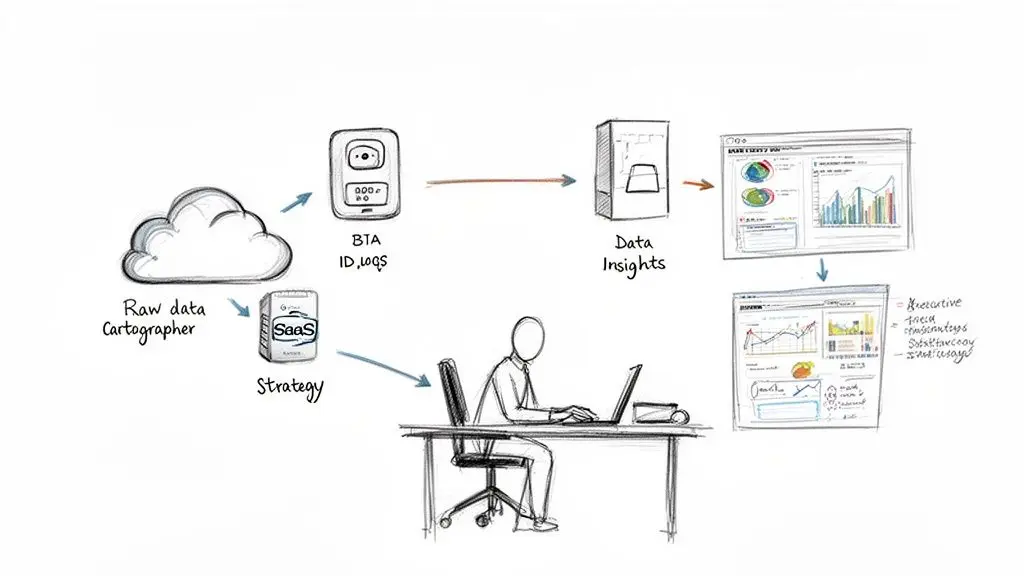
For a CTO or founder, a Business Intelligence Analyst is an essential strategic partner, not merely a report builder. This individual operates at the intersection of data, technology, and business operations, ensuring that the vast information generated by your systems produces measurable value. Their function is to create a reliable “data map” of the organization, allowing executives and product managers to navigate complex metrics with confidence and transform abstract data points into a coherent narrative of operational reality.
Core Functions and Operational Impact
Understanding a BI analyst’s value requires examining their day-to-day functions. These activities extend far beyond data extraction; they are focused on architecting a sustainable data-driven culture within the organization. The primary responsibilities have a direct and tangible impact on operational efficiency and strategic alignment.
Business Intelligence Analyst Core Functions at a Glance
| Core Function | Description | Business Impact |
|---|---|---|
| Data Translation | Converts high-level business questions (e.g., “What is the root cause of our user engagement drop?”) into precise data queries and analytical projects. | Aligns technical effort directly with pressing business priorities, ensuring data work solves concrete operational problems. |
| Insight Delivery | Designs, builds, and maintains the interactive dashboards and automated reports that serve as the organization’s single source of truth. | Establishes clarity and consistency, eliminating conflicting reports and enabling faster, more reliable decision-making across departments. |
| Stakeholder Empowerment | Trains business users to self-serve insights from established dashboards, reducing dependency on the data team for routine inquiries. | Frees up engineering and data science resources from ad-hoc report requests, allowing them to focus on deeper architectural and predictive work. |
The BI analyst’s primary strength lies in this unique blend of technical proficiency and business-focused communication.
A common implementation risk is to relegate the BI analyst to a reactive, ticket-based role. Their true value is proactive; they architect systems that empower the entire organization to answer its own questions, freeing expensive engineering resources to focus on core product development.
Distinguishing from Adjacent Data Roles
It is critical to differentiate the BI analyst from related roles like data engineers or data scientists to build an effective data team.
While data engineers build and maintain the data pipelines, the BI analyst consumes data from these systems to create business value. Unlike data scientists, who often focus on predictive modeling and complex statistical analysis, the BI analyst is primarily concerned with interpreting historical and current data to inform immediate business decisions. The ultimate goal of a business intelligence analyst is to make data accessible, understandable, and actionable, ensuring that decisions are based on a clear, evidence-based understanding of operational data, not intuition.
A Look Inside Their Daily Workflow
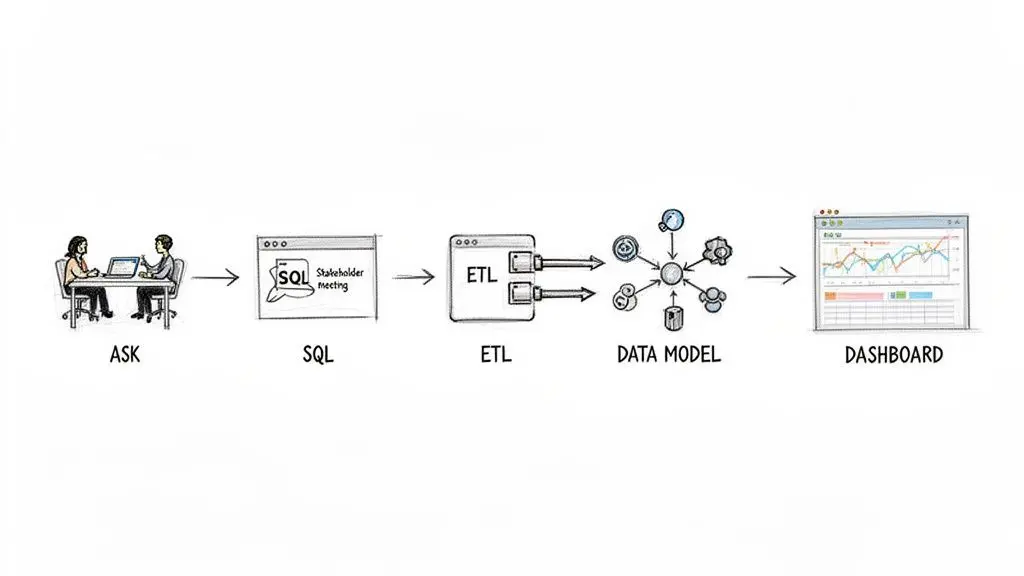
The BI analyst workflow is a structured cycle that transforms ambiguous business problems into automated, scalable insights. It is not about “pulling numbers” but a collaborative and iterative process that starts with a business need, not a technical task.
The process typically begins with a conversation. A product leader might pose a high-level problem like, “We need to understand why user churn is increasing.” The BI analyst’s first task is translation: converting this business concern into specific, measurable data questions. A superficial approach would be to dump all user activity data into a spreadsheet. A professional BI analyst probes deeper: How is “churn” defined in this context? What are the key events in the user journey that correlate with attrition?
From Business Questions to Technical Execution
Once requirements are clearly defined, the analyst shifts to technical execution, leveraging data manipulation and modeling skills. This is a multi-stage process where precision is essential for producing trustworthy outputs.
First is data sourcing, which involves writing complex SQL (Structured Query Language) queries to extract data from multiple sources—production databases, event logs, and third-party SaaS APIs. The goal is to gather all the raw components needed for the analysis.
Next is the ETL (Extract, Transform, Load) process. Raw data is rarely analysis-ready. The analyst must perform data cleansing: correcting inconsistent entries, standardizing formats, joining disparate tables, and structuring the data into a logical model. This is the unglamorous but foundational work of all reliable analytics.
This is followed by building a scalable data model. Instead of creating a one-off report, a skilled analyst designs a reusable model. This artifact can power not only the current dashboard but also future analyses, ensuring consistency and saving significant development time.
Building and Validating the Solution
With clean, structured data, the analyst uses a BI tool like Tableau, Power BI, or Looker to build an interactive dashboard. Effective data visualization is critical here; the objective is to present complex information in a way that allows non-technical managers to understand trends, explore the data, and answer follow-up questions independently.
The process does not end at deployment. Several final steps differentiate a professional BI analyst.
- Data Validation: The analyst must rigorously validate the numbers against other trusted sources. A dashboard with incorrect data is worse than no dashboard; it actively promotes poor decision-making.
- Comprehensive Documentation: Every metric, calculation, and data source must be clearly documented. This builds trust and ensures consistent interpretation of the data across the organization.
- User Training and Empowerment: The final step is to train stakeholders on how to use the dashboard. The goal is to make them self-sufficient, empowering them to answer their own questions without generating new data requests.
The real measure of a BI analyst’s success is not the number of dashboards they build, but the number of meaningful business decisions their work enables. The workflow is designed to create a scalable system for insight, not just a series of isolated reports.
The Essential Mix of Technical and Strategic Skills
A highly effective business intelligence analyst combines deep technical skill with sharp business acumen. A common hiring mistake is to prioritize technical proficiency alone, which can result in solutions that are technically perfect but strategically irrelevant. Without business context, a dashboard may accurately track metrics that have no bearing on value creation.
Hiring for technical expertise in isolation is a significant risk. It can lead to dashboards tracking vanity metrics or complex reports that are accurate but useless for decision-making. The BI analysts who deliver substantial impact are those who can bridge the gap between raw data and real-world business outcomes.
Core Technical Proficiencies
On the technical side, certain skills are non-negotiable foundations for executing the role.
Key technical skills include:
- SQL Mastery: Proficiency in Structured Query Language (SQL) is the absolute prerequisite. An analyst must be able to write complex, efficient queries to extract, join, and transform data from multiple sources.
- BI Platform Expertise: Deep knowledge of at least one major BI platform is essential. This includes tools like Tableau, Microsoft Power BI, or Looker, used to build interactive visualizations and automated reports.
- Data Warehousing Concepts: A solid understanding of data warehousing architecture is crucial. Familiarity with concepts like star schemas, dimensional modeling, and ETL/ELT processes enables effective collaboration with data engineers and the creation of scalable data models.
- Spreadsheet Fluency: Advanced skills in tools like Microsoft Excel or Google Sheets remain vital for ad-hoc analysis, data cleaning, and prototyping solutions before full implementation in a BI tool.
These technical skills represent the “how” of a BI analyst’s job. Our guide on business analytics software offers a structured approach to selecting the right tools.
Indispensable Strategic Competencies
While technical skills enable execution, strategic competencies transform a data technician into a valuable business partner. These skills are often harder to quantify but are more critical for ensuring BI solutions lead to better decisions.
A business intelligence analyst who cannot translate a business problem into a data question—and then translate the data’s answer back into a business solution—is merely a report generator. Their true value lies in their ability to navigate this translation in both directions.
Strategic skills that differentiate top-tier analysts:
- Business Acumen: The ability to understand the company’s goals, market dynamics, and operational constraints. A strong BI analyst connects every data request to the broader business context.
- Problem-Solving: Stakeholders often describe symptoms, not root causes. A skilled analyst excels at navigating ambiguous requests, asking probing questions to uncover the real problem that needs solving.
- Communication and Storytelling: Data does not speak for itself. The analyst must frame raw numbers within a compelling narrative that persuades stakeholders to act, using clear visuals and precise language.
The most valuable BI analyst is a hybrid professional, equally comfortable debating business strategy with a product leader and writing a complex SQL query.
Technical vs. Strategic Skills for a BI Analyst
The dual nature of the role requires a balance of hard and soft skills. One side builds the engine; the other determines where to drive.
| Skill Category | Essential Skills | Business Relevance |
|---|---|---|
| Technical Skills (The “How”) | SQL, BI Platforms (Power BI, Tableau), Data Warehousing, Spreadsheets. | These skills ensure the analyst can access, clean, and present data accurately and efficiently. Without them, insights remain trapped in databases. |
| Strategic Skills (The “Why”) | Business Acumen, Problem-Solving, Communication, Storytelling. | These skills ensure technical work is focused on the right problems and that findings lead to action, driving tangible business improvement. |
A BI analyst with only technical skills produces reports. One with both technical and strategic skills produces results. Hiring should focus on identifying the latter.
Where the BI Analyst Fits in Your Data Architecture
For a CTO, the BI analyst is not an isolated function but a critical node in the data value chain. They are the final layer where architectural investments in data infrastructure translate into measurable business impact. Their work is entirely dependent on the quality and integrity of upstream data sources.
The BI analyst sits at the confluence of several key roles. They are the primary consumers of pipelines built by data engineers and rely on clean, structured data residing in warehouses. They also depend on software developers, whose applications are the original source of operational data.
This position means their effectiveness is a direct reflection of your architectural integrity. A poorly designed data pipeline or an inconsistent data model will invariably lead to unreliable BI, creating a “garbage in, garbage out” scenario that erodes trust in all data initiatives.
Supporting Reliable Business Intelligence Architecturally
To mitigate the risk of unreliable analytics, your architecture must treat BI as a primary consideration, not an afterthought. This requires implementing patterns that ensure data is clean, consistent, and accessible long before it reaches a BI tool.
Key architectural patterns include:
- A Centralised Data Warehouse: Consolidating data into a single source of truth is non-negotiable. This prevents analysts from pulling conflicting data from different systems and ensures a consistent factual basis for all reporting.
- Well-Defined Data Models: Data engineers must collaborate with BI analysts to create logical, well-documented models (e.g., star schemas). These models pre-aggregate and structure data for performance, simplifying and accelerating queries.
- Robust ETL/ELT Pipelines: Automated, monitored, and resilient data pipelines are the foundation of reliable BI. These systems must handle data cleaning, transformation, and validation systematically to maintain data quality at scale.
A common architectural failure is treating data pipelines as simple data movers. Effective pipelines are data refineries. They must enforce schema, validate inputs, and handle errors gracefully to deliver analysis-ready data, protecting the BI analyst from the chaos of raw, unstructured inputs.
Upholding Governance and Privacy by Design
The BI analyst plays a crucial role in operationalizing data governance and privacy. While compliance managers and engineers define policies, the analyst often implements them at the presentation layer, acting as a final checkpoint for ensuring sensitive data is handled correctly.
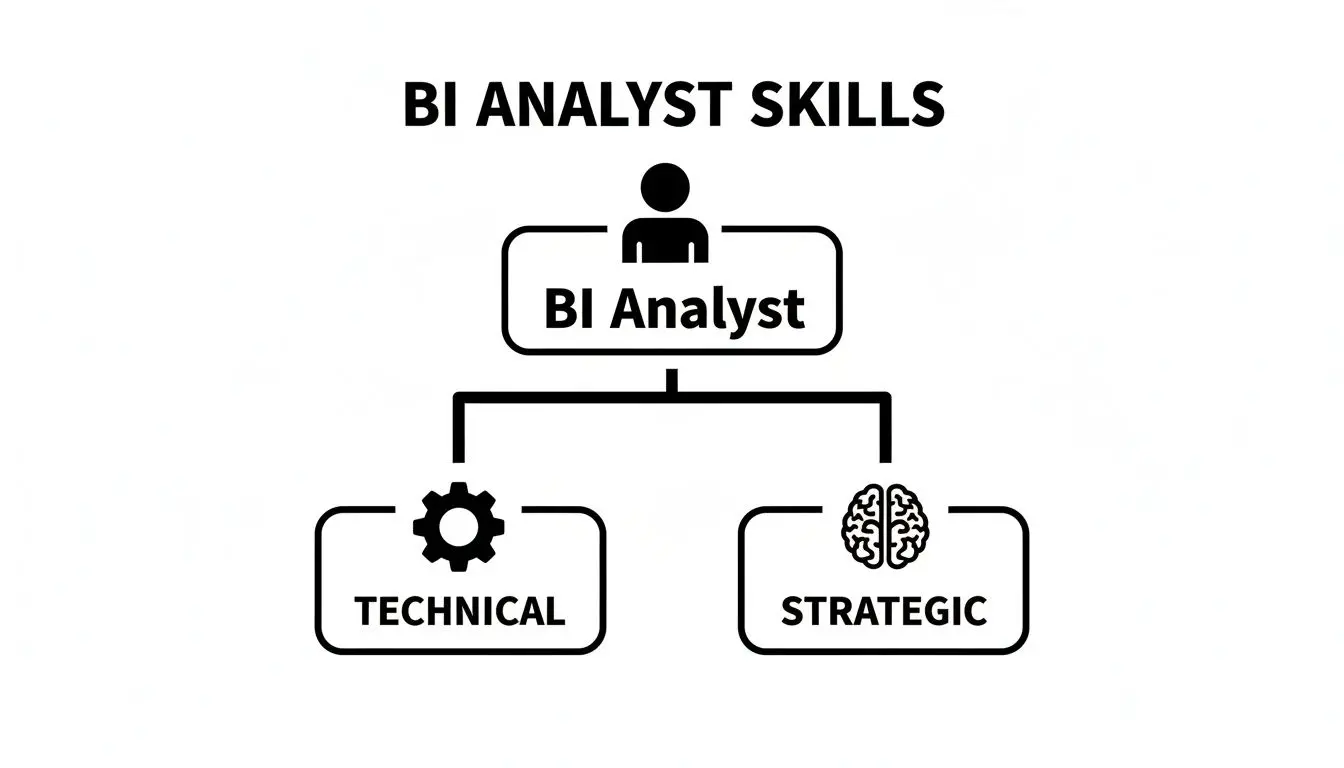
The diagram highlights how technical execution and strategic oversight must converge to produce trustworthy and compliant analytics.
For instance, when building a dashboard, a BI analyst must ensure it adheres to regulations like GDPR by design. This could involve:
- Implementing row-level security so users see only the data they are authorized to access.
- Aggregating personally identifiable information (PII) to prevent direct exposure.
- Excluding sensitive fields from reports based on user roles.
The growth of this role is tied to its importance in both strategy and compliance. The median total compensation of $117,000 for BI Analysts at top tech firms reflects a surge driven by AI adoption, with IT specializations pushing salaries even higher. As companies like Devisia integrate AI agents into workflows, the analyst’s role in governing data access becomes even more critical. More salary trends can be found on Levels.fyi.
By integrating BI requirements into core system design, you empower analysts to deliver reliable insights while upholding your organization’s data governance standards. For more on structuring technical services, our article on Service-Oriented Architecture provides useful context.
Understanding Career Paths and Salary Benchmarks
For leaders building a data team, understanding the BI analyst career trajectory is fundamental. This is not a static role; an effective analyst progresses from tactical execution to strategic influence. Recognizing this progression is key to designing career paths that retain top talent.
The journey typically begins at a junior level, where the focus is on execution. A junior BI analyst handles well-defined tasks, builds standard reports from existing data models, and learns the company’s data landscape. Success is measured by accuracy and timeliness. As they gain experience, their responsibilities expand significantly.
From Execution to Strategic Influence
A mid-level BI analyst moves beyond building pre-defined reports. They begin to own entire analytical projects, translating ambiguous stakeholder requests into concrete technical requirements and new data models. They are expected not just to present data but also to offer initial interpretations and recommend next steps.
A senior BI analyst operates at a strategic level. Their focus shifts from creating individual assets to shaping the company’s overall data strategy.
At the senior level, responsibilities often include:
- Mentoring junior analysts and establishing best practices for the team.
- Leading complex, cross-functional projects requiring a deep understanding of the business.
- Consulting with leadership to identify new opportunities for leveraging data.
- Evaluating and recommending new BI tools or architectural improvements.
From this point, a senior analyst can progress into an Analytics Manager role, overseeing the BI function, or transition to a more technical Data Architect position, designing the foundational data structures for the enterprise.
Establishing Realistic Salary Benchmarks
Attracting and retaining this talent requires a realistic understanding of market compensation. In the technology sector, BI analyst salaries reflect their critical role in converting data into operational insights for companies like Devisia, which specializes in custom software and AI systems.
A common hiring trap is to underestimate the market rate for a BI analyst possessing a strong combination of technical and strategic skills. Competitive compensation acknowledges that this role directly influences business strategy and operational efficiency.
Industry data confirms this. While the average base salary for a BI Analyst varies, it increases significantly with experience, particularly within IT. Data shows that IT-specific roles command a premium, with median salaries for experienced professionals often exceeding $124,500. This reflects the high demand for analysts who can navigate complex technical environments and deliver insights with minimal supervision. For more details, consult this salary research from PayScale_Analyst/Salary).
Ultimately, competitive compensation and clear career paths are non-negotiable for hiring the right people and providing them with compelling reasons to grow with your organization.
How to Hire and Onboard Your First BI Analyst
Hiring your first business intelligence analyst is a critical step toward becoming a data-informed organization. A mismatch can result in a technical expert who is disconnected from business needs. A successful hire, however, provides a strategic partner who delivers measurable value.
The hiring process should be designed to identify candidates with both technical proficiency and business acumen. A common mistake is to write a generic job description focused entirely on tools. Instead, frame the role around the business problems you need to solve. This approach attracts candidates who think like strategists, not just technicians.
Crafting an Effective Job Description
The job description is your most important initial filter. It must clearly articulate not only the required skills but also the operational context in which the BI analyst will work.
Ensure it includes these key elements:
- Business Context: Briefly explain the core business questions the analyst will address. For example: “Analyze user behavior data to identify root causes of churn and inform the product roadmap.”
- Technical Stack: List the specific databases, BI platforms (e.g., Power BI or Tableau), and data sources they will use. This allows candidates to self-assess their technical fit.
- Key Responsibilities: Use action-oriented language that goes beyond “create dashboards.” Examples include: “translate stakeholder questions into clear technical requirements” and “build scalable data models to enable self-service analytics.”
- Success Metrics: Define what successful performance looks like in terms of outcomes. For example: “Reduce engineering time spent on ad-hoc data requests by 30%” or “Establish a single source of truth for key company KPIs.”
Designing a Practical Interview Process
Your interview process must evaluate both technical ability and strategic thinking. A multi-stage approach is most effective for assessing a candidate’s full skill set.
The most insightful interviews push candidates beyond theoretical answers. A practical assessment shows you exactly how they think, communicate, and solve problems under realistic pressure—skills a simple Q&A can never fully reveal.
A robust interview structure should include:
- Technical Screening: A short SQL test or a discussion of data modeling concepts to establish a technical baseline.
- Take-Home Assessment: Provide a sample dataset and a real-world business problem. Ask the candidate to analyze the data, create a simple visualization, and present their findings. This reveals their entire workflow, from data preparation to communication.
- Presentation and Discussion: Have the candidate present their take-home assignment. This is where you can evaluate their communication skills, strategic thinking, and ability to defend their conclusions.
Building a Structured Onboarding Plan
Once you have hired an analyst, a structured onboarding plan is crucial for enabling them to deliver value quickly. The first few weeks should focus on building business context and establishing key relationships.
Your onboarding checklist should prioritize:
- System Access: Ensure immediate access to all necessary databases, software licenses, and BI tools.
- Stakeholder Introductions: Schedule meetings with key leaders from product, engineering, and marketing to help the analyst understand business priorities.
- Data Deep Dive: Pair them with a data engineer or senior developer to review the data architecture, key tables, and known data quality issues.
- First Project: Assign a small, well-defined project with a clear deliverable. This provides an early win and helps them learn the workflow.
This structured approach—from job description to onboarding—sets your new BI analyst up for successful integration and enables them to start driving better, data-informed decisions. Our guide on the IT Project Manager role shares valuable principles on stakeholder alignment that are also applicable here.
A Few Common Questions
Here are concise answers to common questions from leaders about the Business Intelligence Analyst role and its integration into an organization.
What’s the Real Difference Between a BI Analyst and a Data Analyst?
The primary distinction lies in focus and output.
A Data Analyst typically conducts deep, ad-hoc investigations to answer specific, urgent business questions. Their work often culminates in a focused report or presentation. Think of them as specialists deployed to solve a particular problem.
A Business Intelligence Analyst, in contrast, focuses on systems and scalability. Their goal is to build and maintain the long-term infrastructure for reporting, such as automated dashboards and performance scorecards. They architect self-service tools that enable the entire organization to answer recurring questions independently.
So, When Is It Time to Hire Our First BI Analyst?
The time to hire is when your engineering or product teams become a bottleneck for data requests. If your developers are frequently pausing core development to run manual SQL queries for other departments, that is a clear signal. You are using expensive engineering resources for tasks a BI analyst is specialized to handle.
Another indicator is the emergence of conflicting metrics from different teams. When sales reports one customer acquisition cost and marketing reports another, it creates confusion and erodes trust in data. A BI analyst’s role is to establish a single source of truth, making reliable data accessible to everyone and freeing technical talent to focus on building your product.
How Do BI Analysts Work with AI and Machine Learning Teams?
BI analysts are crucial partners for any AI and machine learning (ML) team, serving as the bridge between complex data science models and business application. They are involved throughout the ML lifecycle.
Key areas of collaboration include:
- Data Preparation: They are experts at sourcing, cleaning, and validating the datasets required for model training, ensuring the quality of input data.
- Performance Monitoring: Once a model is deployed, a BI analyst builds the dashboards needed to track its performance, monitoring metrics like model accuracy and data drift to ensure it operates as expected.
- Translating Insights: This is a critical function. They translate the complex outputs of an AI model into clear, actionable insights for non-technical stakeholders, ensuring the business value of AI initiatives is both measurable and understood.
At Devisia, we build the reliable software and AI-enabled systems that turn data into a strategic asset. If you need to transform your business vision into maintainable, high-impact digital products, we provide a clear path from pragmatic architecture to meaningful results. Learn more at devisia.pro.