
Every significant technology initiative, from legacy system modernization to integrating AI capabilities, begins with two fundamental questions: Where are we now? and Where do we need to be? The As-Is To-Be analysis provides a disciplined framework to answer these questions, translating abstract strategic goals into a concrete, executable roadmap.
The Problem: Drifting Projects and Flawed Assumptions
Without a clear understanding of the current state and a well-defined target, complex technology projects are prone to failure. Scope creep, budget overruns, and missed deadlines become inevitable as teams operate on incomplete information and flawed assumptions. The original business objectives are often lost in implementation complexities, resulting in systems that solve the wrong problems.
An As-Is To-Be analysis directly confronts this ambiguity. It is the structured process of documenting the current operational state (the As-Is) to design a robust, achievable future state (the To-Be). This process is not an academic exercise; it is a critical risk mitigation strategy that forces a candid assessment of reality before committing significant resources.
This guide provides a practical, step-by-step process for CTOs, product leaders, and engineering managers to:
- Conduct a thorough As-Is analysis to map existing systems, workflows, and technical debt.
- Define a pragmatic To-Be architecture that is explicitly aligned with business objectives.
- Develop a strategic gap analysis and an incremental implementation plan.
A meticulously documented As-Is state provides the evidence required to justify change. A well-defined To-Be state provides engineering teams with a clear architectural blueprint, ensuring their work delivers measurable business value.
Ultimately, this methodical approach ensures technical decisions serve strategic goals. It establishes a clear purpose for every system component and line of code: to move the organization from its current operational reality to its desired future state.
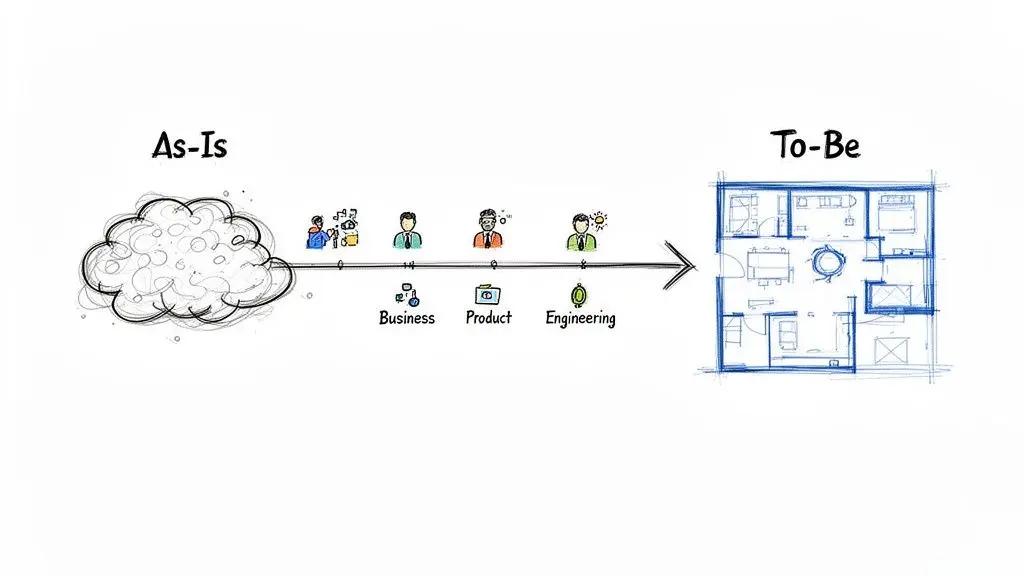
Establishing a Baseline: The As-Is Model
Before designing a future state, you must first understand the present. The As-Is model is a candid, evidence-based snapshot of your current operational reality. Its purpose is to document existing business processes, actual user workflows, system architectures, data flows, and persistent pain points.
This is not a superficial diagramming exercise. It is a combined architectural audit and operational health check. The primary goal is to surface inefficient workarounds, hidden dependencies, and sources of technical debt. For any modernization or compliance-driven initiative, establishing this baseline is non-negotiable. A well-documented As-Is state provides the necessary evidence to justify change, identify security vulnerabilities, and achieve stakeholder alignment.
Core Components of the Current State
A comprehensive As-Is analysis requires a deep investigation into the technical, procedural, and human elements of your existing systems.
Key areas to document include:
- System Architecture: Map all applications, databases, APIs, and third-party integrations. Document their versions, dependencies, and communication protocols.
- Business Processes: Detail the step-by-step workflows teams actually follow, distinguishing them from official, documented procedures. Capture informal “tribal knowledge.”
- Data Flows: Trace the lifecycle of data—where it is created, stored, processed, and accessed. This analysis often reveals performance bottlenecks and compliance risks related to regulations like GDPR.
- User Workflows: Observe users interacting with the system in their native environment. Document their methods, frustrations, and workarounds.
This structured approach is essential in a market driven by digital transformation. The global IT services market is projected to grow from USD 1.65 trillion in 2026 to USD 2.51 trillion by 2031, with 87% of enterprises already adopting multi-cloud strategies. For organizations managing legacy systems, a rigorous As-Is To-Be analysis is the only viable starting point for modernization. You can discover more about these IT services market trends here.
The Risk of a Superficial Analysis
A common failure mode is treating the As-Is analysis as a perfunctory checklist item. A naive approach that only documents the “official” processes will fail to uncover the critical insights needed to inform the future state.
The real value of the As-Is model comes from uncovering the unofficial workarounds, hidden single points of failure, and the accumulated technical debt that degrades performance and security. Without this deep understanding, any To-Be design is built on a foundation of flawed assumptions.
Skipping this foundational work leads to predictable project failures: budget overruns, missed deadlines, and a new system that solves theoretical problems instead of real ones.
A Practical Workflow for Documenting the Current State
A robust As-Is analysis is an investigative process, not merely a documentation task. It requires a structured workflow that synthesizes input from business, product, and engineering stakeholders to create an accurate and actionable baseline.
This workflow provides a clear path from raw information to an evidence-based understanding of the current state, exposing the inefficiencies and risks that justify change.
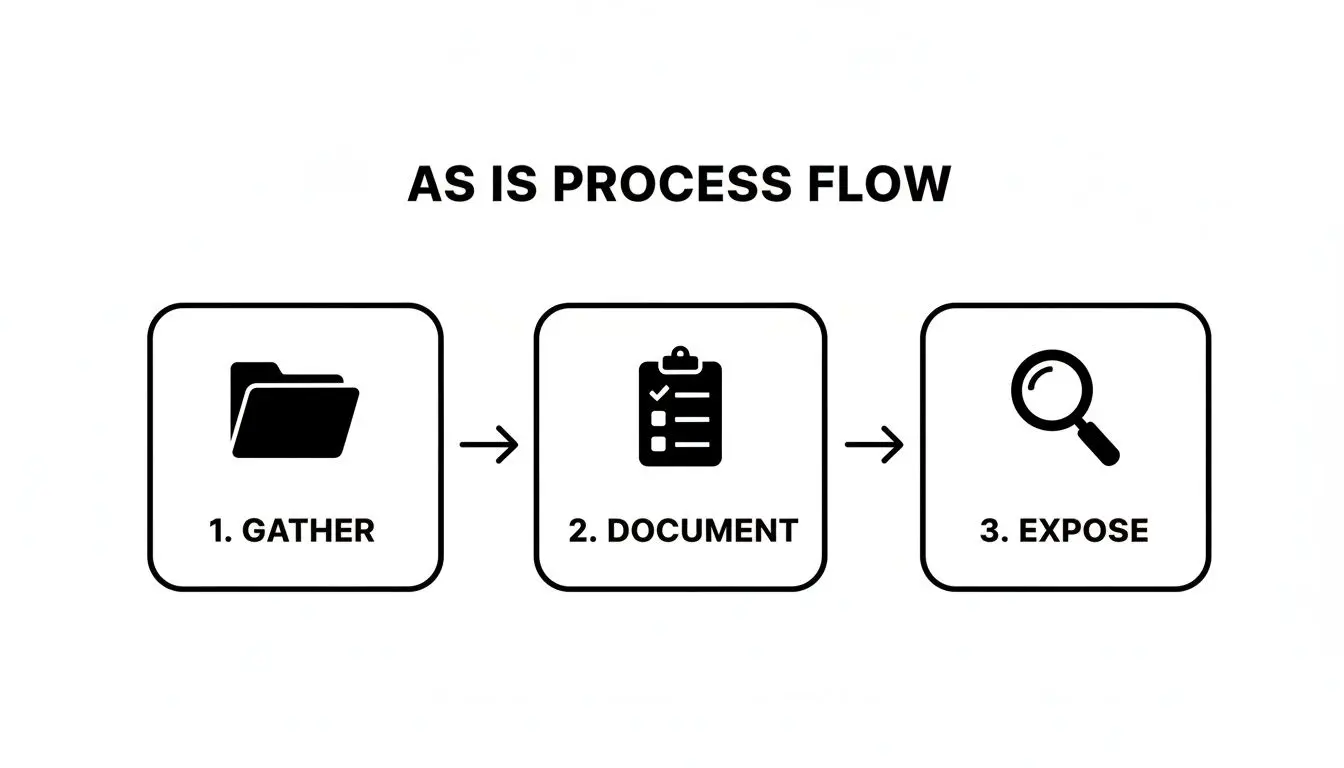
Step 1: Stakeholder Interviews and Direct Observation
Begin by engaging with individuals who operate within the system daily: end-users, line managers, and technical support staff. The objective is to uncover the unwritten rules and informal workarounds that official documentation omits.
Effective discovery relies on precise questions.
- For Users: “Walk me through your process for completing this task. Where do you encounter friction? What informal steps do you take to work around system limitations?”
- For Managers: “What are the primary bottlenecks impacting your team’s throughput? Where do errors or delays most frequently occur?”
- For Engineers: “Which components of this system are most fragile or difficult to maintain? Where does our technical debt create the most significant operational drag?”
Direct observation is equally critical. Watching a user interact with the system often reveals pain points and workarounds they would not articulate in an interview.
Step 2: Artifact Collection and Review
Next, gather all existing documentation to build an evidence trail that corroborates or contradicts interview findings.
Key artifacts include:
- Architectural diagrams (even if outdated)
- System logs and performance monitoring data
- Code repositories and deployment scripts
- User manuals and training materials
- Compliance reports and security audit findings
This step provides the quantitative data needed to support qualitative observations, creating a comprehensive picture of the as is e to be starting point.
Step 3: System and Process Mapping
With qualitative and quantitative data collected, the next step is to synthesize it into clear, visual models. These diagrams serve as communication tools to align all stakeholders on a shared understanding of the current state.
Standard modeling techniques include:
- Business Process Model and Notation (BPMN): For visualizing end-to-end business workflows.
- Data Flow Diagrams (DFDs): For tracing how information moves through systems and processes.
- C4 Model Diagrams: For illustrating system architecture at varying levels of abstraction.
These models become the definitive record of the As-Is state.
Step 4: Gap Analysis and Problem Identification
The final step is to analyze the collected information to identify specific pain points, bottlenecks, and risks. This is where the investigative effort yields actionable insights, explicitly pinpointing sources of inefficiency, security vulnerabilities, and technical debt.
This analysis is indispensable for any modernization initiative. With cloud services projected to command 65.6% of the IT market by 2035, a clear baseline is non-negotiable for planning migrations. Attempting to move legacy systems to modern architectures without a deep As-Is analysis is a primary cause of project failure. Learn more about the IT services market forecast.
Designing a Pragmatic To-Be Architecture
With a clear understanding of the current state, the focus shifts to designing the future. The To-Be model is the strategic blueprint for the target system, outlining optimized processes, modernized architecture, and improved user experiences.
This is not a speculative wish list. A pragmatic To-Be model must be an achievable state that directly addresses the weaknesses identified in the As-Is analysis and aligns with measurable business goals. A vague vision is useless; the To-Be architecture must be grounded in technical and operational reality.
Defining Success with Measurable KPIs
The first step in designing the To-Be state is to define success in quantitative terms. Without clear metrics, there is no objective way to determine if the new architecture is an improvement. Key Performance Indicators (KPIs) connect technical decisions to business outcomes.
These KPIs should directly address the pain points identified in the As-Is analysis.
- Operational Efficiency: Target a 25% reduction in manual data entry steps or a 15% decrease in average ticket resolution time.
- Performance and Reliability: Target a 50% reduction in API latency or a service level objective (SLO) of 99.95% system uptime.
- Time-to-Market: Reduce the lead time for deploying new features from six weeks to two weeks.
Such metrics transform the To-Be design from a purely technical exercise into a business-driven initiative, justifying the investment and providing a clear yardstick for success.
Selecting the Right Architectural Pattern
The next step is to select an architectural pattern that fits the specific context of the problem, the business, and the team. There is no universally “best” architecture; the choice is always a series of trade-offs between complexity, scalability, and operational overhead.
A common implementation risk is adopting an architectural trend without considering the team’s skillset or the actual business requirements. A microservices architecture offers scalability but introduces significant operational complexity that can overwhelm a team not equipped to manage distributed systems.
Consider these common patterns and their trade-offs:
| Architectural Pattern | Best For | Key Trade-Offs |
|---|---|---|
| Monolith | Early-stage products, simple applications, or teams with limited operational capacity. | Simpler initial development and deployment; can become a bottleneck to scaling and maintenance as complexity grows. |
| Microservices | Complex systems where components require independent scaling and deployment. | High scalability and team autonomy; introduces significant operational overhead and distributed systems complexity. |
| Serverless | Event-driven workflows and applications with intermittent or unpredictable traffic patterns. | Low operational burden and auto-scaling; can lead to vendor lock-in and challenges with local testing and debugging. |
A pragmatic choice of architecture is critical for the long-term maintainability of the system. For a deeper look at architectural styles, you can explore our overview of Service-Oriented Architecture (SOA), a foundational pattern for many modern systems.
Planning for Incremental Delivery
Finally, a pragmatic To-Be architecture is delivered incrementally, not in a single “big bang” release. The big-bang approach is notoriously high-risk, kills momentum, and delays critical user feedback. The architectural vision must be decomposed into logical, phased releases that deliver value early and often.
This phased approach allows for risk management, iterative feedback, and continuous demonstration of progress to stakeholders. Each phase should deliver a self-contained piece of functionality, moving the system closer to the complete as is e to be transformation while maintaining operational stability throughout the process.
Integrating AI and Automation into Your Future State
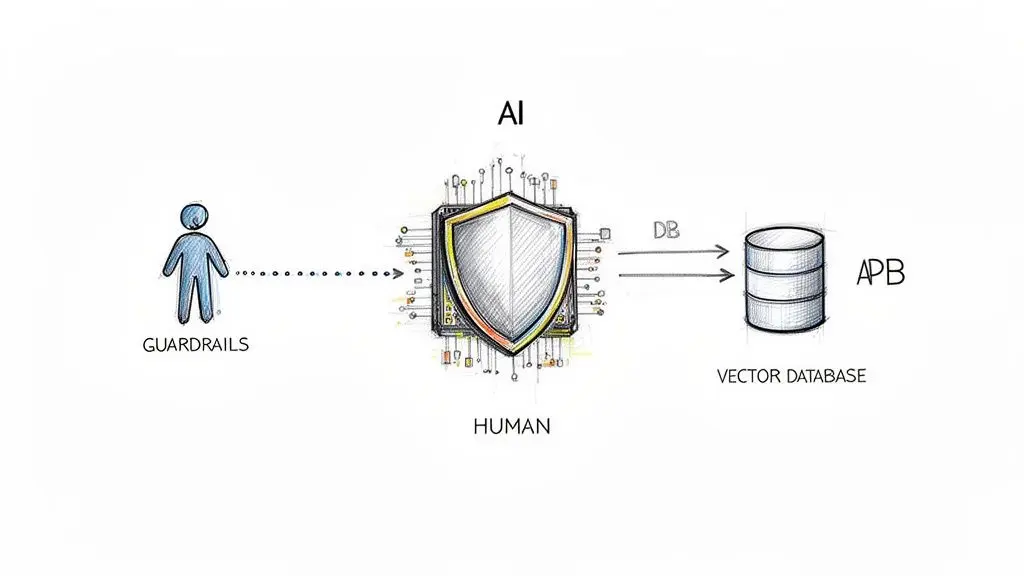
When designing a To-Be state, AI and automation cannot be an afterthought. A naive approach of “bolting on” an LLM to a legacy system creates significant technical debt and operational risk. A strategic integration begins by identifying high-value opportunities where AI solves a concrete business problem, moving beyond hype to target specific workflows suitable for intelligent automation.
This requires a systems-thinking approach, designing for reliability with robust guardrails, fallback mechanisms, and human-in-the-loop controls for critical decision points.
Identifying High-Value AI Opportunities
Not every problem requires an AI solution. The key is to identify tasks that are repetitive, data-intensive, or prone to human error—areas where automation delivers a measurable return on investment. The pain points identified in your As-Is model are the primary candidates.
Viable opportunities for AI integration often include:
- Automating Data Processing: Extracting and categorizing information from unstructured documents to eliminate manual data entry.
- Powering Intelligent Workflows: Routing support tickets or approving requests based on learned patterns, freeing human experts to handle complex escalations.
- Enabling Semantic Search: Moving beyond keyword matching to a search capability that understands user intent, dramatically improving the utility of knowledge bases.
This targeted approach ensures your as is e to be transition is driven by business needs, connecting AI development directly to operational outcomes.
Architectural Implications for AI-Enabled Systems
Integrating AI has significant architectural consequences. Your To-Be design must account for new components and their unique operational demands.
A common pitfall is underestimating the supporting infrastructure required to operate AI systems reliably and cost-effectively. The model itself is just one component of a larger system encompassing data pipelines, monitoring, and governance.
Key architectural considerations include:
- API vs. Self-Hosted Models: The choice between third-party APIs (e.g., OpenAI) and self-hosted open-source models involves a trade-off between convenience, cost, and data privacy.
- Data Infrastructure: For applications using retrieval-augmented generation (RAG), a vector database becomes a core component, enabling the necessary high-performance similarity searches.
- Observability: Robust logging and monitoring are required to track model performance, detect drift, and manage token consumption to prevent uncontrolled cost escalation.
AI is a major driver of change in IT services. With 84% of professionals expecting increased investment by 2026, integrating AI into architectural planning is now a standard practice. This is amplified by the 54% of companies with partially digitized workflows, which are prime candidates for AI-driven automation. You can read the full research about these AI adoption trends.
Building AI-enabled systems that are robust, secure, and governable is critical. For practical guidance, check out our AI Risk & Privacy Checklist to help map potential vulnerabilities.
Conclusion: Bridging Strategy and Execution
The As-Is To-Be framework provides the essential bridge between business strategy and technical execution. It replaces guesswork with an evidence-based plan.
A thorough As-Is analysis delivers the hard data required to justify investment and align stakeholders around a shared understanding of the current reality. A well-defined To-Be model provides development teams with a clear, actionable roadmap. By following this as is e to be process, organizations significantly reduce project risk and ensure that engineering efforts deliver measurable value.
The ultimate goal is to establish a stable foundation for incremental progress. This ensures that even complex modernization projects move forward with purpose, transforming strategic objectives into maintainable, high-value software systems.
This methodical planning is the first step in a successful delivery cycle. To see how this architectural vision is implemented and deployed, explore our guide on CI/CD pipelines, which covers the next phase of bringing a To-Be model to production.
Common Questions About As-Is and To-Be Analysis
Executing an as is e to be analysis for system modernization often raises practical questions. Here are common queries from leaders guiding their teams through this process.
How Long Should an As-Is Analysis Take?
The duration depends on the scope. For a single application or a well-defined business process, the analysis can often be completed in one to three weeks.
For a complex enterprise system with numerous integrations and stakeholders, the timeline may extend to four to eight weeks. The key is to time-box the effort to avoid “analysis paralysis,” focusing on gathering just enough information to make informed decisions for the To-Be design.
What Are the Most Common Pitfalls to Avoid?
Several common mistakes can derail a modernization project before implementation begins.
Key risks include:
- Superficial As-Is Analysis: Missing undocumented workflows or subtle pain points creates a flawed foundation for the entire project.
- Designing in a Vacuum: Creating the To-Be model without direct input from end-users results in a system that fails to solve real-world problems.
- “Big Bang” Planning: Designing a monolithic migration that cannot be delivered incrementally increases risk and delays valuable feedback.
- Poor Documentation: Failing to document the rationale behind To-Be design decisions leads to a loss of context and future maintenance challenges.
Which Tools Are Best for Creating These Diagrams?
The best tool is one your team will use collaboratively and effectively. For process mapping (BPMN) and data flow diagrams, platforms like Miro, Lucidchart, or Diagrams.net are effective choices due to their flexibility and collaboration features.
For architectural diagrams, tools that support the C4 model or standard UML are suitable for illustrating system structure. The goal is always clarity and shared understanding, not the technical sophistication of the tool itself.
An overly complex tool can become a barrier to communication. A simple, clear diagram created with a basic tool is always more valuable than a technically perfect but incomprehensible one.
How Does This Framework Fit with Agile Methodologies?
An as is e to be analysis is a complementary strategic activity, not a replacement for Agile practices. It sets the high-level architectural vision and defines the guardrails for the project.
Once the vision is established, the To-Be model is decomposed into smaller, incremental deliverables. These work packages are then executed within an Agile framework like Scrum or Kanban. This approach ensures that each sprint remains aligned with the broader strategic objective, connecting daily execution to the long-term architectural vision.
A methodical, architecture-first approach to software is at the core of our philosophy. Devisia translates business vision into reliable, maintainable digital products, bridging the gap between strategy and execution. Learn how we can help you build your To-Be architecture.