
Digital transformation in retail is not a marketing initiative; it is a fundamental re-engineering of core systems to resolve operational constraints. The primary problem is often technical debt: fragmented customer data, siloed inventory systems, and rigid legacy platforms that inhibit innovation. The solution is an architectural overhaul toward a modern, API-first model that establishes a single source of truth.
The Problem: Architectural Friction, Not Surface-Level Gaps
True transformation addresses the underlying engineering failures, not just the symptoms. Many retailers operate on systems built decades ago, creating data silos that are architecturally incapable of communicating with each other. This technical friction manifests as critical business problems.
For example, an in-store associate’s inability to access a customer’s online purchase history, or a website showing inventory that sold out hours ago, are not minor inconveniences. They are direct consequences of a disconnected, monolithic architecture. These issues erode customer trust and create operational inefficiencies.
From Fragmented Systems to a Single Source of Truth
The most critical engineering objective is to move away from disparate databases and applications. The goal is a unified, API-first architecture that establishes a single source of truth for all operational data. This ensures data is consistent, reliable, and accessible in real-time across all channels.
This foundational layer enables critical capabilities:
- Unified Customer Profiles: Every interaction, from a website click to an in-store return, contributes to a single, coherent view of the customer.
- Real-Time Inventory: Online and physical stores query the same live inventory data, eliminating stock discrepancies and inaccurate fulfillment.
- Operational Agility: New features or sales channels can be integrated via APIs without requiring a full system rebuild.
A naive approach, such as layering a new mobile app over a fragmented back-end, exacerbates the problem. It adds complexity, creates a disjointed customer experience, and ultimately increases technical debt and operational costs.
An Engineering-Led Approach to Modernization
Viewing this challenge through an engineering lens transforms it from a vague business goal into a specific re-engineering project. The task is to build a robust, maintainable, and scalable platform designed for long-term evolution, not just to apply short-term fixes.
This shift is a significant global trend. The retail digital transformation market is projected to grow at a CAGR of 28.6% from 2026 to 2030, according to data on Grand View Research. This growth is driven by organizations leveraging AI and cloud infrastructure to rebuild the customer experience from the ground up. This pragmatic, engineering-first mindset converts technology from a liability into a strategic asset.
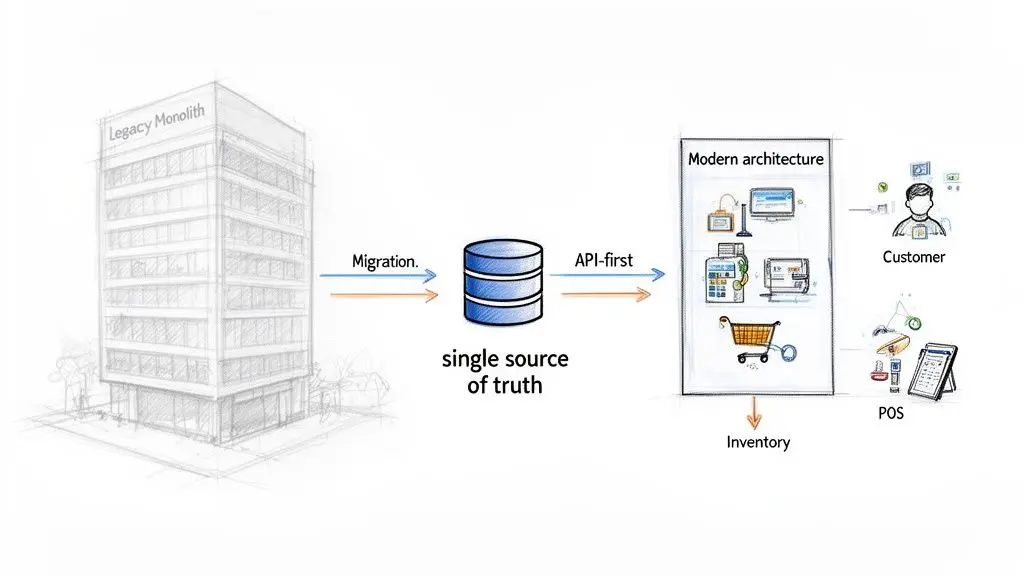
The Architectural Blueprint for Modern Retail
A successful digital transformation is not achieved by procuring isolated technologies. It requires a coherent architectural foundation. For a technical leader, the work involves shifting from a rigid monolithic system to an agile, interconnected architecture that can adapt to business needs. This is an engineering mandate, not a purchasing decision.
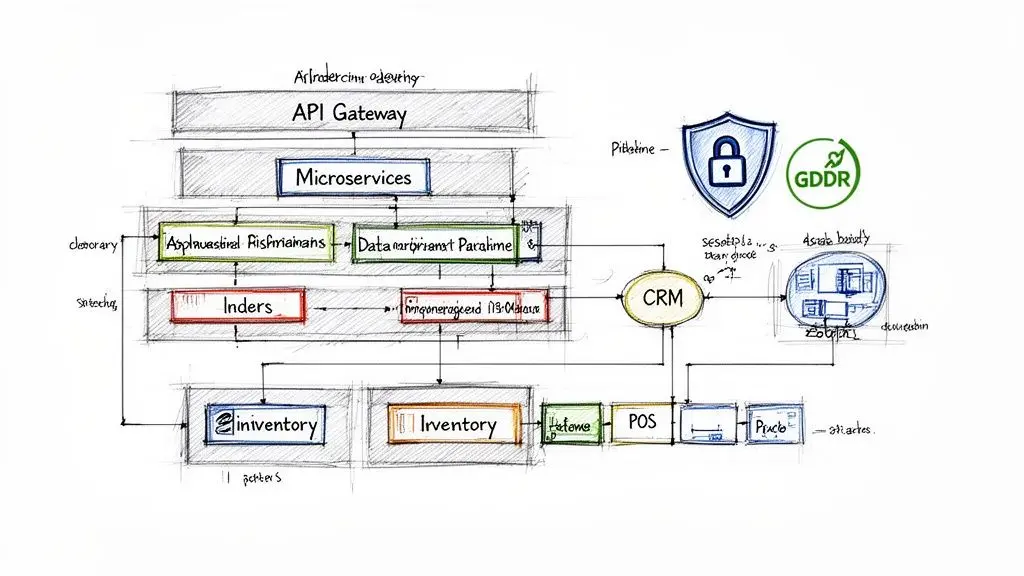
Choosing the Right Architectural Pattern: Trade-offs and Constraints
The choice between monolithic, microservices, and composable commerce architectures involves trade-offs in complexity, scalability, and operational overhead. A monolith, where all components are tightly coupled within a single application, is simple to deploy initially. However, it rapidly becomes a bottleneck to innovation. A minor update requires redeploying the entire system, leading to high-risk releases and slow development cycles.
A microservices architecture decomposes the system into small, independent services (e.g., inventory, customer management, order processing). Each service can be developed, deployed, and scaled autonomously. The primary trade-off is the introduction of distributed system complexity, including challenges like service discovery, data consistency, and distributed monitoring. You can explore this further in our guide to service-oriented architecture.
A composable commerce approach extends this by integrating best-of-breed, API-first services from various vendors. This offers maximum flexibility but demands a mature internal engineering team and a robust integration strategy to manage the ecosystem.
The most pragmatic starting point for many retailers is not a “big bang” rewrite but a gradual decoupling of critical functions from the monolith. Isolating a single domain, such as inventory management, as a separate microservice can deliver immediate value and validate the architectural approach without incurring systemic risk.
To evaluate these choices, consider the core technology pillars and their practical implications.
Core Technology Pillars for Retail Transformation
This table outlines key technologies, their function in a retail context, and critical implementation considerations.
| Technology Pillar | Primary Function in Retail | Key Implementation Consideration |
|---|---|---|
| Microservices | Decouples business functions (e.g., cart, inventory, pricing) for independent development and scaling. | Start by decoupling one high-value, low-risk domain. Avoid creating a “distributed monolith” by ensuring services are truly independent with separate data stores. |
| API Gateway | Acts as a single, secure entry point for all client requests, routing them to the appropriate backend service. | Implement robust authentication, rate limiting, and request logging at the gateway level to protect backend services and provide clear observability. |
| Event-Driven Architecture | Enables asynchronous, real-time data flow between systems (e.g., order_placed, shipment_updated) without direct coupling. | Use a durable message broker like Apache Kafka or RabbitMQ. Enforce well-defined and versioned event schemas to prevent breaking downstream consumers. |
| Cloud Infrastructure | Provides the on-demand compute, storage, and networking required for scalable retail operations. | Adopt an “infrastructure as code” (IaC) approach using tools like Terraform to ensure environments are reproducible, versioned, and auditable for compliance. |
| Data Lake / Warehouse | Centralises data from all sources (POS, e-commerce, CRM) for analytics, business intelligence, and AI/ML model training. | Establish a clear data governance strategy from inception. Focus on data quality, lineage, and access controls to ensure analytics are based on trusted information. |
Correctly implementing these pillars is about building a foundation that can evolve with the business.
The API as the System’s Connective Contract
Regardless of the architectural pattern, an API-first design is non-negotiable. APIs serve as the formal contract between different parts of the system. They create a unified abstraction layer that connects disparate components—CRM, POS terminals, warehouse management software—into a coherent whole.
For instance, when a customer returns an item in-store, a well-designed API call should trigger a cascade of real-time events:
- The inventory service is immediately updated, making the item available for online purchase.
- The CRM service logs the return against the customer’s profile.
- The finance service initiates the refund process.
A naive implementation, such as a nightly batch job, creates data latency, leading to operational errors and a poor customer experience. Real-time data flow, enabled by a robust API layer, is the backbone of a modern retail operation.
Engineering a Resilient Data Pipeline
Every customer interaction generates valuable data. A modern retail architecture requires a data pipeline capable of capturing, processing, and analyzing this information in real-time. This is typically implemented using an event-driven architecture where state changes (e.g., order_placed, inventory_updated) are published as events to a central message bus.
This decouples producers from consumers, ensuring data integrity and system resilience. Downstream services—such as analytics dashboards, fraud detection systems, or recommendation engines—can subscribe to these event streams independently.
Cloud platforms are foundational to this model, expected to hold a 36.72% market share in the IT region by 2026, with a 12.2% CAGR. This infrastructure provides the scalable data services and compute necessary for AI. For instance, combining IoT and AI has been shown to improve demand forecasting accuracy by up to 30%. You can explore more about these market trends in retail transformation.
Privacy by Design: An Architectural Mandate
Security and privacy cannot be treated as features to be added post-launch. In an environment governed by regulations like GDPR, a reactive approach to compliance is a significant business risk.
Privacy by design must be integrated into the architecture from the outset. Key principles include data minimization (collecting only what is necessary), implementing robust role-based access controls (RBAC), and enforcing end-to-end encryption for data in transit and at rest. When these safeguards are built into the core system, compliance becomes a structural guarantee, not a fragile, last-minute addition.
Building a True Omnichannel Customer Experience
The term “omnichannel” is often misapplied. It does not simply mean having a website, an app, and a physical store. The engineering challenge is to create a single, unified customer experience that spans all channels seamlessly.
A true omnichannel experience is achieved when the distinction between digital and physical channels disappears for the customer, becoming one continuous journey.
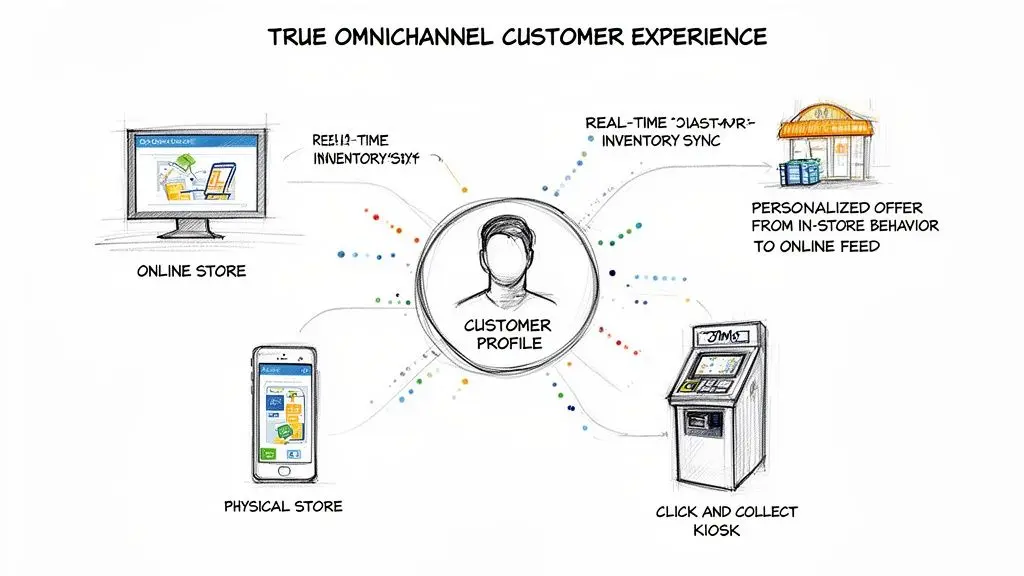
This seamlessness is not a front-end design problem; it is a back-end architectural one. Most retailers operate with data silos: the e-commerce platform has its own customer database, the point-of-sale (POS) system has another, and marketing tools have a third. This configuration makes a unified experience architecturally impossible.
The Technical Challenge of a Single Customer View
To achieve an omnichannel state, a foundational shift to a single source of truth for both customer data and inventory is required. This is the core work of digital transformation in retail. The objective is to engineer a system where every customer interaction, regardless of channel, reads from and writes to the same central data stores.
This unified architecture enables high-value experiences:
- Persistent Shopping Carts: A customer adds an item to their cart on the mobile app. An in-store associate can immediately view this cart and assist with the physical product.
- Contextual Personalization: An in-store purchase of running shoes triggers relevant recommendations for athletic apparel on the website.
- Streamlined Logistics: An online “click-and-collect” order instantly reserves inventory at the correct physical store, ensuring a frictionless pickup experience. Our guide to chatbots in retail explores how conversational AI can further streamline these interactions.
A superficial omnichannel strategy—one that links front-end channels without unifying back-end data—is counterproductive. It creates frustrating inconsistencies, such as displaying an item as “in stock” online when it is sold out in-store. This leads directly to operational failures and erodes customer trust.
Real-Time Inventory Synchronization
A significant engineering hurdle is real-time inventory synchronization. When a product is sold in-store, the online stock level must be updated within seconds. Nightly batch updates are no longer sufficient. This necessitates an event-driven architecture where every sale, return, or stock movement publishes an event that all subscribed systems consume instantly.
This level of integration is a powerful driver of growth. Omnichannel integration is a core factor in the retail sector’s 18.6% CAGR. With cloud deployments now powering over 61% of the infrastructure, retailers can achieve the real-time synchronization needed to reduce fulfillment times by 25% and improve retention by up to 40%. You can find more insights in the global digital transformation in the retail sector report.
Engineering for a Unified Experience
The back-end architecture required for a true omnichannel experience is complex but essential. It involves creating robust APIs that expose a unified view of customer data, inventory levels, and order history to every channel. From a technical standpoint, this requires centralizing data into a Customer Data Platform (CDP) and an Inventory Management System (IMS) that serve as the undisputed sources of truth.
The return on this architectural discipline is a fundamental competitive advantage built on sound engineering, transforming a collection of disconnected channels into a single, intelligent, and responsive business.
Integrating AI with Governance and Cost Control
Integrating AI into retail operations requires a pragmatic approach focused on solving specific business problems, not chasing technological trends. The objective is to engineer targeted, measurable AI systems governed by robust controls for security, compliance, and cost.
Without this discipline, an AI initiative can quickly become an expensive, unreliable, and non-compliant liability.
Successful AI integration focuses on high-impact use cases where automation and prediction provide a clear, measurable advantage. These are practical tools designed to improve core business metrics.
Key applications with clear ROI include:
- AI-Driven Demand Forecasting: Modern models can process complex variables—weather forecasts, local events, social media trends—to predict demand with greater accuracy than simple historical averages. This directly reduces overstocking and stockouts.
- High-Fidelity Recommendation Engines: Sophisticated models analyze individual browsing behavior, purchase frequency, and session duration to deliver relevant product suggestions that increase average order value.
- Automated Inventory Management: AI systems can automate reordering, optimize stock levels across locations, and predict supply chain disruptions. This transforms inventory management from a reactive to a proactive, data-driven function.
Establishing Responsible and Reliable AI Systems
The most significant risk in AI adoption is not model inaccuracy but a lack of governance and control. A “set it and forget it” approach, where models operate without oversight, creates serious financial, reputational, and legal risks.
For example, a biased algorithm could systematically understock products for certain demographics. An insecure Large Language Model (LLM) could be exploited to leak sensitive customer data or generate brand-damaging responses.
To mitigate these risks, a human-in-the-loop (HITL) control system is essential for critical decisions. While an AI can recommend optimal stock levels, the final purchase order for high-value goods should require human authorization. This blends machine efficiency with human judgment and accountability.
Governance is an architectural necessity, not an optional feature. Responsible AI adoption requires building guardrails directly into the system to manage model bias, data privacy, runaway API costs, and brand safety.
For any customer-facing LLM, programmatic guardrails are non-negotiable. These are rules that prevent the model from discussing inappropriate topics, making unauthorized commitments, or deviating from brand guidelines. They act as a critical safety mechanism, ensuring the AI operates within predefined boundaries.
Identifying these risks is a critical first step. Our free AI Risk & Privacy Checklist can help you evaluate your systems for vulnerabilities.
Managing Costs with Continuous Monitoring
AI models, particularly LLMs accessed via APIs, can generate unpredictable and substantial costs. A misconfigured recommendation engine or a chatbot in a repetitive loop can accrue thousands of dollars in API charges within hours.
Continuous monitoring is therefore a mandatory operational requirement.
Effective cost control requires several layers of technical implementation:
- Strict Rate Limiting: Capping the number of API calls a system can make in a given period prevents runaway processes.
- Intelligent Caching: Storing the results of frequent, identical queries (e.g., recommendations for a popular product) avoids redundant API calls and reduces costs.
- Real-Time Observability: Dashboards that track token usage, API latency, and error rates in real-time are crucial for identifying anomalies before they become significant financial issues.
By treating AI as a powerful but resource-intensive system component, retailers can build solutions that are both intelligent and economically sustainable.
Your Roadmap for Incremental and Safe Delivery
Attempting a “big bang” digital transformation is a common and costly strategic error. The high risk, massive upfront investment, and long time-to-value make this approach impractical for most organizations.
An incremental delivery model is a more pragmatic strategy. It is designed to reduce risk, accelerate learning, and deliver measurable value at each stage. This approach relies on a series of focused sprints that build momentum and validate the architecture one step at a time.
Phase 1: Focused Discovery
Before writing any code, conduct a tightly-scoped discovery phase. This is a practical exercise to identify the single greatest point of operational friction—the bottleneck that, if resolved, would yield the most significant business impact.
For most retailers, this pain point is typically one of two issues:
- Fragmented Inventory Data: Discrepancies between online and physical store systems lead to lost sales and customer dissatisfaction.
- Siloed Customer Profiles: The inability to connect a customer’s online behavior with their in-store purchases makes effective personalization impossible.
The output of this phase should be a precise problem statement and the specific KPIs that will be used to measure success.
Phase 2: Foundational Architecture
With a clear objective defined, the next step is to build the minimum viable architecture to support it. This does not mean building the entire future platform. It means creating the core data models and API layers needed to solve the initial, critical problem.
For example, if the goal is to unify inventory, this phase focuses on building a single source of truth for stock levels and exposing it through a clean, internal API. This foundational work establishes the architectural pattern for all subsequent development, ensuring scalability and maintainability.
A key decision here is selecting a technology stack that is fit for purpose, not over-engineered. The goal is to enable future growth without introducing unnecessary complexity today. Simplicity and robustness are paramount.
Phase 3: The Minimum Viable Product Launch
The MVP delivers the first return on investment. You launch one high-impact feature that directly addresses the problem identified in the discovery phase. For a unified inventory system, the MVP could be an internal tool allowing customer service teams to view real-time stock levels across all locations.
This initial launch accomplishes two critical goals: it solves an immediate business problem and validates the architectural approach in a production environment. The resulting feedback loop is invaluable.
Phase 4: Iterative Enhancement and Scaling
Once the MVP is live and stable, you enter a continuous cycle of improvement. With the foundational architecture in place, new capabilities can be layered on incrementally.
This could include:
- Exposing the unified inventory API to the e-commerce website.
- Integrating an AI-powered demand forecasting model that consumes the new, reliable data feed.
- Adding personalized recommendations driven by a unified customer profile.
A clear process is essential, especially when integrating complex systems like AI. Every new capability must be supported by appropriate governance and cost management from its inception.
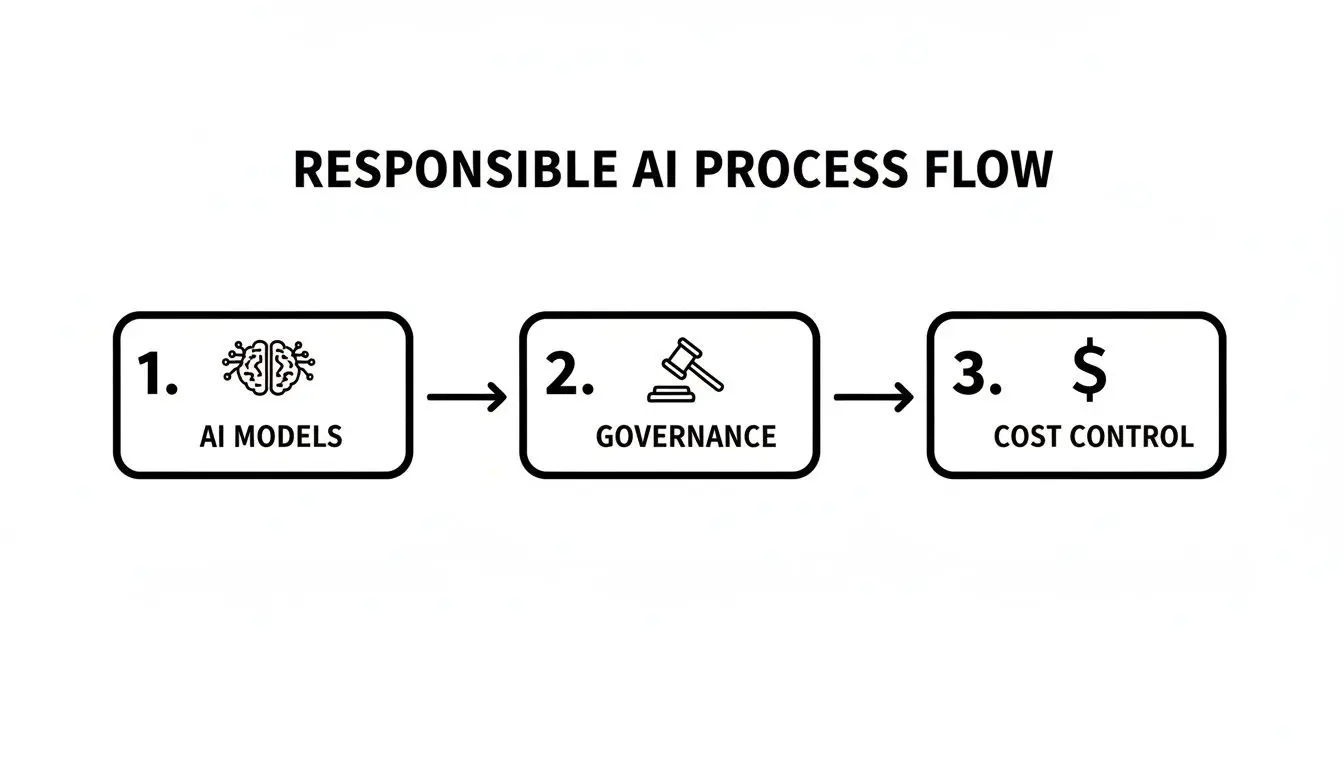
This diagram illustrates that building AI models is only the first step. For sustainability, they must be enclosed in strong governance frameworks and continuously monitored for cost. By following this phased roadmap, a high-risk project is transformed into a manageable and predictable series of deliveries.
The specific rollout strategy depends on the organization’s size and complexity.
Incremental Rollout Strategy by Business Size
| Business Tier | Phase 1 Priority | Phase 2 Goal | Common Pitfall to Avoid |
|---|---|---|---|
| Startups | Solve one critical customer-facing problem (e.g., checkout friction). | Build a core, reusable service (e.g., a simple inventory API). | Over-engineering a solution for a scale that does not yet exist. |
| SMBs | Unify one core dataset (e.g., customer or inventory data). | Expose unified data to one key channel (e.g., e-commerce site). | Attempting to unify all data at once instead of focusing on the highest-value set first. |
| Enterprises | Pilot a new capability in a single, isolated business unit or region. | Create a scalable, governed platform based on pilot learnings. | A successful pilot that fails to scale due to internal politics or the lack of a clear expansion plan. |
While the principles of starting small and iterating are universal, the execution must be tailored to your specific organizational context.
Measuring Success and Avoiding Common Pitfalls
The success of a digital transformation must be measured by its tangible impact on the business. Without clear metrics tied to operational health and profitability, the initiative is simply an expensive exercise in change.
Success is not defined by launching a new application but by quantifiable improvements in business performance.
Key Performance Indicators for Transformation
Every initiative should be anchored to concrete, measurable outcomes. The right KPIs provide an objective assessment of whether architectural changes are delivering value.
- Customer Lifetime Value (CLV): A rising CLV indicates that unified customer profiles and personalization are effectively building loyalty and increasing repeat business.
- Inventory Turnover Rate: A higher turnover rate is direct evidence that improved demand forecasting and real-time inventory systems are reducing overstock and aligning supply with demand.
- Stockout Percentage: A sustained decrease in stockouts is a direct measure of the effectiveness of a unified inventory system in preventing lost sales.
- Order Fulfilment Accuracy: This metric, which tracks the percentage of orders shipped correctly and on time, reflects the health of the entire supply chain and logistics integration.
These KPIs link technical work directly to business outcomes.
Costly Pitfalls to Avoid
Many transformation initiatives fail due to flawed strategy, not incorrect technology. A lack of clear planning can result in complex, insecure, and expensive systems that deliver minimal value. The most common pitfalls are often the most avoidable.
A successful transformation is an ongoing architectural commitment to building simple, robust, and secure systems for the long term, not for a short-term win.
Three common strategic errors are:
- Selecting Technology Before Defining the Problem: A team becomes enamored with a new AI platform or composable framework without first defining the specific business problem it is intended to solve. This leads to an over-engineered solution in search of a purpose.
- Underestimating Data Governance: Creating a single source of truth is a significant undertaking. Without clear data ownership, quality standards, and access controls, a data lake can quickly become a data swamp, rendering any analytics or AI models built upon it useless.
- Treating Security as an Afterthought: In the rush to launch new features, security is often deferred. However, every new API endpoint and data integration creates a potential attack vector. Integrating security into the architecture from day one is non-negotiable.
Frequently Asked Questions
What is the first practical step for a small business starting a digital transformation?
The first step is a discovery phase, not a technology purchase. Map your existing processes to identify the single largest operational bottleneck, which is often fragmented inventory or customer data.
Define a small, high-impact problem to solve first, such as creating a single source of truth for inventory accessible via an internal API. This incremental approach validates the strategy and delivers immediate value without the risk of a large-scale project.
How can we ensure our retail AI integration is secure and compliant?
Security and compliance are architectural principles, not add-on features. For AI, this means implementing privacy by design through multiple layers: strong data governance to anonymize or pseudonymize customer data, model governance to test for bias and ensure transparency, and operational security measures like human-in-the-loop controls and strict access protocols.
Security cannot be retrofitted; it must be a foundational component of the system’s design. A reactive approach to compliance introduces unacceptable risk to both customers and the business.
What is the technical difference between multichannel and omnichannel retail?
Multichannel means operating across several channels that are not integrated—a website, an app, and a physical store that function as data silos.
Omnichannel requires the integration of these channels into a single, seamless customer experience. Architecturally, this necessitates a unified back-end where customer profiles, inventory, and order history are centralized and accessible in real-time across all touchpoints. A customer can begin a transaction on their app, receive in-store recommendations based on that interaction, and complete the purchase online for delivery, all as part of one consistent journey.
Devisia provides end-to-end custom software development, helping businesses build robust, maintainable, and secure digital platforms. We translate business vision into reliable technical products with a clear path to measurable value. Learn more at https://www.devisia.pro.