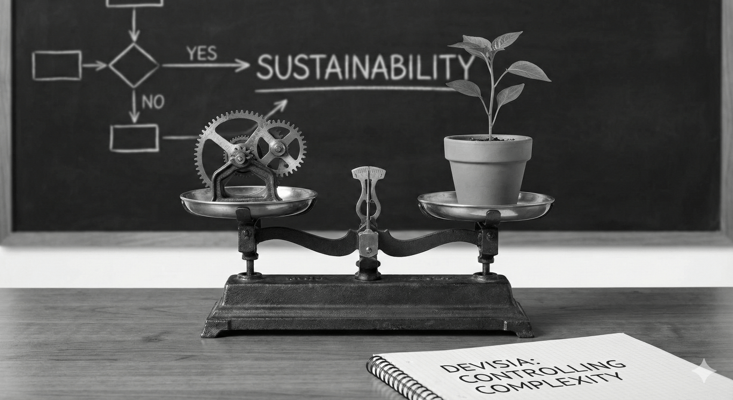
Custom software is often sold as freedom: software tailored exactly to your needs, your processes, your business. As a software development company, we see every day how this freedom can become a strategic asset or a technical bottleneck.
And yet, many custom projects turn into long-term liabilities.
Not because they didn’t work at launch — but because, over time, they became fragile, hard to change, and expensive to maintain.
At Devisia, we’ve learned that the real challenge of custom software development is not building it, but keeping it healthy over time through ai by design and ai security standards.
The real risk of custom software
Most custom projects fail quietly.
They launch. They are used. They deliver value — at first.
Then, slowly:
- changes become harder
- small fixes require large effort
- knowledge concentrates in a few people
- fear replaces confidence
This doesn’t happen because of bad developers. It happens because complexity was allowed to grow unchecked.
Custom software is not risky by default. Uncontrolled complexity is.
Custom does not mean improvised
One of the most common misconceptions is that “custom” means:
- faster decisions
- fewer constraints
- skipping upfront thinking
In reality, it’s the opposite.
The more tailored a system is, the more important it becomes to:
- understand the problem deeply
- define boundaries early
- design for change, not just for today
Without this, custom software becomes tightly coupled to current assumptions — and breaks as soon as the business evolves.
Discovery before code
The most valuable phase of a custom project is often the least visible one: discovery.
Before writing code, we focus on:
- what problem really needs to be solved
- what can stay manual
- what must be automated
- what is likely to change in 6–12 months
This phase is not about producing documents. It’s about reducing uncertainty before it becomes technical debt.
Every line of code written without clarity is a future cost.
Simple architecture beats complete features
A common mistake is trying to make the first version “complete”.
Complete systems are rarely simple. Simple systems are rarely complete — and that’s a good thing.
We deliberately favor:
- fewer concepts
- fewer abstractions
- clear responsibilities
- explicit trade-offs
A system that does less, clearly, is easier to:
- understand
- extend
- debug
- replace when needed
Complexity should be earned, not assumed.
Deciding what not to build
One of the most important design decisions in a custom project is what not to build.
Not every process needs software. Not every workflow needs automation. Not every edge case needs a feature.
We actively question:
- is this core or peripheral?
- can this remain manual for now?
- does this add clarity or just functionality?
Saying “no” early is often the best way to protect a system in the long run.
Ownership over dependency
Custom software should increase autonomy, not dependency.
That means:
- readable codebases
- explicit architectural decisions
- predictable deployment and operations
- documentation that explains why, not just how
A system is healthy when the team feels confident changing it — even months later.
Custom software as a long-term system
The goal of custom software is not just to solve today’s problem.
It’s to create a system that:
- adapts as the business evolves
- remains understandable over time
- does not require constant heroics to maintain
When done right, custom software becomes an asset. When done without restraint, it becomes a constraint.
Our approach at Devisia
We approach custom software as product work, not one-off delivery.
That means:
- discovery before implementation
- architecture aligned with business goals
- incremental releases with feedback
- continuous attention to maintainability
Because the true success of custom software is not launch day — it’s how confidently you can change it one year later.
Takeaway
Custom software should reduce complexity, not move it elsewhere.