When building systems for agriculture, artificial intelligence is not a futuristic concept; it is a tool for solving urgent operational problems. It enables a move past traditional methods that cannot meet modern food demands, regulatory pressures, and razor-thin margins. The focus is not on “doing AI” but on using data-driven software to address concrete business challenges.
The Problem Space: Why AI in Agriculture is a Strategic Necessity
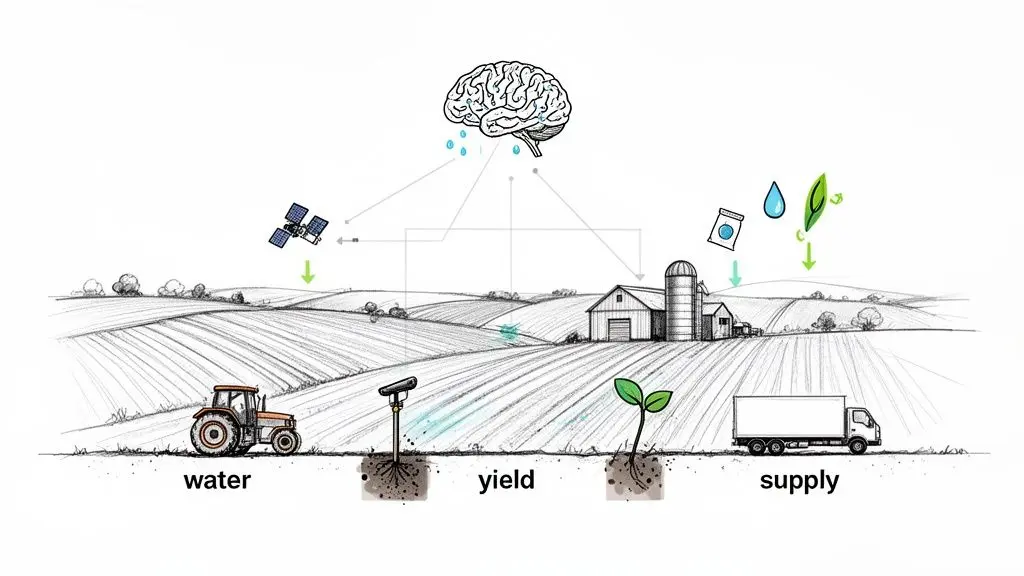
The agricultural sector faces a fundamental constraint: the need to increase productivity and sustainability with finite resources. The global population is projected to reach nearly 10 billion by 2050, intensifying pressure on food systems already strained by climate volatility, labour shortages, and declining soil health.
For CTOs and founders in agritech, these are not abstract issues. They are immediate business drivers that threaten operational stability and profitability. Traditional farming, which relies on experience and manual intervention, is hitting its operational and financial limits. This is where artificial intelligence in agriculture becomes a strategic tool for risk management and efficiency.
Operational Risks Unaddressed by Traditional Methods
Legacy farming practices create clear operational and financial risks that AI systems are uniquely suited to mitigate. These challenges propagate through the entire value chain, from seed procurement to final delivery.
Here are the core problems driving the industry toward AI-driven software:
- Resource Inefficiency: Uniform application of water, fertiliser, and pesticides across non-uniform fields is both expensive and environmentally unsustainable. This practice drives up operational costs and invites regulatory scrutiny.
- Supply Chain Opacity: A lack of real-time visibility between farm-level production and market demand leads to significant post-harvest losses, suboptimal pricing, and logistical bottlenecks. Manual sorting and grading compound these issues by being slow, labour-intensive, and inconsistent.
- Climate and Regulatory Volatility: Unpredictable weather events and tightening environmental regulations (e.g., related to water usage and chemical runoff) demand a level of operational agility that is impossible to achieve with manual methods alone. Predictive capabilities become essential for proactive management.
- Labour Scarcity and Cost: A persistent shortage of skilled agricultural labour limits scalability and inflates overhead. Automation is no longer a luxury but a critical component for business continuity and cost control.
By framing AI as a direct solution to these tangible business problems, technical leaders can build a compelling case for investment. The objective is not to chase technological trends but to engineer reliable software systems that deliver measurable improvements in efficiency, cost reduction, and risk management. This pragmatic approach cuts through the hype and aligns technology with core business objectives.
Key AI Applications for Core Agricultural Operations
To understand the practical value of artificial intelligence in agriculture, we must focus on applications that solve clear, expensive problems. For a technical leader, the only use cases that matter are those delivering a measurable return on investment.
These are not futuristic concepts; they are practical tools being deployed today to mitigate resource waste, market volatility, and operational inefficiencies. Let’s examine the four primary domains where AI transforms raw data into a strategic asset.
Precision Farming and Resource Optimisation
The Problem: Waste is a constant drain on a farm’s finances. The standard approach of applying inputs uniformly across large, heterogeneous fields inevitably leads to over-application in some areas and under-application in others. This is inefficient and environmentally damaging.
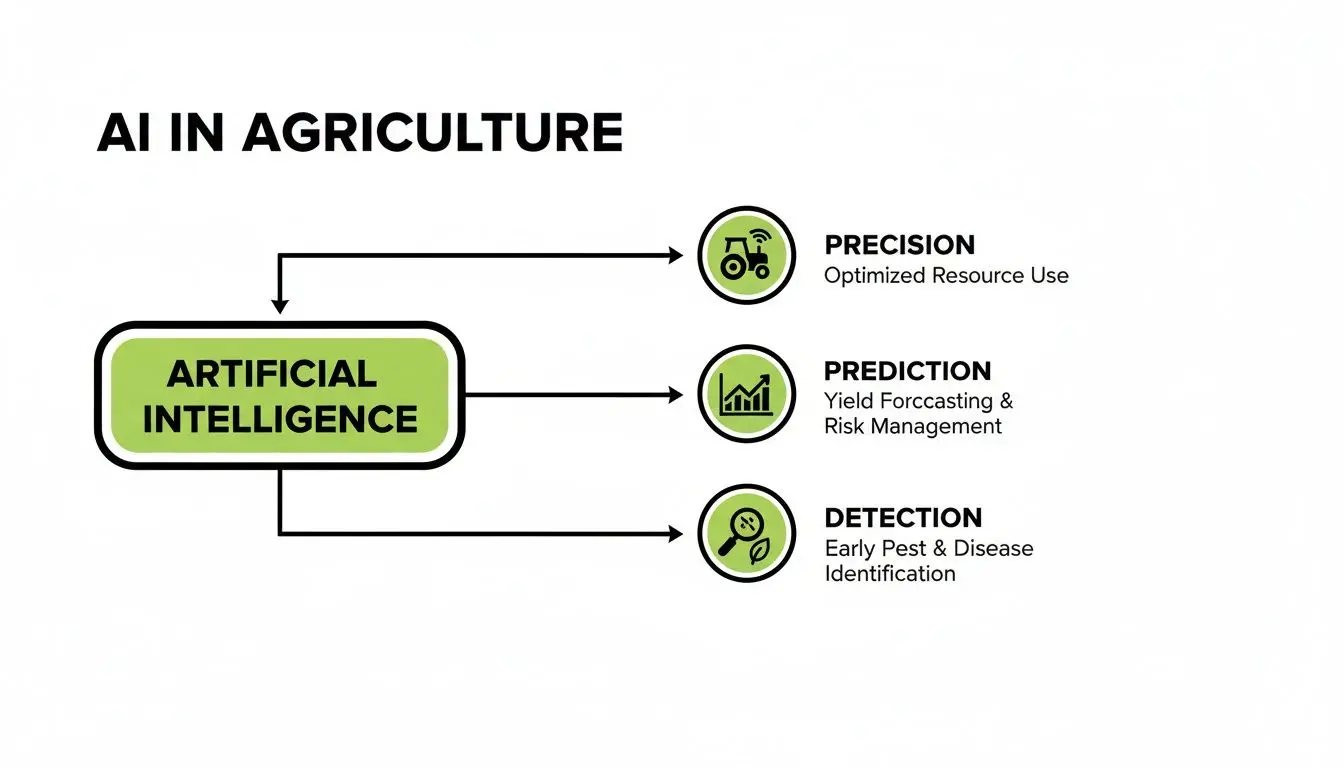
The Solution: Precision farming uses AI to treat different parts of a field based on their specific, real-time needs. AI algorithms integrate and analyse data from IoT sensors, drone imagery, and satellites to create a high-resolution map of field variability.
This data-driven approach enables two key technical applications:
- Variable Rate Application (VRA): AI-powered farm machinery, guided by GPS, adjusts the volume of fertiliser, seed, or water it applies in real time, metre by metre. This ensures each plant receives a precise dosage, significantly cutting input costs.
- Targeted Irrigation: AI systems analyse soil moisture levels, cross-reference them with hyperlocal weather forecasts, and factor in the crop’s growth stage to automate irrigation schedules. This prevents overwatering, conserves a critical resource, and mitigates yield loss from water stress.
By shifting from blanket application to surgical precision, AI helps convert agricultural inputs from a blunt instrument into a finely-tuned tool. This not only reduces operational expenditure but also minimises environmental runoff—a key consideration under tightening regulations like the EU’s Common Agricultural Policy (CAP).
Predictive Analytics for Yield and Market Forecasting
The Problem: Uncertainty is the primary constant in agriculture. Volatile weather, fluctuating commodity prices, and biological unpredictability make planning logistics, securing contracts, and managing cash flow exceptionally difficult.
The Solution: Predictive analytics provides an operational edge by forecasting future outcomes based on historical data. Machine learning models are trained to analyse massive datasets—years of weather patterns, soil health metrics, satellite imagery, and market trends. For instance, by analysing vegetative indices from satellite data over a season, a model can predict end-of-season yield with high confidence weeks before harvest. This enables more effective logistics planning, labour allocation, and contract negotiation.
In the European Union, the adoption of AI is leading to tangible productivity gains. Farm management systems integrating artificial intelligence and IoT now see a 35% utilisation rate. Weather forecast systems account for 20% of AI applications, helping farmers mitigate losses from increasingly unpredictable conditions. You can explore more recent findings by reviewing the latest AI in agriculture statistics.
Automated Pest and Disease Detection
The Problem: Crop loss due to pests and diseases can destroy a season’s revenue. The traditional method of manual field scouting is slow, labour-intensive, and often identifies an outbreak only after it has spread, making containment costly and difficult.
The Solution: This is an ideal application for computer vision. By training an AI model on thousands of labelled images, a system can learn to identify specific pests, weeds, and the earliest signs of disease with an accuracy and speed that a human cannot match.
This enables:
- Early Warning Systems: Drones or fixed cameras can continuously monitor fields, with AI algorithms flagging anomalies long before they are visible to the human eye.
- Targeted Spraying: Once a threat is identified and located, AI can direct smart sprayers to treat only the affected plants, dramatically reducing pesticide usage, cost, and environmental impact.
Supply Chain and Post-Harvest Optimisation
The Problem: The journey from farm to consumer is notoriously inefficient. Significant value is lost to spoilage, inconsistent manual grading, and suboptimal logistics.
The Solution: AI introduces objectivity, speed, and intelligence into post-harvest processes. Computer vision systems can sort and grade produce faster and more consistently than human teams, analysing size, shape, colour, and defects in milliseconds. This enforces quality control and allows producers to segment their harvest for different markets, maximising revenue.
Further down the supply chain, AI models can optimise logistics by predicting the shelf life of produce based on its grade and storage conditions, then mapping the most efficient transport routes to minimise spoilage.
AI Application Areas in Agriculture
The table below summarises the problem each application solves and the primary AI technology that enables it. This maps the “what” and “why.” The next sections focus on the “how”—the architecture required to implement these systems.
| Application Area | Problem Solved | Core AI Technology |
|---|---|---|
| Precision Farming | Resource waste (water, fertiliser) from non-uniform fields | Machine Learning (analysing sensor, drone, and satellite data) |
| Predictive Analytics | Market and yield uncertainty due to weather and price volatility | Machine Learning (time-series forecasting on historical data) |
| Pest & Disease Detection | Slow, manual detection leading to crop loss | Computer Vision (image recognition for early anomaly detection) |
| Supply Chain Optimisation | Post-harvest spoilage, inconsistent quality, and logistics gaps | Computer Vision (for automated grading) & Machine Learning (for route optimisation) |
Architectural Patterns for Agricultural AI Systems
Translating use cases into a working production system requires careful architectural choices. For CTOs and product leaders, the right patterns determine whether a system is a fragile proof-of-concept or a scalable, reliable operational tool. The design must account for the messy reality of agricultural data and remote field operations.
A pragmatic approach begins with a modular, service-oriented architecture. This avoids a monolithic system that is difficult to update and maintain. Key functions—data ingestion, model execution, and system integration—are treated as distinct, interoperable services.
Architecture for Data Ingestion from Diverse and Unreliable Sources
The Problem: Agricultural AI systems are data-intensive, but the data is never clean, uniform, or consistently available. It arrives from a mix of sources with different formats, frequencies, and levels of reliability.
The Solution: A robust ingestion pipeline is the first critical piece of infrastructure. The architecture must be designed to handle:
- IoT Sensor Streams: Continuous, low-latency data (e.g., from soil moisture probes, weather stations). This requires an architecture designed for stream processing using technologies like Kafka or MQTT.
- Drone and Satellite Imagery: Large, high-resolution image files, often collected in batches. These demand pipelines that can handle bulk data transfers and preprocessing without failure.
- Manual and Legacy Inputs: Data entered by farm workers, often through outdated software or spreadsheets. This data is frequently unstructured and requires a strong validation and normalisation layer to ensure quality.
A common and effective pattern is a central data lake or lakehouse for storing raw data in its native format. From there, ETL (Extract, Transform, Load) or ELT pipelines clean, standardise, and structure the data for model training and inference.
Risk of a Naive Approach: A superficial architecture assumes data will be pristine and connectivity will be stable. A robust system, however, is built with the expectation of dropped sensor connections, corrupted image files, and inconsistent manual entries. It must include mechanisms for data validation, error logging, retries, and dead-letter queues to maintain stability in a real-world environment.
Selecting and Deploying ML Model Architectures
The Problem: Choosing the wrong machine learning model for the job results in poor performance, wasted compute resources, and a failed project. There is no one-size-fits-all model.
The Solution: The model choice must be driven entirely by the problem you are solving.
- Computer Vision Models (e.g., CNNs): Convolutional Neural Networks are the standard for image analysis tasks like pest detection, weed identification, and automated produce grading. The key trade-off is between model size/complexity and performance on edge devices. A larger model may be more accurate but too slow or power-hungry for a drone or tractor-mounted camera.
- Time-Series Forecasting Models (e.g., ARIMA, LSTM, Transformer-based): These models are designed to predict future values based on historical sequential data. They are ideal for yield forecasting, commodity price prediction, and anticipating resource demand. Their success is entirely dependent on the quality and length of the historical data available for training.
- Hybrid Models: Often, the most effective solutions combine multiple model types. For example, a system might use a CNN to identify disease symptoms from drone imagery, then feed that output into a time-series model to predict the rate of spread based on weather forecasts.
You will also face a build-vs-buy decision: using open-source models (e.g., from Hugging Face, PyTorch Hub) versus proprietary APIs (e.g., from cloud providers). Open source offers greater control and customisation but demands more in-house MLOps expertise. APIs accelerate initial development but can lead to vendor lock-in and introduce data privacy concerns, as you are sending business data to a third party.
System Integration for Actionable Insights
The Problem: An AI model’s prediction is useless if it remains trapped on a dashboard. The insight must be integrated into the operational tools and workflows already used on the farm.
The Solution: The architecture must bridge the gap between the AI system and the Farm Management Software (FMS), machinery, and personnel on the ground.
- API-Driven Integration: The AI system exposes its predictions via a secure, well-documented API. The FMS can then call this API to retrieve recommendations, such as a variable rate fertiliser map, and display it to the user or send it to machinery.
- Event-Driven Architecture: The AI system publishes events (e.g., “Pest_Detected, Location: X,Y, Confidence: 98%”) to a message bus. Other systems, like an automated sprayer or a mobile notification service, can subscribe to these events and act on them independently. This decouples the systems, making the overall architecture more flexible and resilient.
Your architectural choices will determine whether your agricultural AI system becomes a powerful operational tool or a complex science project. Favouring modularity, designing for data imperfections, and planning for seamless integration are essential for delivering tangible business value.
Implementation Deep Dive: Precision and Prediction Models
Moving from an architecture diagram to a system that functions reliably in a field presents significant engineering challenges. The goal is to translate raw data into direct, physical actions—turning sensor readings into tractor commands and historical weather patterns into trustworthy forecasts. Success hinges on a design that anticipates real-world complexity.
From Sensor Data to Actionable Precision Maps
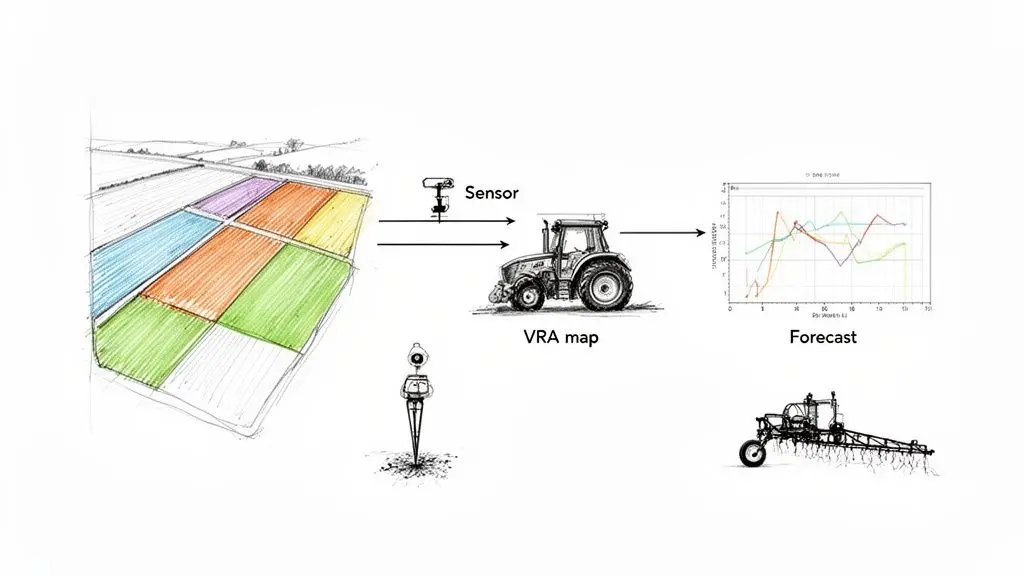
The core output of a precision farming system is often a Variable Rate Application (VRA) map—a digital instruction file that tells machinery exactly how much product (fertiliser, pesticide, water) to apply at specific GPS coordinates.
Creating this map is a multi-step data fusion process. An AI model might analyse drone imagery to identify areas of low vegetation, cross-reference that with soil sensor data confirming low moisture, and then generate a “prescription” map for targeted irrigation. This map is then transmitted to the GPS-guided controller on a tractor or irrigation system, which executes the instructions automatically.
Risk of a Naive Approach: A model relying solely on a single data source like satellite NDVI (a measure of plant health) is brittle. It might see a dry patch and recommend adding more fertiliser, mistaking water stress for a nutrient deficiency. A properly architected system fuses multiple data sources (e.g., NDVI, soil moisture, topography, weather data) to make a more accurate diagnosis and avoid costly errors.
The Implementation Nuances of Predictive Analytics
Predictive models are built to reduce the immense uncertainty in farming by forecasting outcomes like harvest size, disease risk, or optimal picking times. However, their accuracy is fragile and requires careful management.
A critical pitfall is data drift or concept drift. A yield model trained on ten years of stable weather data will fail during a season of unprecedented drought because the input data no longer resembles its training distribution. Without continuous monitoring and periodic retraining, a once-valuable tool can become dangerously misleading.
Another risk is deploying “black box” models. If a model predicts a 15% drop in yield but cannot explain why, the output is not actionable. Product leaders and CTOs must demand models that offer interpretability, allowing an agronomist to see that the prediction is based on a specific potassium deficiency combined with a forecasted heatwave. Trust is built on transparency. A strong foundation in your data architecture is a prerequisite, as covered in our guide to building a data management platform.
The true value of AI in agriculture is realised when abstract data is converted into direct, measurable action. A system that reduces fertiliser use by 20% or improves yield forecast accuracy by 10% provides a clear, defensible ROI and demonstrates the tangible benefit of a well-architected solution.
Today, precision farming dominates the market for artificial intelligence in agriculture, using GPS, drones, and satellite imagery to drive decisions. In technologically advanced markets, this approach allows farms to reduce input costs by 20-30% while boosting yields by an average of 15%, according to the latest Grand View Research report. This is how a promising technology becomes an essential operational asset.
Managing AI Deployment Risks, Governance, and Costs
Engineering a high-performing AI model is a significant achievement, but deploying it reliably in a live agricultural environment is a separate and more complex challenge. This is where operational, financial, and compliance risks emerge. For CTOs and compliance managers, a successful launch is not the finish line; it is the starting point for long-term system management.
Privacy and governance must be architectural choices, not features bolted on after development. A deployed model is not a static asset; it is a dynamic system that requires active management.
MLOps for Preventing Model Performance Decay
An AI model’s performance is never static; it will degrade over time. This phenomenon, known as model decay or concept drift, occurs when the real-world data the model encounters in production no longer matches the data it was trained on. A yield prediction model trained on historical weather data, for example, will struggle when faced with unprecedented climate patterns.
To combat this, a robust MLOps (Machine Learning Operations) framework is not a buzzword but a necessary operational discipline. This includes:
- Continuous Monitoring and Observability: Implementing dashboards that track key model performance metrics (e.g., accuracy, F1 score), data drift, and prediction latency in real time.
- Automated Retraining Pipelines: Establishing triggers that automatically initiate a model retraining job when performance degrades below a predefined threshold or when significant data drift is detected.
- Version Control for Models, Data, and Code: Treating models and datasets as versioned artifacts alongside code. This enables reproducibility, auditing, and rapid rollbacks if a new model version underperforms.
Without these practices, a once-accurate model can quietly become a source of dangerously incorrect advice, eroding user trust and creating significant operational risk.
Human-in-the-Loop (HITL) for High-Stakes Decisions
Not all AI predictions carry equal weight. An incorrect recommendation for sorting produce is a minor issue. A flawed command for pesticide application, however, can have severe financial and environmental consequences. For these high-stakes decisions, a Human-in-the-Loop (HITL) workflow is an essential risk mitigation pattern.
An HITL system does not blindly execute the AI’s output. Instead, the model acts as an expert assistant, flagging low-confidence predictions or high-impact recommendations for review by a human expert (e.g., an agronomist) before any action is taken. This balances automation with human judgment.
This design pattern is critical for building trust and ensuring safety. It also creates a powerful feedback loop: the corrections made by human experts become high-quality training data, enabling the model to improve over time.
Navigating Data Governance and Compliance
Agricultural data—from soil chemistry and yield maps to farm financials—is often highly sensitive and commercially valuable. Once an AI system begins processing this information, it becomes subject to data protection regulations like GDPR. A data breach or compliance failure is not just a technical problem; it is a business crisis that can result in heavy fines and reputational damage.
Effective governance starts with privacy by design. Key architectural and procedural practices include:
- Data Minimisation: Collecting and processing only the data absolutely necessary for the model’s function.
- Anonymisation and Pseudonymisation: Applying technical methods to de-identify personal or commercially sensitive information wherever possible.
- Strict Access Control: Implementing role-based access control (RBAC) to ensure only authorised users and systems can access or manage sensitive datasets.
Predictive analytics using artificial intelligence in agriculture is a major focus in the EU, where weather forecasting and yield predictions represent 20% and 15% of IoT-AI use cases, respectively, according to insights on how AI models are shaping EU agricultural practices on bpm.com. A robust governance framework is non-negotiable for operating in this environment. Our AI Risk & Privacy Checklist can help structure your compliance efforts.
Managing Cloud and Operational Costs
The operational costs of running AI models, particularly in the cloud, can escalate rapidly if not managed proactively. A model that requires powerful GPUs for every inference can generate a surprisingly large bill.
Pragmatic cost management involves:
- Model Optimisation: Using techniques like quantisation, pruning, and knowledge distillation to create smaller, more efficient models that require less computational power.
- Auto-scaling Infrastructure: Architecting cloud infrastructure to scale resources up or down based on real-time demand, avoiding payment for idle compute capacity.
- Strategic Caching: Caching the results of frequent or computationally expensive queries to avoid redundant calculations.
By engineering for governance, operational reality, and cost-efficiency from the outset, you build a system that is not only powerful but also secure, compliant, and financially sustainable.
Frequently Asked Questions
When discussing the implementation of artificial intelligence in agriculture with technical and product leaders, a set of common, practical questions arises. These questions move beyond the hype and focus on the real-world challenges of data, ROI, and team capabilities.
What Are the Biggest Data Challenges in Agricultural AI?
The primary challenge is not a lack of data but its poor quality, fragmentation, and lack of standardisation. Agricultural environments generate inconsistent data that can easily break a naive AI model.
The main hurdles are:
- Data Silos and Heterogeneity: Information is fragmented across IoT sensors, farm management software, drone imagery, and manual logs, each with its own data format. Integrating these disparate sources into a clean, unified dataset is a major architectural challenge.
- Poor Data Quality and Connectivity: Spotty network coverage in rural areas, sensor malfunctions, and human error during data entry lead to noisy, incomplete, and unreliable data. A robust system must incorporate strong data cleaning, validation, and imputation pipelines.
- Lack of Standardisation: There are few industry-wide standards for agricultural data formats or APIs. This means a model built for one farm’s equipment may be incompatible with another’s, hindering scalability and interoperability.
How Should We Measure the ROI of an Agricultural AI Project?
Measuring Return on Investment (ROI) must extend beyond a single metric like crop yield. A realistic assessment considers a holistic set of operational KPIs that directly impact profitability and risk.
Key metrics to track include:
- Input Cost Reduction: Quantify the precise reduction in resources like fertiliser, pesticides, and water. A 15% decrease in fertiliser use across 500 hectares is a clear, defensible ROI metric.
- Resource and Fuel Efficiency: Measure improvements in water use efficiency (crop per drop) or the fuel consumption of farm machinery. These metrics are critical for both cost savings and sustainability reporting.
- Labour Optimisation: Calculate the person-hours saved by automating tasks such as crop scouting, weed mapping, or produce sorting. This directly addresses labour shortages and reduces operational overhead.
What Is the First Step for a Company with No Prior AI Experience?
For a company new to AI, the most effective approach is to start small and build momentum with a focused pilot project. Avoid large-scale, high-risk initiatives.
The objective of a pilot is to de-risk the investment and demonstrate value quickly. A successful pilot provides the concrete data needed to secure buy-in for a larger deployment, transforming the conversation from a speculative idea into a proven solution.
A practical first step is a discovery phase followed by a small-scale proof-of-concept (PoC).
- Identify a single, high-impact problem with a narrow scope.
- Audit your existing data sources to confirm you have what you need.
- Build a PoC with clearly defined success metrics to prove both technical feasibility and business value before committing significant resources.
At Devisia, we build reliable, secure, and compliant AI-enabled systems by focusing on pragmatic architecture and measurable business outcomes. If you are ready to move from concept to a working pilot, let’s discuss a clear path forward. Learn more at https://www.devisia.pro.