
For years, “AI in retail” was more of a conference buzzword than a production-ready technology. That has changed. Today, implementing AI is about applying intelligent systems to solve complex operational problems, deliver personalization at scale, and drive tangible efficiency. For a technical leader, this is not just another feature to bolt on; it represents a core architectural shift.
This guide provides a pragmatic approach for CTOs, architects, and engineering leaders to plan, build, and operate AI systems in a retail context.
The Problem: Why AI is Now a Strategic Imperative
The conversation around AI in retail has moved from speculative to essential. Retailers face mounting operational complexity, thinning margins, and intense competition that demand more than incremental improvements. Customers now expect a baseline of deeply personalized interactions—a level of customization impossible to deliver with manual processes or legacy rule-based software.
AI is the technical foundation that makes meeting these challenges possible by addressing specific, persistent problems:
- Data Overload and Underutilization: Retailers possess vast amounts of data from sales, inventory, and customer behavior. The primary challenge is the lack of tooling to extract actionable signals from this noise.
- Operational Inefficiency: Manual forecasting leads to classic retail failures: costly overstocking or damaging stockouts. Combined with supply chain disruptions, these inefficiencies create cascading operational failures.
- Impersonal Customer Experiences: A one-size-fits-all approach to marketing and product recommendations fails to engage modern shoppers, leading directly to lost sales and poor retention.
The Business Case Backed by Data
The economic argument for AI is supported by clear market projections. The global AI in retail market is forecast to grow from USD 13.86 billion in 2026 to USD 97.83 billion by 2033, reflecting a compound annual growth rate (CAGR) of 32.2%.
This growth is driven by tangible returns, not speculative spending. For more detailed figures, you can review data-driven insights on the AI in retail market.
From a systems engineering perspective, AI’s function is augmentation, not replacement. It automates the repetitive, data-intensive tasks that lead to operational drag, freeing up engineering and business teams to focus on high-value strategic work.
The evidence is in the operational results. The table below outlines the direct impact retailers are reporting from integrating AI into their core systems.
Projected Business Impact of AI Adoption in Retail
| Metric | Reported Improvement Range |
|---|---|
| Revenue Uplift | 5% – 15% (from personalisation & forecasting) |
| Inventory Cost Reduction | 20% – 50% (via demand forecasting) |
| Customer Acquisition Cost (CAC) | 10% – 20% reduction |
| Marketing Campaign ROI | 15% – 25% improvement |
| Operational Efficiency | 10% – 40% gain |
These are not marginal improvements; they are significant enough to reclassify AI from a discretionary R&D expense to a critical driver of business resilience and growth.
For CTOs and founders, the directive is clear. Deferring AI adoption is no longer a conservative stance—it is a competitive risk. The companies that will lead in the next decade are those that architect AI as a fundamental, maintainable component of their digital infrastructure, not as a series of isolated experiments.
High-Impact AI Use Cases for Modern Retail
The true test of AI in retail is its ability to solve specific, costly problems. For a technical leader, the objective is not to chase trends but to deploy systems that deliver measurable returns. The most effective AI implementations target high-value areas where intelligent automation demonstrably outperforms traditional, rules-based software.
These applications are not science fiction; they are production-ready systems designed to address core retail challenges. Each use case represents a shift from manual, reactive processes to automated, predictive operations.
Hyper-Personalization at Scale
The Problem: Most recommendation engines are superficial. They operate on simplistic “customers who bought X also bought Y” logic, failing to capture the nuance of an individual shopper’s intent and context. This results in generic suggestions that feel impersonal and rarely drive meaningful engagement.
The Solution: A modern approach utilizes embedding models to create rich, mathematical representations of products and customer behaviors. Instead of merely matching keywords or purchase history, these systems can grasp semantic relationships. For instance, they can infer that a user searching for “durable, waterproof hiking boots” is likely also interested in moisture-wicking socks and a lightweight backpack, even if those specific terms were never used.
This deeper understanding enables genuine hyper-personalization, moving from simple recommendations to anticipating customer needs. The technical implementation directly translates to:
- Higher conversion rates: By presenting the right product at the right moment.
- Increased average order value (AOV): By suggesting genuinely complementary items.
- Improved customer loyalty: By creating a shopping experience that feels uniquely understood.
Intelligent Inventory and Demand Forecasting
The Problem: Stockouts and overstock are two of the most persistent and costly issues in retail. Traditional forecasting, which often relies solely on historical sales data, is brittle and cannot adapt to sudden market shifts, emerging trends, or supply chain disruptions. The outcome is a constant, expensive balancing act that is frequently wrong.
The Solution: AI-powered demand forecasting systems address this by analyzing a much wider array of signals. These models can ingest and process:
- Historical sales data
- Web traffic and search trends
- Social media sentiment
- Competitor pricing and promotions
- Weather forecasts and local events
By identifying complex patterns across these diverse datasets, the system can predict demand with far greater accuracy. This enables retailers to automate inventory management, reduce carrying costs from overstock, and minimize lost revenue from stockouts. The architectural benefit is a more resilient and responsive supply chain.
The core principle is shifting from reactive ordering to predictive procurement. An AI model can flag an anticipated surge in demand for a specific product weeks in advance, giving operations teams the lead time needed to adjust stock levels and prevent a critical inventory failure.
Computer Vision for In-Store Analytics
The Problem: For brick-and-mortar retailers, the physical store often functions as a data black box. It is difficult to understand customer behavior—how they navigate aisles, which displays attract attention, and where bottlenecks occur—with the same granularity available from an e-commerce platform.
The Solution: Computer vision systems, using strategically placed cameras and AI models, transform this. These systems can anonymously analyze video feeds to generate real-time, aggregate insights without collecting personal data. Key applications include:
- Heatmap Generation: Visualizing foot traffic to identify popular zones and dead spots.
- Queue Management: Automatically detecting long checkout lines and alerting staff to open new registers.
- Planogram Compliance: Verifying that products are stocked on shelves according to the planned layout.
This data provides store managers with actionable intelligence to optimize store layouts, improve staff allocation, and enhance the overall in-store experience, directly bridging the analytical gap between physical and digital retail.
Conversational AI and Loss Prevention
The Problem: Customer support teams are often overwhelmed by repetitive queries, while theft remains a significant operational drain.
The Solution: AI offers pragmatic solutions for both challenges. Intelligent chatbots and voice assistants can handle a high volume of common customer inquiries—from order tracking to return policies—freeing up human agents for more complex issues. For a deeper analysis, see our guide on implementing chatbots in the retail sector.
Simultaneously, AI-driven loss prevention systems use computer vision to identify suspicious behaviors in real time, such as shelf-sweeping or ticket-switching, and can discreetly alert security personnel. This provides a proactive layer of security that is far more efficient and scalable than manual monitoring alone.
Architecting for Scalable AI in Retail
Integrating AI into a retail operation is not about running disconnected experiments; it’s about engineering a robust, maintainable system that becomes a core part of the infrastructure. The architectural choices made today will determine the scalability, cost-effectiveness, and compliance of your AI systems for years to come.
A pragmatic approach avoids chasing every new model release. Instead, it focuses on building a flexible foundation capable of handling the high volume and velocity of retail data—from customer clicks to supply chain events—while remaining compliant and cost-effective.
The goal is to create a system that scales with the business, whether starting with a single use case or planning a full-scale AI deployment. This map illustrates how different AI applications interconnect to create a unified system supporting the entire customer journey.
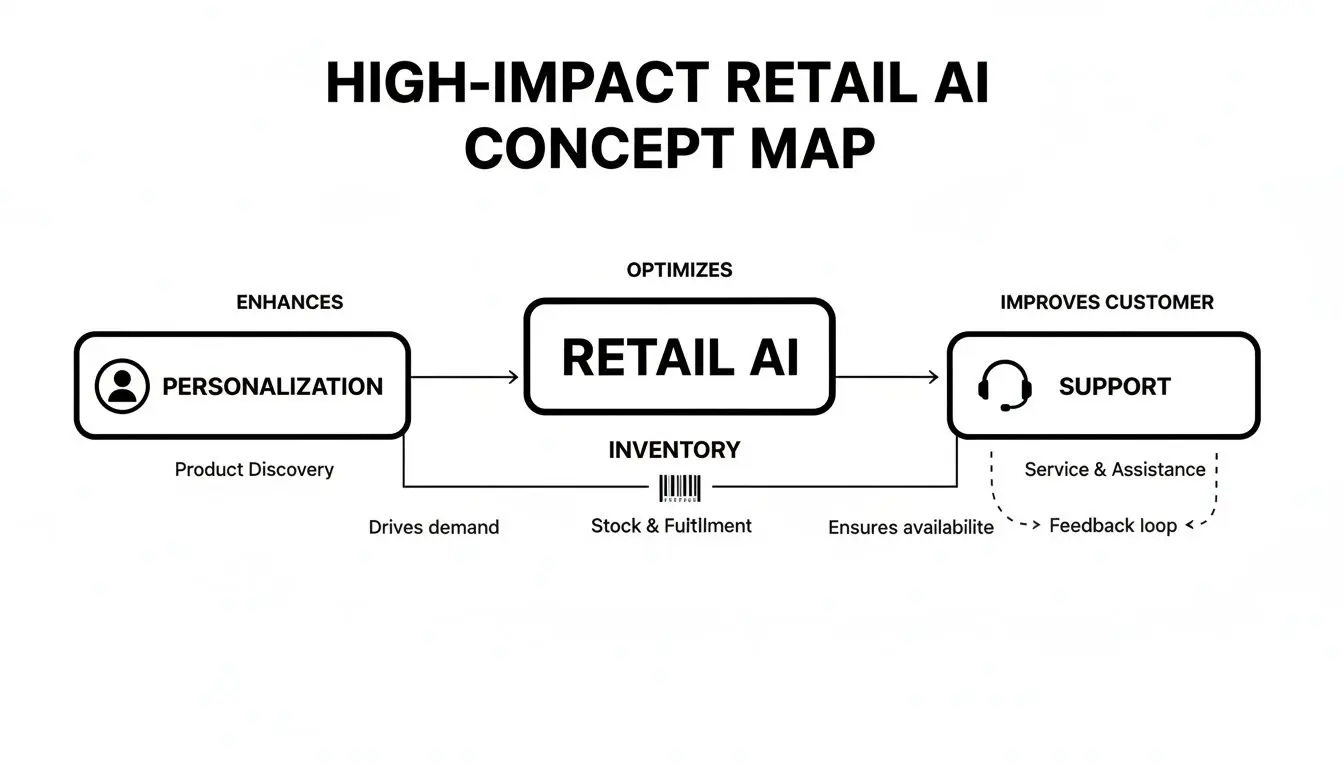
This represents an ecosystem where each component enhances the intelligence of the whole.
LLM Strategy: API vs. Self-Hosting
A foundational architectural decision is the approach to using Large Language Models (LLMs). The choice between third-party APIs (e.g., OpenAI, Anthropic) and self-hosting open-source models involves a trade-off between control, cost, and complexity.
- Third-Party APIs: Offer rapid implementation and access to state-of-the-art models without the significant upfront investment in infrastructure and MLOps talent. The trade-offs include potential data privacy risks (especially with PII), vendor lock-in, and unpredictable usage-based pricing.
- Self-Hosting Open-Source Models: Provides maximum control over data, enables deep customization, and offers predictable costs (post-setup). The trade-off is the substantial operational overhead of managing GPU infrastructure, fine-tuning models, and performing ongoing maintenance.
A hybrid approach is often the most pragmatic. Use powerful, managed APIs for complex, non-sensitive tasks while deploying smaller, fine-tuned open-source models on-premise or in a private cloud for specific, high-volume functions where data privacy and cost control are critical.
The Central Role of Vector Databases and Embeddings
Modern personalization and semantic search are built on embeddings—numerical representations of data such as products, images, or customer reviews. These vectors capture semantic meaning, enabling an AI to understand context far beyond simple keyword matching.
A vector database is the specialized engine designed to store, index, and query these embeddings at high speed and scale.
In practical terms, a vector database allows you to execute queries like, “Show me products with a similar style to this user-uploaded photo, but in blue and made from recycled materials.” A traditional relational database cannot perform such a semantic search efficiently.
Integrating a vector database is a cornerstone of a scalable retail AI architecture. It functions as the long-term memory for your AI, enabling it to build a deep, contextual understanding of your product catalog and customers. This pattern is fundamental for creating sophisticated recommendation engines and semantic search capabilities.
Designing Agentic Workflows and Ensuring Privacy by Design
As AI systems mature, they evolve from executing single tasks to managing complex, multi-step agentic workflows. An AI agent can be designed to autonomously orchestrate a process, such as optimizing a supply chain route. For example, it could monitor weather data, detect a potential shipping delay, evaluate alternative carriers via API, and automatically re-route a shipment to prevent disruption.
Building these agents requires a clear architectural pattern that includes:
- Tool Calling: Granting the AI agent controlled access to specific, pre-approved APIs to interact with other systems (e.g., your inventory management software or a supplier’s booking portal).
- Guardrails: Implementing strict rules and human-in-the-loop (HITL) checks to prevent unintended actions and ensure all decisions align with business policies.
- Observability: Logging every action the agent takes to provide full transparency and auditability.
Finally, privacy cannot be an afterthought. Regulations like GDPR mandate privacy by design, meaning data protection must be an integral part of your system architecture. This involves techniques like data minimization, pseudonymization, and ensuring any user data processed by AI is handled with explicit consent for a clearly defined purpose. Attempting to bolt on privacy controls post-deployment is technically difficult and presents a significant compliance risk. You can learn more about how these principles apply to broader initiatives in our article on digital transformation in retail.
A Phased Implementation Roadmap for AI in Retail
Integrating AI into a retail business should not be a single, monolithic project. A successful rollout is a series of incremental, well-defined steps that build on each other, demonstrating value at each stage. This phased approach mitigates risk, allows the team to develop expertise, and builds organizational buy-in.
A “big bang” approach to AI implementation is a classic pitfall, often resulting in budget overruns, significant technical debt, and team burnout. Here is a breakdown of a pragmatic, four-phase implementation plan.
Phase 1: Focused Discovery (Identify a High-Value Problem)
The initial step is not technological; it is about problem definition. A common mistake is starting with a vague goal like “we need better personalization.” A more effective starting point is a specific, measurable pain point with a clear business cost.
For example, a vague goal can be refined to a concrete problem: “Our return rate for online apparel is 25% due to sizing uncertainty, which is driving up our reverse logistics costs.” This provides a clear target for an AI initiative.
During this phase, the objectives are to:
- Analyze operational data to identify the most expensive bottlenecks.
- Consult with customer support and in-store staff, who have direct insight into recurring problems.
- Map the potential business impact and define clear success metrics (e.g., reduce the return rate by 5% in the pilot category).
Phase 2: Rapid Prototyping (Validate Technical Feasibility)
With a well-defined problem, the next step is to build a minimal prototype. The goal is not a polished product but to answer one critical question with the least possible effort: “Is an AI-based approach technically viable for solving this problem?”
For the sizing issue, a prototype might involve using a simple model to analyze product descriptions and customer reviews for a small subset of products, generating improved size guidance. This is a controlled experiment, often using hardcoded data or simplified logic.
A prototype’s success is measured not by its features, but by the clarity of its findings. It is a low-cost method to validate the technical approach before committing significant resources.
This phase is about de-risking the project. The results determine whether to proceed, pivot, or abandon the initiative without incurring major costs.
Phase 3: Controlled Pilot (Measure Real-World Impact)
Once a prototype demonstrates feasibility, the solution moves to a controlled pilot. This involves deploying the solution live but to a very small, specific audience segment.
For the sizing example, this could mean rolling out the AI-powered recommendations to just 1% of website visitors or for a single product category.
The pilot phase is where you gather critical data:
- Measure Business Impact: Is the solution actually reducing return rates? Are conversion rates improving?
- Gather User Feedback: How are customers interacting with the feature? Is it clear and helpful?
- Assess System Performance: What is the model’s latency? What are the operational costs under live traffic?
This provides the hard evidence needed to build a business case for a full-scale rollout. Given that 97% of retailers plan to increase their AI spending, moving from experiment to enterprise deployment is becoming a competitive necessity. You can explore the latest statistics on AI in e-commerce to understand the velocity of this trend.
Phase 4: Incremental Scaling (Deploy and Monitor)
A successful pilot validates the solution’s value and mitigates the most significant risks. The final phase is scaling, but this should be done incrementally, not as a single cutover.
Progressively roll out the feature—first to 10% of users, then 50%, and finally to all users.
This incremental expansion allows you to monitor system performance, manage infrastructure costs, and make fine-tuned adjustments based on real-world behavior. It transforms AI implementation from a high-stakes gamble into a manageable, data-driven process, ensuring your investment in AI in retail delivers sustainable results.
Managing AI Governance, Cost, and Observability
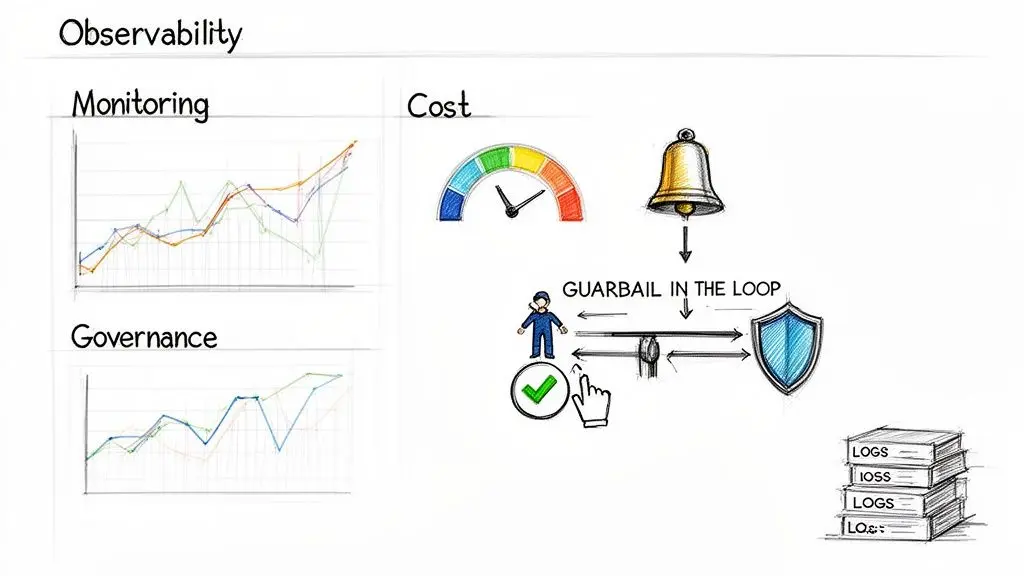
Deploying an AI model to production is only the beginning. Post-launch operational discipline determines whether an AI system becomes a strategic asset or a source of risk and unpredictable costs. For a CTO, non-functional requirements—governance, cost, and observability—are as critical as model accuracy. Without a robust framework for these elements, even a technically brilliant AI initiative can devolve into an operational liability.
Treating AI in retail as a mission-critical system is not optional. It requires a pragmatic framework for control, financial oversight, and real-time insight.
Implementing Responsible AI Governance
AI governance is not about bureaucracy; it is about risk management. An unconstrained AI can produce biased, incorrect, or brand-damaging outputs. The solution is to architect guardrails from day one.
A highly effective pattern is the human-in-the-loop (HITL) workflow. This design flags low-confidence predictions or high-stakes decisions for human review before execution. For example, an AI agent’s decision to re-route a high-value shipment should almost always require manual sign-off to prevent a costly automated error.
Additionally, systems require strict guardrails: hard-coded rules that constrain the AI’s operational boundaries. These can prevent a dynamic pricing engine from setting prices outside a pre-approved range or stop a chatbot from engaging in sensitive topics. These controls ensure the AI operates within safe, predictable business parameters. To identify potential blind spots, use our AI Risk & Privacy Checklist to audit your systems.
Managing Unpredictable AI Costs
Runaway costs, particularly from third-party model APIs, are a significant concern for any technical leader. A few inefficient queries can rapidly exhaust a budget. Proactive cost management is essential.
Effective strategies include:
- Model Tiering: Route simple tasks (e.g., sentiment analysis) to smaller, cheaper models. Reserve powerful and expensive models like GPT-4 for complex reasoning tasks where they provide unique value.
- Prompt Engineering: Shorter, more efficient prompts result in lower token counts and reduced costs. Fine-tuning prompts for conciseness and effectiveness is a key cost-control lever.
- Intelligent Caching: Many user queries are repetitive. Caching responses to common questions allows you to serve them instantly without incurring another API call, which cuts costs and improves latency.
AI System Management Trade-Offs
Choosing the right management strategy involves balancing performance, cost, and control. There is no single “best” approach; the optimal choice depends on the specific use case and business constraints.
| Strategy | Primary Benefit | Key Consideration / Trade-Off |
|---|---|---|
| Human-in-the-Loop (HITL) | Maximum Safety & Control | Increases operational overhead and can slow down real-time processes. |
| Aggressive Caching | Significant Cost Reduction | Risks serving stale or less personalized content if not implemented carefully. |
| Model Tiering | Optimised Cost-Performance | Adds architectural complexity to route requests to the appropriate model. |
| Strict Guardrails | Risk Mitigation | May limit the AI’s flexibility and ability to handle novel edge cases. |
A blended approach is often the most effective. Use HITL for high-value decisions, employ model tiering and caching for customer-facing interactions, and implement guardrails across the entire system.
Establishing Robust Observability
You cannot manage what you do not measure. Observability involves instrumenting AI systems to gain deep, real-time insights into their behavior. It goes far beyond simple “up/down” service monitoring.
A robust observability framework for retail AI must track:
- Performance Metrics: Latency, error rates, and throughput to ensure the system is fast and reliable.
- Quality and Accuracy: How often are product recommendations clicked? Do demand forecasts align with actual sales data?
- Cost Tracking: Granular monitoring of API usage and infrastructure costs per user, feature, or transaction. This links expenditure directly to business activity.
- Behavioral Drift: Tracking whether a model’s outputs are changing over time. A sudden shift is a strong indicator that it requires retraining.
This data, collected through structured logging, should feed into dashboards with automated alerting. If model accuracy drops or costs spike, your team needs to be notified immediately—not at the end of the month. This facilitates a shift from reactive fire-fighting to proactive maintenance, ensuring your AI systems remain reliable, accurate, and cost-effective.
Key Takeaways for Your AI Retail Strategy
Successful AI implementation in retail is not about acquiring a single technology; it is a strategic and architectural commitment. For technical leaders, the path forward requires discipline and a sharp focus on creating measurable business value. Avoid large, high-risk “moonshot” projects. Instead, adopt a pragmatic, incremental approach that builds momentum and institutional knowledge.
This journey is best navigated by adhering to a few core principles. Consider this a concise checklist for any AI initiative.
Start with a High-Value Problem
The best AI projects do not begin with discussions of models or algorithms. They start by pinpointing a specific, costly business problem. Is it high return rates from incorrect sizing? Is it lost sales from frequent stockouts of a key product line?
Focus on a narrow, well-defined issue where any improvement can be clearly measured. This provides your technical teams with a clear objective and simplifies the process of proving a positive return on investment.
Adopting AI is a strategic necessity, not an optional feature. Your goal should be to solve tangible business challenges, using technology as the means to an end. Prioritise solving a problem that directly impacts your bottom line.
Design for Incremental and Compliant Delivery
Embrace a phased rollout that prioritizes speed and learning over attempting to achieve perfection on day one.
- Prototype Rapidly: Build small, focused prototypes to validate core technical assumptions with minimal resource commitment.
- Pilot in a Controlled Environment: Test your solution with a small segment of real users to collect empirical data and feedback.
- Scale Incrementally: Gradually expand successful pilots, monitoring performance and cost closely at each stage.
Throughout this process, privacy and compliance must be architectural choices, not afterthoughts. Engineer your systems with GDPR and other regulations in mind from the outset. This de-risks your investment and builds essential customer trust.
Implement Robust Governance and Observability
Finally, AI systems in production require rigorous operational management. Implement strong governance, including human-in-the-loop controls for high-stakes decisions, to ensure the AI’s behavior remains aligned with your business rules.
Simultaneously, establish a robust observability practice to track performance, accuracy, and cost in real time. Without diligent cost controls and monitoring, even the most promising AI system can become an unsustainable financial drain. These practices ensure your AI initiatives remain maintainable, reliable, and deliver a positive ROI over the long term.
Frequently Asked Questions About AI in Retail
Even with a solid plan, business and technical leaders have practical questions about the realities of AI implementation. Clear answers regarding investment, data privacy, and ROI are critical for building confidence and maintaining project momentum.
How Much Initial Investment Is Required?
The myth that a multi-million-dollar budget is required to start with AI is incorrect. The initial investment is dictated entirely by the scope of the first phase.
A focused discovery phase to identify one high-impact problem may only require internal team time, with no significant capital outlay.
A phased approach is key to controlling costs:
- Prototyping: Often involves using existing data, open-source tools, or low-cost APIs to test the viability of an idea.
- Piloting: This step has a higher cost for limited infrastructure and development but is tightly scoped to prove ROI before scaling.
The objective is to avoid large, upfront capital expenditures. Instead, align spending with incremental delivery. Each phase is funded only after the previous one has demonstrated its value, de-risking the financial commitment and building a data-driven business case.
What Are the Biggest Data Privacy Challenges?
The primary challenge with AI in retail is architecting systems that are compliant with regulations like GDPR from day one. Feeding personally identifiable information (PII) into a third-party model without proper safeguards is a significant compliance and reputational risk.
Privacy is not a feature to be added later; it is an architectural choice. Systems must be engineered from the ground up to minimize data exposure and respect user consent. Reacting to compliance issues post-deployment is always more expensive and damaging.
To address this, architects must apply privacy-by-design principles. This includes using techniques like data pseudonymization, processing sensitive data on-premise when necessary, and ensuring models are trained only on data for which explicit consent has been obtained. Every AI workflow requires clear data governance.
How Should We Measure the True Return on Investment?
Measuring AI’s ROI requires looking beyond technical vanity metrics. Model accuracy alone does not generate revenue. Success is measured by connecting the AI’s output to a concrete business outcome.
This is why Key Performance Indicators (KPIs) must be defined during the discovery phase, before any code is written.
For example:
- For a demand forecasting AI: The KPI is not prediction accuracy itself, but a measurable reduction in inventory carrying costs or a decrease in stockouts, valued in monetary terms.
- For a personalization engine: The KPIs are direct improvements in conversion rate, average order value (AOV), and customer lifetime value (CLV).
By establishing these specific, measurable business metrics first, you create a direct link between the AI’s performance and the company’s bottom line, making the ROI clear and justifiable.
Building reliable, compliant, and cost-effective AI systems is a core competency at Devisia. We partner with companies to translate business vision into production-ready software using a pragmatic, phased approach that delivers measurable value. If you need a technical partner to navigate your AI journey, learn more at https://www.devisia.pro.